Band 5.5 IELTS Writing Task 1 Model Answer
Overall Band Score: 5.5 · Cambridge IELTS 18 · 2026-11-05
IELTS Writing Task 1 question
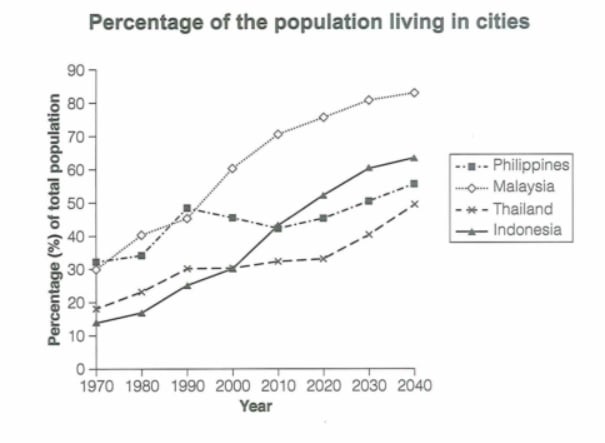
The graph below gives information about the percentage of the population in four Asian countries living in cities from 1970 to 2020, with predictions for 2030 and 2040. Summarize the information by selecting and reporting the main features and make comparisons where relevant.
Student answer (Band 5.5)
the line graph illustrates about the population of four Asian countries including Malaysia, Indonesia, Phillppines and thailand living in cities from 1970 to 2020. In this graph estimation of population in these countries for 2030 and 2040 also mentioned.
In 1970, population of Malaysia and Phillppines are approximately equal and are high as compared to rest of these two countries, thailand and indonesia.
Population of Malaysia gradually increases with the passage of time and in 2020 highest number of people lives in cities. Indonesian' population from 1970 to 2020 dramatically increases but its about 60% of the population .
As we compare Thailand and phillppine's population its about 20% and 30% respectively and its slowly rises and its maximum population in 2020 is approximately 25% and 40% respectively.
if we talk about prediction for 2030 and 2040,population of all countries thailand, phillppines, malaysia and indonesia moderately grow about 40%, 45%, 80%, 55% respectively. Thailand is the country which has lowest population percentage in 2030 and 2040 in cities as compared to other countries is approximately 40%.
AI examiner evaluation
| Criterion | Band |
|---|---|
| Task Achievement / Task Response | 5.0 |
| Coherence and Cohesion | 6.0 |
| Lexical Resource | 5.0 |
| Grammatical Range and Accuracy | 5.0 |
| Overall | 5.5 |
Task Achievement / Task Response: Band 5.0
You identify the topic, time span and forecast period, and you note the broad rise in urban populations, especially in Malaysia and Indonesia. However, the response only partially reports the main features and several comparisons are inaccurate or unclear. For example, Malaysia and the Philippines begin at roughly 30% and 32%, but the claim that both are high compared with the other countries is not developed into a clear overview. The statement that Indonesia reaches “about 60%” by 2020 is incorrect; it is about 52%, while 60% is closer to its 2030 figure. The Philippines and Thailand figures for 2020 are also understated. Include a concise overview and select accurate start/end figures and key changes.
Coherence and Cohesion: Band 6.0
The response has a generally understandable sequence: it introduces the graph, discusses the earlier figures, then moves to trends and forecasts. Paragraphing is limited, however, and the information is not grouped consistently by the most useful comparisons. Phrases such as “In 1970,” “As we compare,” and “if we talk about prediction” help signal movement, but some links feel mechanical, and “its” makes the reference unclear in places. The final sentence repeats that Thailand is lowest after the forecast figures have already been listed. Organise the response into a clear introduction, overview and detail paragraphs, and use comparisons to connect related trends rather than moving between countries without a clear pattern.
Lexical Resource: Band 5.0
You use relevant vocabulary such as “gradually increases,” “dramatically increases” and “prediction,” so the reader can follow the general subject. However, the range is limited and several word choices or collocations are inaccurate, including “population … are high,” “highest number of people lives,” and “moderately grow.” Repetition of “population” and “approximately” also makes the description less precise. Spelling and form errors such as “Phillppines,” “thailand” and “Indonesian'” are noticeable. Use standard terms such as “urban population” or “proportion living in cities,” and choose verbs that describe the data accurately, for example “rose,” “declined slightly” or “is projected to increase.”
Grammatical Range and Accuracy: Band 5.0
You attempt both simple and more extended sentences, including “As we compare Thailand and phillppine's population…,” but control is inconsistent. Errors in agreement and verb forms occur in phrases such as “population … are approximately equal,” “highest number of people lives,” and “its slowly rises.” Articles and sentence construction are also often missing or awkward, as in “In 1970, population of Malaysia…” and “In this graph estimation … also mentioned.” Punctuation and capitalisation are inconsistent, particularly at sentence beginnings and around commas. These errors sometimes make relationships between figures difficult to interpret. Practise accurate subject–verb agreement and complete sentence patterns, while keeping comparisons in shorter, controlled clauses.
See this exact question answered at other band scores. The same prompt compared across bands.
Browse more IELTS Writing model answers or get your own writing scored by the same AI examiner.