Band 4.5 IELTS Writing Task 1 Model Answer
Overall Band Score: 4.5 · Cambridge IELTS 18 · 2026-11-06
IELTS Writing Task 1 question
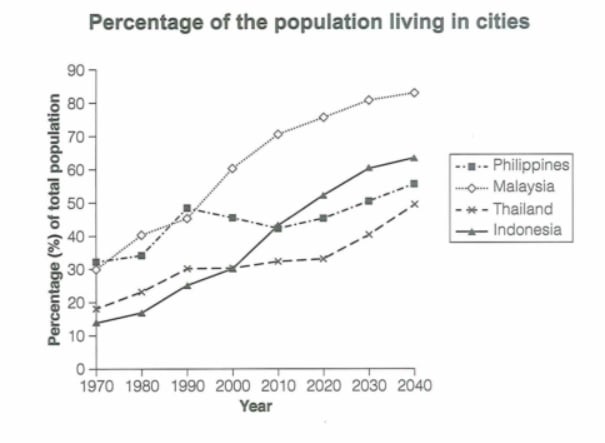
The graph below gives information about the percentage of the population in four Asian countries living in cities from 1970 to 2020, with predictions for 2030 and 2040. Summarize the information by selecting and reporting the main features and make comparisons where relevant.
Student answer (Band 4.5)
The line graph provides data how the proportion of the total population changed between 1970 and 2020 with the next 20 year predictions in the four cities of Asian countries.
Overall it can be seen that, Malaysia has the highest proportion of the total population and predicted to remain in the largest by the end of the period. Philippines population fluctuating all the previous years but predicted to be increased
AI examiner evaluation
| Criterion | Band |
|---|---|
| Task Achievement / Task Response | 3.5 |
| Coherence and Cohesion | 4.5 |
| Lexical Resource | 5.5 |
| Grammatical Range and Accuracy | 5.0 |
| Overall | 4.5 |
Task Achievement / Task Response: Band 3.5
The response identifies the general topic and gives a partial overview: Malaysia is described as having the highest proportion and remaining highest, while the Philippines is said to fluctuate before rising. However, the overview is incomplete and the report does not describe the other two countries or provide supporting figures and comparisons. The graph covers four countries, but the response refers to “four cities,” which misrepresents what is being measured. The claim about Malaysia is broadly accurate, although the Philippines’ trend is only partly characterised. Most importantly, the response is 70 words, below the required 150, so the task is addressed only minimally. To develop the report, include key changes for Indonesia and Thailand, compare their trajectories with Malaysia, and support the overview with selected data.
Coherence and Cohesion: Band 4.5
There is a basic attempt to organise the response into an introduction and an overview, and “Overall” signals the shift to the main summary. The ideas are related to the graph, but the response ends before a clear progression through the main trends can be established. The overview also joins two points in a way that leaves the second incomplete: “Philippines population fluctuating all the previous years but predicted to be increased.” There are no developed body paragraphs or comparisons to guide the reader through the four series. Use a clear sequence—overview first, then grouped country trends—and connect comparisons explicitly, for example by contrasting Malaysia’s steady rise with the Philippines’ fluctuation.
Lexical Resource: Band 5.5
The response uses some relevant task vocabulary, including “proportion,” “predictions,” “highest,” and “fluctuating,” so the topic is generally understandable. However, the range is narrow because the short response repeats broad terms such as “population” and “proportion” without describing specific movements or comparisons. Some word combinations are imprecise: “in the four cities of Asian countries” does not accurately express the chart’s subject, and “predicted to be increased” is not a natural way to describe a projected rise. More precise trend language would help convey the data, such as “the share of people living in cities,” “rose steadily,” or “is projected to increase.” Aim to use varied, accurate verbs and comparison phrases throughout the report.
Grammatical Range and Accuracy: Band 5.0
The response attempts a complex overview sentence beginning “Overall it can be seen that,” but grammatical control is uneven. In “Malaysia has the highest proportion … and predicted to remain,” the second clause lacks a subject and auxiliary; write “and is predicted to remain.” The phrase “Philippines population fluctuating” is missing an article and a finite verb, while “but predicted to be increased” has an incomplete construction and an unsuitable passive form. The opening sentence also has a faulty pattern in “provides data how the proportion … changed.” These errors make parts of the message difficult to follow. Practise complete clauses with clear subjects and verbs, and use straightforward past and future forms to report trends accurately.
See this exact question answered at other band scores. The same prompt compared across bands.
Browse more IELTS Writing model answers or get your own writing scored by the same AI examiner.