Band 5.5 IELTS Writing Task 1 Model Answer
Overall Band Score: 5.5 · Cambridge IELTS 18 · 2026-11-06
IELTS Writing Task 1 question
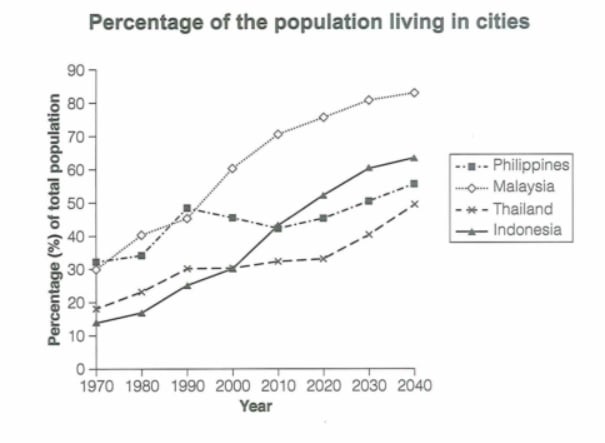
The graph below gives information about the percentage of the population in four Asian countries living in cities from 1970 to 2020, with predictions for 2030 and 2040. Summarize the information by selecting and reporting the main features and make comparisons where relevant.
Student answer (Band 5.5)
The line graph shows amount of four nation in Asia living in Urban places from 1970 to 2020, along predictions for 2030 and 2040.
During 1970 Indonesian's were just 12% living in cities as compared to 30% with its neighbouring country Malaysia which is highest among all.
Thailand and Philippines remain under just 30% of their enitre population in cities.
There is a Massive increase in Malaysian Population from 30% to 75% in just 50 years which is highest among other three countries.
Indonesia is second in terms of most people living in cities with 50% of their population.
There was a major decline in Thailand population druing 1980 when it was competing with Malaysia but it dropped to 40% in 2020.
Moreover, Malaysia is leading with more than 80% people with future Predictions while Indonesia is second followed by Philippines,Thailand with less than 50% of their population living in urban areas.
In Conclusion, amount of people living in cities have increaed from 1970 to 2020 in Malaysia as well as in Indonesia Whereas, It slightly increase in Thailand and Philippiness in
AI examiner evaluation
| Criterion | Band |
|---|---|
| Task Achievement / Task Response | 5.5 |
| Coherence and Cohesion | 5.0 |
| Lexical Resource | 5.5 |
| Grammatical Range and Accuracy | 5.0 |
| Overall | 5.5 |
Task Achievement / Task Response: Band 5.5
You identify the broad upward trend and make relevant comparisons, including Malaysia’s strong growth and Indonesia’s rise to second place by 2020. However, several details are inaccurate or unclear: Indonesia is about 14% in 1970, not 12%, and Thailand did not undergo a major decline in 1980; its urban share rose gradually from about 18% to 33.5% by 2020. The claim that Thailand was competing with Malaysia at that point is also unsupported. Your overview is incomplete because it does not clearly summarise the contrasting paths of all four countries, especially the Philippines’ rise, dip and recovery. Report the main trends accurately and distinguish historical figures from forecasts to develop the response more fully.
Coherence and Cohesion: Band 5.0
The response has some organisation: it begins with an introduction, moves through historical comparisons, mentions forecasts, and attempts a conclusion. However, the progression is not consistently clear. The paragraph beginning “There was a major decline” interrupts the trend summary and contains a confusing comparison, while the final sentence is unfinished, leaving the conclusion incomplete. Linking words such as “Moreover” and “In Conclusion” are used, but they do not always create a clear relationship between ideas. Group the information into a clear overview and paragraphs comparing the historical trends and forecasts. Use transitions to show contrasts and changes over time, and ensure each paragraph develops one coherent point.
Lexical Resource: Band 5.5
You use some relevant vocabulary for describing a graph, including “increase,” “decline,” “predictions,” and “leading,” so the main topic is generally understandable. However, the range is limited and several choices are inaccurate or unnatural, such as “amount of four nation,” “living in Urban places,” and “competing with Malaysia.” Capitalisation is also inconsistent, and spelling errors such as “enitre,” “increaed,” and “Philippiness” reduce accuracy. Choose standard graph language and use it precisely: for example, describe the “proportion of the population living in urban areas” and say that a figure “rose” or “fell.” More accurate collocations and careful spelling would make your comparisons clearer.
Grammatical Range and Accuracy: Band 5.0
You attempt both simple statements and longer sentences, but control is uneven, and errors sometimes make relationships between ideas difficult to follow. Examples include “During 1970 Indonesian's were,” where the time expression and sentence construction are faulty, and “amount of people living in cities have increaed,” where the subject and verb do not agree. The final sentence, “Whereas, It slightly increase … in,” is incomplete and has problems with punctuation and verb form. Articles, plurals, and sentence boundaries also need attention. Practise writing complete sentences with a clear subject and verb, and check agreement and tense consistency. A wider range of structures will be more effective when the basic sentence patterns are accurate.
See this exact question answered at other band scores. The same prompt compared across bands.
Browse more IELTS Writing model answers or get your own writing scored by the same AI examiner.