Band 6.0 IELTS Writing Task 1 Model Answer
Overall Band Score: 6.0 · Cambridge IELTS 18 · 2026-11-07
IELTS Writing Task 1 question
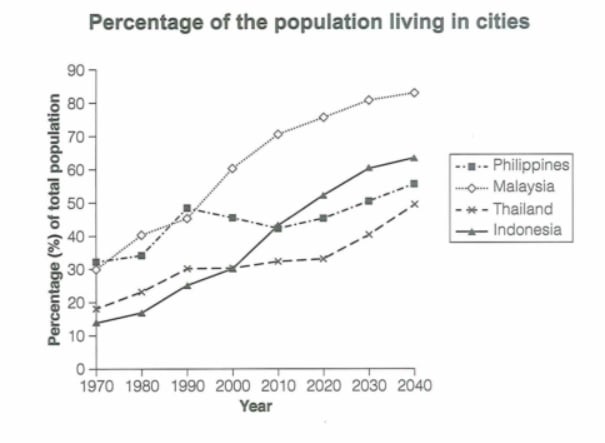
The graph below gives information about the percentage of the population in four Asian countries living in cities from 1970 to 2020, with predictions for 2030 and 2040. Summarize the information by selecting and reporting the main features and make comparisons where relevant.
Student answer (Band 6.0)
The line graph illustrates the percentage of the people living in the urban area in four Asian country between 1970 and 2020, with projection for 2030 and 2040.
Overall, The population living in the urban area increased in all the four countries during the time . Malaysia and Indonesia recorded the noticeable growth. While Philippines and Thailand shows slow change.
In 1970, only 30% of the people in Malaysia lived in Urban area, whereas this rate increased gradually and reached more than 70% by 2020. and it's predicted that by 2040 this number will goes more than 80%. Indonesia followed the similar trend and in 1970, It started with the lowest percentage well under 20% of the population lived in the city area, But the number grew quickly, BY 2040, more than 60% of Indonesian people are predicted to live in city area.
The Philippines had the highest percentage in 1970, which was around 30%. The figure increased to just under 50% by 1990 and then the percentage slightly declined in 2010. After that trend increased gradually and by 2040 the projection is above 50%.In contrast, Thailand shows a slower increase, growing from around 20% in 2070 to about 30% in 2020, and it is expected to reach above 60% by 2040 .
AI examiner evaluation
| Criterion | Band |
|---|---|
| Task Achievement / Task Response | 6.0 |
| Coherence and Cohesion | 6.5 |
| Lexical Resource | 6.0 |
| Grammatical Range and Accuracy | 5.5 |
| Overall | 6.0 |
Task Achievement / Task Response: Band 6.0
You provide a relevant overview, identifying growth across all four countries and the stronger rises in Malaysia and Indonesia. The main comparisons are generally supported: Malaysia climbs from about 30% to over 70% by 2020, while Indonesia rises from the lowest starting point to above 60% by 2040. You also describe the Philippines’ rise and subsequent dip. However, some details are inaccurate or unclear: Thailand is said to reach above 60% by 2040, whereas the chart shows about 50%, and “from around 20% in 2070” should refer to 1970. The overview also calls the Philippines and Thailand’s changes slow, although the Philippines rises overall. More precise reporting of these features would make the response more complete.
Coherence and Cohesion: Band 6.5
The response has a clear overall arrangement: an introduction and overview are followed by two paragraphs comparing the countries, with Malaysia and Indonesia grouped together and the Philippines and Thailand discussed afterward. This gives the reader a sensible route through the information. Linking expressions such as “whereas,” “After that,” and “In contrast” help signal comparisons and changes. Some cohesion is less controlled, however. The transition “and it's predicted” begins awkwardly after a full stop, and the final paragraph moves between the Philippines and Thailand without a clear separation of their trends. In addition, inconsistent capitalisation and spacing around sentence boundaries interrupt the flow. Clearer sentence boundaries and more precise links between each country’s stages would strengthen progression.
Lexical Resource: Band 6.0
You use an adequate range of vocabulary for describing a line graph, including “projection,” “gradually,” “declined,” “increased,” and “followed the similar trend.” These choices communicate the main movements, and some variation avoids relying entirely on “increase.” However, several phrases are imprecise or unnatural, such as “people living in the urban area,” “this rate,” and “the number grew quickly,” where “proportion” or “figure” would be more suitable for percentages. “Noticeable growth” is understandable but could be more precise, and “city area” is repeated. There are also inconsistent forms such as “country” for a plural group and “projection” where a plural or more natural construction is needed. More accurate collocations and varied terms for proportions would improve precision.
Grammatical Range and Accuracy: Band 5.5
You attempt a mix of simple and complex sentences, including comparisons with “whereas” and clauses introduced by “which” and “and then.” Meaning is generally clear, but some grammatical errors recur. For example, “four Asian country” needs a plural noun, “Philippines and Thailand shows” needs subject–verb agreement, and “this number will goes” has an incorrect verb form. Articles and sentence construction are also inconsistent in phrases such as “in the urban area” and “the population lived in the city area.” Punctuation and capitalisation errors, including “Overall, The” and the lower-case sentence beginning “and it's predicted,” further affect accuracy. Review agreement, verb forms, and sentence boundaries while retaining your attempts at complex structures.
See this exact question answered at other band scores. The same prompt compared across bands.
Browse more IELTS Writing model answers or get your own writing scored by the same AI examiner.