Band 4.5 IELTS Writing Task 1 Model Answer
Overall Band Score: 4.5 · Cambridge IELTS 18 · 2026-11-08
IELTS Writing Task 1 question
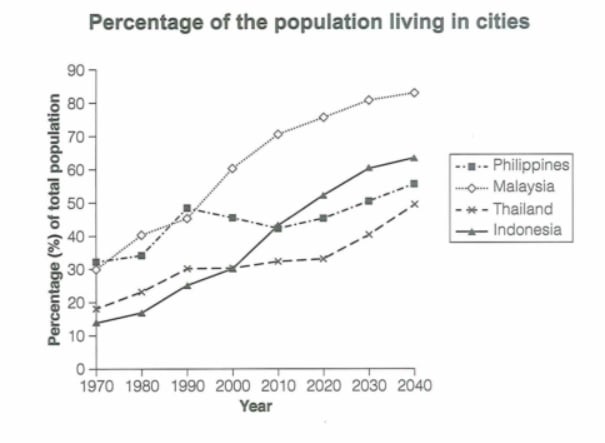
The graph below gives information about the percentage of the population in four Asian countries living in cities from 1970 to 2020, with predictions for 2030 and 2040. Summarize the information by selecting and reporting the main features and make comparisons where relevant.
Student answer (Band 4.5)
The line graph compares the percentage of four Asian countries populations who have been living in cities from 1970 to 2020, with predictions for 2030 and 2040.
Overall the huge numbers of people from malasysia have been living in citiesand it may increase in future,While the lowest numbers of people from indonasia are living in cities.
In 1970 approximately 12%of populations in indonasia were living in urban areas and its being increase yearly so near in future it might reach 65% in 2040 , in contrast thailand were slighlty above with 18% and will reach 50% respectively years ,While philliphines faced ups and down and begin with
AI examiner evaluation
| Criterion | Band |
|---|---|
| Task Achievement / Task Response | 4.0 |
| Coherence and Cohesion | 4.0 |
| Lexical Resource | 5.0 |
| Grammatical Range and Accuracy | 4.5 |
| Overall | 4.5 |
Task Achievement / Task Response: Band 4.0
You identify the graph’s subject and make an attempt to describe trends, including Malaysia’s high urban share and growth in Indonesia and Thailand. However, the response is incomplete and reports only a small portion of the data: the claim that Indonesia had the lowest figure is true for 1970, but not across the whole period, and the Philippines’ trend is left unfinished. The overview is also imprecise, and there is no meaningful comparison of all four countries or account of the main changes. The response contains 94 words, below the required 150; 13 words copied from the prompt were not counted. To improve, complete the summary and select key starting, ending and comparative figures from the graph.
Coherence and Cohesion: Band 4.0
There is a basic attempt to organise the response, beginning with an introduction and an overview before moving to country details. Linking expressions such as “Overall,” “in contrast” and “While” show an effort to connect ideas. However, the progression is difficult to follow because the final sentence breaks off at “begin with,” and the country information is not developed into clear, complete comparisons. Several ideas are joined in a long sentence with unclear punctuation, making relationships between figures harder to understand. Use separate paragraphs for the overview and detailed comparisons, and ensure each sentence is complete and focused on a clear time period or trend.
Lexical Resource: Band 5.0
You use some relevant task vocabulary, including “percentage,” “predictions,” “urban areas,” and “ups and down,” so the reader can recognise the topic and intended trends. However, the range is limited and several choices or spellings reduce clarity, such as “huge numbers” for a percentage, “malasysia,” “indonasia,” “slighlty,” and “philliphines.” The phrase “have been living in cities” is also less natural for describing population proportions on a graph. Aim for precise terms such as “urban population,” “proportion,” “rose,” and “fluctuated,” and check country names carefully. More accurate collocations would make the report clearer and more appropriate to an academic summary.
Grammatical Range and Accuracy: Band 4.5
The response attempts both simple and more complex sentence forms, including a contrast introduced by “While” and a clause beginning “so.” However, grammatical control is weak and errors frequently affect readability. For example, “four Asian countries populations” lacks a possessive form, “it may increase” has an unclear reference, and “its being increase yearly” uses an incorrect verb construction. The sentence beginning “In 1970” also shifts between past and future forms without a clear structure, while the final clause is incomplete. Use straightforward, complete sentences and check subject–verb agreement, tense, articles and punctuation. For example, describe past figures in the past tense and predictions with “is projected to” or “will.”
See this exact question answered at other band scores. The same prompt compared across bands.
Browse more IELTS Writing model answers or get your own writing scored by the same AI examiner.