Band 5.0 IELTS Writing Task 1 Model Answer
Overall Band Score: 5.0 · Cambridge IELTS 18 · 2026-11-08
IELTS Writing Task 1 question
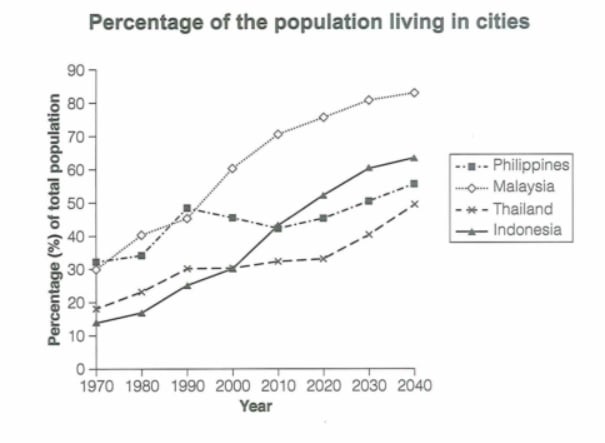
The graph below gives information about the percentage of the population in four Asian countries living in cities from 1970 to 2020, with predictions for 2030 and 2040. Summarize the information by selecting and reporting the main features and make comparisons where relevant.
Student answer (Band 5.0)
This graph illustrates the data about the proportion of population living in urban areas in four countries of the Asia and also predicts the future population ratio between 2030 and 2040.
Overall, Malaysia accounts for the highest population percentage in future and smallest share is shown by Thailand, while in the 1970, Philippines made up the highest share of percentage and the Indonesia lagged behind all the cities in that year.
The population of Philippines in the 1970 was approximately 32%, then it peaked in 1990 at almost at 48%. In 2010, it faced and decline and again started rising after that and is expected tomaximum in 2040
.
AI examiner evaluation
| Criterion | Band |
|---|---|
| Task Achievement / Task Response | 4.0 |
| Coherence and Cohesion | 5.0 |
| Lexical Resource | 5.5 |
| Grammatical Range and Accuracy | 5.5 |
| Overall | 5.0 |
Task Achievement / Task Response: Band 4.0
You identify the graph’s subject and give a brief overview, noting Malaysia’s future lead and the Philippines’ highest starting point. You also report the Philippines’ rise to about 48% in 1990 and subsequent decline, which is broadly accurate. However, the response covers only one country in detail and omits the main trends for Malaysia, Thailand and Indonesia, as well as useful comparisons across the period. The overview is also inaccurate in saying Thailand has the smallest share in the future: Indonesia is higher than Thailand in both 2030 and 2040. The final Philippines trend is left incomplete. At 109 words, the response is below the required 150, further limiting the task coverage. Include an overview and key figures for all four lines.
Coherence and Cohesion: Band 5.0
The response has a basic sequence: an introduction, an overall statement and then a detail paragraph about the Philippines. This gives the reader some sense of structure, and phrases such as “Overall” and “then” help signal the relationship between ideas. However, there is no clear progression through the graph as a whole because nearly all detail concerns one country, and the final sentence stops before completing its point. The overview also combines several comparisons in one sentence, making the relationships harder to follow. Organise the body into clear comparisons—for example, the two higher urbanisation trends and the two lower ones—and use linking phrases to show changes over time. Complete each point before moving on.
Lexical Resource: Band 5.5
You use some relevant task vocabulary, including “proportion,” “peaked,” “share” and “lagged behind,” and the meaning is generally understandable. There is also some variation in how you refer to the figures, rather than repeating one term throughout. However, several expressions are awkward or imprecise, such as “the Asia,” “future population ratio” and “expected tomaximum.” “Population percentage” is also less natural here than a phrase describing the urban share of each country’s population. These choices reduce precision, especially in the overview. Aim for accurate collocations such as “percentage of the population living in cities,” “is projected to rise” and “the lowest proportion.” Check spacing and word forms when editing.
Grammatical Range and Accuracy: Band 5.5
You attempt a mixture of sentence forms, including a complex overview sentence and a sequence describing change over time. The main meaning can usually be followed, but grammatical control is uneven. Examples include “in the 1970” instead of “in 1970,” “Philippines made up” without the article “the,” and “it peaked in 1990 at almost at 48%,” where the repeated preposition disrupts the sentence. The final clause, “is expected tomaximum in 2040,” is incomplete and does not form a grammatical prediction. There are also inconsistent article and number patterns in “the Indonesia” and “all the cities.” Use complete sentences, check articles and prepositions, and practise accurate passive or projected-future forms such as “is expected to reach.”
See this exact question answered at other band scores. The same prompt compared across bands.
Browse more IELTS Writing model answers or get your own writing scored by the same AI examiner.