Band 4.5 IELTS Writing Task 1 Model Answer
Overall Band Score: 4.5 · Cambridge IELTS 18 · 2026-11-09
IELTS Writing Task 1 question
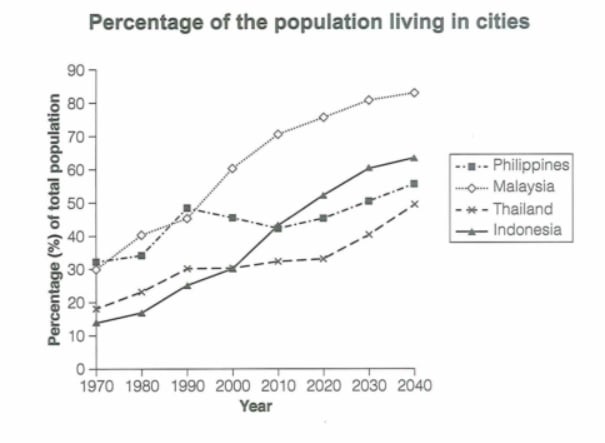
The graph below gives information about the percentage of the population in four Asian countries living in cities from 1970 to 2020, with predictions for 2030 and 2040. Summarize the information by selecting and reporting the main features and make comparisons where relevant.
Student answer (Band 4.5)
The line graph shows the percentage of people living in four Asian countries ,where the population was up and down in 1970 to 2020 with predictions for 2030 and 2040.
Firstly, in Philiphines population was not much raised continue in up and down in 1970 stable in 30% while, in 2040 they reached at 50%. In Malaysia the population was raised very high as compared to others, in 1970 they are in 30 but in 2040 they reached at 88%.Or if we discuss about Thialand their population was very low in percentage as compared to others in the graph clearly show that in population was 15% but 2040 population comprise upto45%.In last, Indonesia thier population was not much or not very low but they are stable , in 1970 stable in 15% but in 2040 merged upto 57%.
in contrast, Malaysia grew very rapidly in Philiphines the population was up and dow n but in Thailand the population was very low as compared to other Asian countries,in Indonesia the population was moderate not much high not much low stable in the moderate percentage.
AI examiner evaluation
| Criterion | Band |
|---|---|
| Task Achievement / Task Response | 5.0 |
| Coherence and Cohesion | 4.5 |
| Lexical Resource | 4.5 |
| Grammatical Range and Accuracy | 4.5 |
| Overall | 4.5 |
Task Achievement / Task Response: Band 5.0
You identify the four countries and make some relevant comparisons, including Malaysia’s strong rise and the Philippines’ fluctuations. However, the response only partially reports the graph’s main features: it gives no clear overview of the overall pattern, and several figures or trends are inaccurate. For example, Malaysia is reported at 88% in 2040, whereas the chart shows about 84%; Indonesia is given as 57%, rather than about 64%; and Thailand is described as remaining very low, although it rises to nearly 50% by 2040. The Philippines’ rise to around 56% is also understated as 50%. Select the most important trends and compare the countries accurately across the period.
Coherence and Cohesion: Band 4.5
The response has a basic sequence: it introduces the graph, discusses the countries, and adds a final comparison. Linking expressions such as “Firstly,” “in contrast,” and “In last” show an attempt to organise ideas. However, the country-by-country account is crowded into one long paragraph, and the final paragraph largely repeats earlier points rather than developing a clear comparison. Some links are awkward or unclear, such as “in Philiphines the population was up and dow n,” which makes the relationship between ideas difficult to follow. Use separate paragraphs for an overview and grouped details, and connect comparisons directly—for example, contrast Malaysia’s high endpoint with Thailand’s lower one.
Lexical Resource: Band 4.5
You use some task-relevant vocabulary, including “percentage,” “predictions,” “raised,” and “up and down,” so the general subject is understandable. However, the range is limited and several expressions are imprecise or unnatural for describing a line graph. “Population was raised” confuses population size with the proportion living in cities, while “merged upto” does not clearly describe an increase. Repetition of “stable,” “very low,” and “as compared to others” also limits precision, and spelling errors such as “Philiphines,” “Thialand,” and “thier” reduce accuracy. Build a small set of accurate trend verbs and comparison phrases, and use them consistently to describe percentages.
Grammatical Range and Accuracy: Band 4.5
The response attempts longer sentences and uses some time references, but sentence structures are limited and many are difficult to control. For example, “in 1970 stable in 30% while, in 2040 they reached at 50%” lacks a clear subject and has faulty clause structure; “in population was 15%” is also incomplete. There are recurring problems with articles, prepositions, agreement, and punctuation, including “in 1970 they are in 30” and missing spaces after full stops. These errors sometimes make the intended comparison unclear. Practise writing complete subject–verb sentences, such as “The figure stood at 30% in 1970 and rose to about 56% by 2040,” before combining ideas with clauses.
See this exact question answered at other band scores. The same prompt compared across bands.
Browse more IELTS Writing model answers or get your own writing scored by the same AI examiner.