Band 5.5 IELTS Writing Task 1 Model Answer
Overall Band Score: 5.5 · Cambridge IELTS 18 · 2026-11-09
IELTS Writing Task 1 question
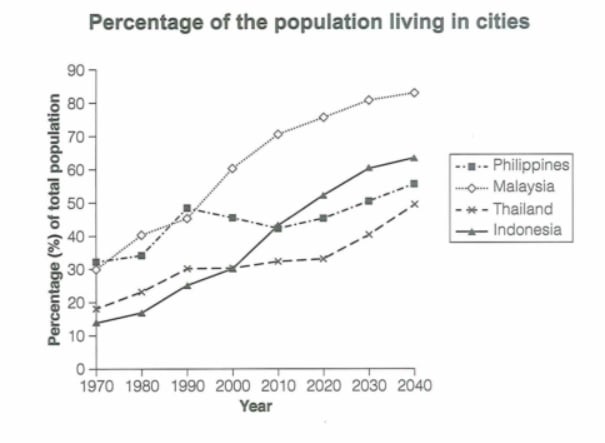
The graph below gives information about the percentage of the population in four Asian countries living in cities from 1970 to 2020, with predictions for 2030 and 2040. Summarize the information by selecting and reporting the main features and make comparisons where relevant.
Student answer (Band 5.5)
The graph illustrates the information about the percentage of the population in Philippines, Malaysia, Thailand and Indonesia living in urban area from 1970 to 2020, with projection for 2030 and 2040.
Overall, There has been a greater increase in proportion of people living in cities of Malaysia and Indonesia, while the percentage inclined relatively slow in Thailand, with both increasing and decreasing trend has been observed in Philippines.
In 1970, Malaysia and Philipines has the greatest number of people living in cities containing 30% and 32% of the total population. Meanwhile, Thailand and Indoesia lies at 18% and 15% respectively. Till 1990, a huge increase can be observed for Malaysia and Philippines reaching to 45% and 46%. The Trend continues for Thaliand and Indonesia as well.
After 1990, while the proportion kept on increasing for other countries, a decline in percentage occurs for the Philipines, coming down to 40% and expected to increase till 48% in 2040. Furthermore, Malaysia is proejcting 80%, Indonesia will surpass the Philippines containing 55% and Thailand to have 45% for 2040.
AI examiner evaluation
| Criterion | Band |
|---|---|
| Task Achievement / Task Response | 5.5 |
| Coherence and Cohesion | 6.0 |
| Lexical Resource | 5.5 |
| Grammatical Range and Accuracy | 5.5 |
| Overall | 5.5 |
Task Achievement / Task Response: Band 5.5
You identify the four countries, cover the historical period and projections, and give an overview that recognises Malaysia and Indonesia’s substantial growth and the Philippines’ fluctuations. However, some key details are inaccurate or too general: the Philippines falls to about 42.5% in 2010, not 40%, and is projected to reach roughly 55.5% in 2040, not 48%. Malaysia is projected at about 83.5%, while Indonesia reaches 64% and Thailand about 49.5%, so the final comparisons are understated. The opening figures also describe percentages as a “number” of people. To strengthen the report, select the most important turning points and compare the countries more precisely, including the fact that Indonesia overtakes the Philippines by 2020.
Coherence and Cohesion: Band 6.0
The response has a clear overall arrangement: an introduction, an overview, and two paragraphs describing the data. The sequence from the starting figures to 1990 and then the later period is generally easy to follow, and linking phrases such as “Meanwhile,” “After 1990,” and “Furthermore” help signal relationships. However, the progression is sometimes weakened by vague references. “The Trend continues” does not specify which countries or what changes, and “other countries” is unclear in the sentence about post-1990 increases. The final paragraph also combines several projections without a clear comparison. Use explicit country names and organise the later trends into clearer comparisons to make the cohesion less dependent on general linking phrases.
Lexical Resource: Band 5.5
You use a reasonable range of task-related vocabulary, including “proportion,” “projection,” “decline,” and “increase,” so the main trends are usually understandable. However, several word choices and collocations are inaccurate or awkward: “percentage inclined relatively slow” and “containing 30%” do not express the data naturally, while “greatest number of people” confuses a percentage with a count. There are also noticeable spelling errors in country names and other words, including “Philipines,” “Indoesia,” “Thaliand,” and “proejcting.” These slips reduce precision in a report where accurate labels matter. Prefer standard trend language such as “the proportion rose gradually” and check spelling carefully before submitting.
Grammatical Range and Accuracy: Band 5.5
You attempt both simple and more complex sentence forms, including a contrast clause beginning “while the proportion kept on increasing” and a sentence describing the 1990 figures. Meaning is generally recoverable, but errors in agreement, tense, articles, and sentence construction remain noticeable. For example, “Malaysia and Philipines has” should use a plural verb, and “Thailand and Indoesia lies” also needs plural agreement. “There has been a greater increase” is an awkward tense choice for a chart spanning past and projected periods, while “with both increasing and decreasing trend” lacks an article and has an unclear structure. Use consistent past tense for historical data and clear future forms for projections, and proofread agreement and articles.
See this exact question answered at other band scores. The same prompt compared across bands.
Browse more IELTS Writing model answers or get your own writing scored by the same AI examiner.