Band 5.0 IELTS Writing Task 1 Model Answer
Overall Band Score: 5.0 · Cambridge IELTS 18 · 2026-11-09
IELTS Writing Task 1 question
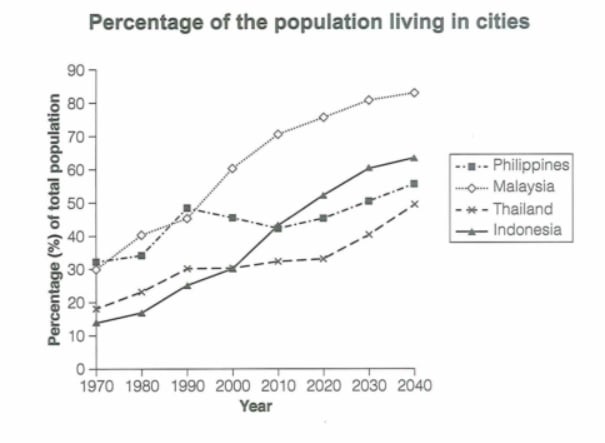
The graph below gives information about the percentage of the population in four Asian countries living in cities from 1970 to 2020, with predictions for 2030 and 2040. Summarize the information by selecting and reporting the main features and make comparisons where relevant.
Student answer (Band 5.0)
This line graph illustrates the percentage of people living in cities in four Asia countries namely; Philippines, Malaysia, Thailand and indonasia from 1970 to 2000, with prediction fo 2030 and 2040. Overall, the proportion of people living in cities increased in all four countries. Malaysia had the highest persentage for most of the period and expected to remain at first in 2040. By constrat, Thailand had the lowest percentage through the period. In 1970, the percentge of people in Indonasia was about 12% and it reached to 30% in 2010. And it is predict that this figure go to 60% by 2040. The percentage of human being in Philippine was 30% in 1970 in it is fluctuated and reache to 50% in given period. Malaysia Approximatly stood at 45% in 1990 and steadily go to 80% in 2040. Meanwhile, Indonsia stood at the lowest percentage that is 12% and reached 25% in 2000 and it is expected this percentage go to 52% in 2040. Although, Thailand remains at the lowest percentage throughout the period.
AI examiner evaluation
| Criterion | Band |
|---|---|
| Task Achievement / Task Response | 5.5 |
| Coherence and Cohesion | 5.0 |
| Lexical Resource | 5.0 |
| Grammatical Range and Accuracy | 5.0 |
| Overall | 5.0 |
Task Achievement / Task Response: Band 5.5
You provide a relevant overview, noting that urbanisation rises overall and that Malaysia is projected to lead by 2040. However, the account only partially covers the graph and includes several important inaccuracies. Indonesia is reported as reaching 30% in 2010 and 60% in 2040, whereas the chart shows about 43% and 64%; the later figure of 52% appears to confuse Indonesia’s 2020 value with its 2040 value. Thailand is not the lowest throughout: it is overtaken by Indonesia around 2000 and is the lowest only in the later years. The Philippines’ fluctuations are mentioned, but its rise to about 56% by 2040 is not clearly reported. Select the main turning points and compare the countries more accurately.
Coherence and Cohesion: Band 5.0
The response has an introduction, an overview and detail paragraphs, so there is some organisation, and the overview gives the reader a useful starting point. However, progression is unclear because Indonesia is described in two separate places, with overlapping and inconsistent figures. The final paragraph begins with “Meanwhile” but repeats the claim that Indonesia was lowest, then shifts to Thailand without clearly explaining the comparison. Linking phrases such as “Although” are also used in ways that do not establish a clear contrast. Grouping the data by meaningful trends—for example, Malaysia’s strong rise, Indonesia’s rapid growth, and the Philippines’ fluctuation—would create a clearer sequence and reduce repetition.
Lexical Resource: Band 5.0
You use some task-relevant vocabulary, including “proportion,” “percentage,” “fluctuated” and “steadily,” and the general subject remains understandable. However, the range is limited and several noticeable spelling and word-choice errors reduce precision: “persentage,” “percentge,” “indonasia” and “Indonsia” refer to the same country or measure, while “human being” is unnatural in this context. Phrases such as “remain at first” and “reached to” are also not idiomatic. Use consistent country names and standard collocations for describing data, such as “ranked highest,” “stood at,” and “rose to.” This would make the comparisons clearer and more appropriate for an academic report.
Grammatical Range and Accuracy: Band 5.0
You attempt both simple and more complex sentences, including an overview with a contrast and a prediction clause. However, the range is limited, and errors occur frequently in verb forms, sentence construction and punctuation. For example, “it reached to 30%” and “it is predict that this figure go” need more accurate verb patterns; “Malaysia … steadily go to 80%” also lacks the appropriate tense and form. The sentence about the Philippines—“was 30% in 1970 in it is fluctuated”—is difficult to follow because clauses are joined incorrectly. Practise accurate past-tense descriptions and prediction structures, and separate complete ideas with full stops rather than joining them loosely.
See this exact question answered at other band scores. The same prompt compared across bands.
Browse more IELTS Writing model answers or get your own writing scored by the same AI examiner.