Band 5.5 IELTS Writing Task 1 Model Answer
Overall Band Score: 5.5 · Cambridge IELTS 18 · 2026-11-09
IELTS Writing Task 1 question
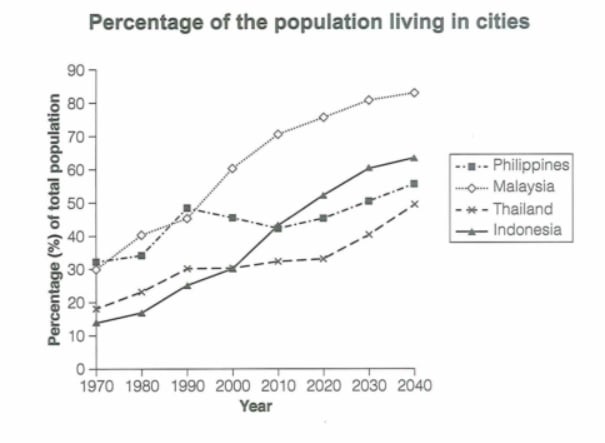
The graph below gives information about the percentage of the population in four Asian countries living in cities from 1970 to 2020, with predictions for 2030 and 2040. Summarize the information by selecting and reporting the main features and make comparisons where relevant.
Student answer (Band 5.5)
The graph illustrates information in percentage on how many people lived in the cities of Philippines, Malaysia, Thailand and Indonesia between 1970 and 2020. Overall, the percentage of malaysians living in cities was the highest. Meanwhile, the percentage of residents living in both Thailand and Malaysia increased graduallyby small increments. However, indonesians living in cities increased dramatically surpassing both Thailand and Malaysia, despite being the lowest on graph. Regarding the malaysians and indonesians, starting in 1970, with a population of 30 and between 10 and 20 percent respectively, living in cities.They continued to go up, until Malaysia stopped at above 80 percent and Indonesia at around 60 percent. Between 1970 and 1990, Tailand increased from just under 20 to approximately 30 percent of the population living in cities. Tailand increased significantly between 2020 and is expected to continue to rise until 2040 betwen 30 and 40 percent , before witnessing a plateu from 1990 to 2020 at around 30 percent. The Philippenes plateued for ten years before it peaked in 1990 at 50 percent. Followed by a major drop until 2010 to around 40 percent. Then it begin to increase and is expected to continue in the future.
AI examiner evaluation
| Criterion | Band |
|---|---|
| Task Achievement / Task Response | 6.0 |
| Coherence and Cohesion | 4.5 |
| Lexical Resource | 6.0 |
| Grammatical Range and Accuracy | 5.0 |
| Overall | 5.5 |
Task Achievement / Task Response: Band 6.0
You identify the four countries and give a general overview, noting Malaysia’s high urban share and the rise in Indonesia. You also report several relevant figures and trends, such as Malaysia reaching above 80% and the Philippines falling after its 1990 peak. However, the overview contains a major contradiction: it says Thailand and Malaysia rose gradually, then claims Indonesia surpassed both, although Malaysia remains highest and Indonesia does not overtake Thailand until much later. The Thailand account is also confusing: its rise to around 30% by 1990 is followed by a plateau, but the later forecast is described unclearly. To strengthen the response, present the main comparisons accurately and organise the key trends by country or period, including the Philippines’ fluctuations and Indonesia’s sustained growth.
Coherence and Cohesion: Band 4.5
The response has an opening overview and then moves through country-specific details, so there is some overall organisation. However, progression is difficult to follow because information is not grouped consistently and several links between ideas are unclear. The Thailand discussion, for example, gives its rise to 1990, then its future increase, and only afterwards mentions the plateau from 1990 to 2020. The sentence beginning “Regarding the Malaysians and Indonesians” also runs into the next idea without clear punctuation, while “Followed by a major drop” is a fragment. Some linking words, such as “However” and “Meanwhile,” do not clarify the relationships accurately. Use separate paragraphs for the overview and details, and order each trend chronologically with clear comparisons.
Lexical Resource: Band 6.0
You use an adequate range of task-related vocabulary, including “percentage,” “surpassing,” “peaked,” “major drop,” and “plateau.” These choices help describe changes rather than merely list figures, and the intended meaning is generally understandable. However, some word choices and collocations are imprecise, such as “increased dramatically surpassing” and “stopped at above 80 percent”; more natural phrasing would be “rose sharply, overtaking” and “reached just over 80%.” There are also spelling errors in “Tailand,” “Philippenes,” “betwen,” and “plateu,” as well as inconsistent capitalisation of country names. Check spelling and use precise verbs for rises, falls, and stable periods to make the descriptions more accurate and fluent.
Grammatical Range and Accuracy: Band 5.0
You attempt both simple and more complex sentence forms, including clauses with “while” or “before” and the phrase “despite being the lowest.” However, some sentences are incomplete or have faulty structure. “Regarding the Malaysians and Indonesians, starting in 1970…” lacks a main clause, and “Followed by a major drop…” is a fragment. In “Tailand increased significantly between 2020 and is expected to continue,” the time expression and verb construction do not form a clear grammatical relationship. There are also errors in agreement and tense, as in “Then it begin to increase,” and punctuation is sometimes missing or misplaced. Build complete sentences around each comparison, maintain past tense for historical data and use “is expected to” for forecasts.
See this exact question answered at other band scores. The same prompt compared across bands.
Browse more IELTS Writing model answers or get your own writing scored by the same AI examiner.