Band 5.0 IELTS Writing Task 1 Model Answer
Overall Band Score: 5.0 · Cambridge IELTS 18 · 2026-11-10
IELTS Writing Task 1 question
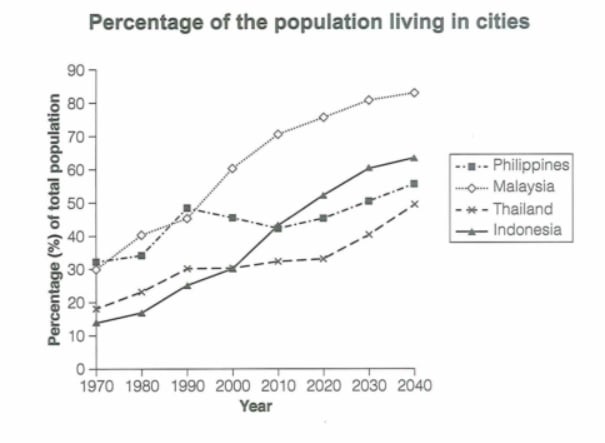
The graph below gives information about the percentage of the population in four Asian countries living in cities from 1970 to 2020, with predictions for 2030 and 2040. Summarize the information by selecting and reporting the main features and make comparisons where relevant.
Student answer (Band 5.0)
The line graph illustrates information about the percentage of the population in four Asian countries such as Philippines, Malaysia, Thailand and Indonesia living in urban areas between 1970 and 2020, with predictions for 2030 and 2040.
Overall, Malaysia recorded the most dramatical growth over the period. In contrast, Thailand recorded the lowest figures among the other Asian countries. The unit is measure in percentage.
In 1970, the population of the Philippines lived 31% in the urban areas, and Malaysia, Thailand and Indonesia recorded a proportion of 30%, 19% and 12%, whereas in 2000, Philippines and Malaysia showed a proportion of 45% and 60% increased significantly. The percentage of people increased to 30% and 40% in Thailand and Indonesia.
In 2020, Malaysia and Indonesia rose considerably with a proportion of 75% and 50%. Philippines declined fraduallly with a proportion of approximately 41% and Thailand
AI examiner evaluation
| Criterion | Band |
|---|---|
| Task Achievement / Task Response | 4.0 |
| Coherence and Cohesion | 5.0 |
| Lexical Resource | 5.5 |
| Grammatical Range and Accuracy | 5.0 |
| Overall | 5.0 |
Task Achievement / Task Response: Band 4.0
You identify the subject, time span and four countries, and you include some relevant comparisons, such as Malaysia’s rise and Thailand’s comparatively low figures. However, the response addresses the task only partially: the overview is vague and does not capture the main contrast that Malaysia becomes the highest while Indonesia also rises strongly, overtaking the Philippines. Several figures are inaccurate or unclear: for 2020, the Philippines is about 45.5%, not 41%, and Thailand is left unfinished. The final forecast period is not reported at all. The response is also below the required 150 words, which limits the detail available. Add a complete overview and cover the key trends through 2040 with accurate comparisons.
Coherence and Cohesion: Band 5.0
The response has a basic paragraph structure: an introduction, an overview and two paragraphs with figures. This gives the reader some sense of how the information is organised. However, progression is limited because the body moves from 1970 to 2000 and then 2020 without completing the account or explaining the later forecast years. Linking is also sometimes awkward: “whereas in 2000” introduces several figures, but the relationship between the countries’ changes is not clearly expressed. The final sentence breaks off after “Thailand,” leaving the comparison incomplete. Use a clear chronological or trend-based structure, complete each comparison, and connect figures with precise references such as “by contrast” or “while.”
Lexical Resource: Band 5.5
You use some appropriate task vocabulary, including “percentage,” “proportion,” “predictions” and “rose considerably,” and the meaning is generally understandable. There is some variation in how you describe changes, but several choices are inaccurate or unnatural, such as “most dramatical growth,” “The unit is measure in percentage,” and “the population of the Philippines lived 31% in the urban areas.” Spelling errors in “fraduallly” and the incorrect form “dramatical” also reduce accuracy. Aim for standard collocations such as “the proportion of the population living in cities” and “the most dramatic increase.” Check spelling and word forms, and avoid repeating “proportion” when a more precise verb or noun can express the trend.
Grammatical Range and Accuracy: Band 5.0
You attempt both simple and more complex sentences, including a comparison beginning “whereas in 2000,” and most of the intended meaning can be followed. However, the range is limited and errors recur in sentence construction and grammatical forms. For example, “The unit is measure in percentage” has an incorrect verb form, while “the population of the Philippines lived 31%” uses an unsuitable subject–verb pattern. The sentence beginning “In 1970” also becomes overloaded, making the relationships between figures difficult to follow. The final sentence is incomplete, and punctuation does not resolve that break. Build shorter, complete sentences around clear subjects—for example, “In 1970, 31% of the Philippine population lived in cities”—and check verb forms and sentence boundaries.
See this exact question answered at other band scores. The same prompt compared across bands.
Browse more IELTS Writing model answers or get your own writing scored by the same AI examiner.