Band 6.0 IELTS Writing Task 1 Model Answer
Overall Band Score: 6.0 · Cambridge IELTS 18 · 2026-11-10
IELTS Writing Task 1 question
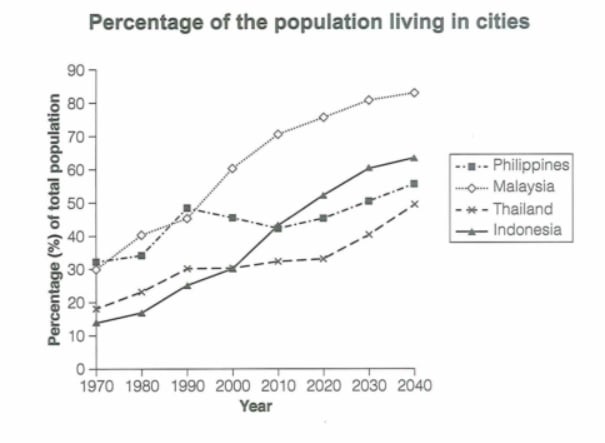
The graph below gives information about the percentage of the population in four Asian countries living in cities from 1970 to 2020, with predictions for 2030 and 2040. Summarize the information by selecting and reporting the main features and make comparisons where relevant.
Student answer (Band 6.0)
The line graph illustrates the proportion of the population in four Asian nations living in cities between 1970 and 2020, with predictions for 2030 and 2040.
Overall, all Asian countries showed an upward trend throughout the period. Malaysia had the highest percentage over the period, while Thailand had the lowest.
In 1970, Philippines had the highest at 31%, Malaysia had 30%, Thailand had 19% and Indionesia had 14%, which was the least compared others. In 1980, all cities increased. Malaysia increased to about 40%, Philippines demonstrated a slight increase to about 33%, Thailand and Indonesia had 21% and 16% respectively. From 1980 to 2020, it showed a increasing and decreasing trend. Malaysia went up rapidly at 73%, it increased a lot. Philippines surged dramatically to 50% in 1990, but after that, it went down to around 42% in 2020. Thailand showed a fluctuating trend, it inclined marginally to 29% and reached 32% in 2020. Indonesia grew quickly to about 50% in 2020.
With predictions for 2030 and 2040, all cities crossed 40% and displayed an increasing trend. Firstly, Malaysia had the peak point to about 82%, Philippines had 53%, Thailand had 45% and Indonesia climb up marginally to about 60%.
AI examiner evaluation
| Criterion | Band |
|---|---|
| Task Achievement / Task Response | 6.0 |
| Coherence and Cohesion | 6.5 |
| Lexical Resource | 6.0 |
| Grammatical Range and Accuracy | 5.5 |
| Overall | 6.0 |
Task Achievement / Task Response: Band 6.0
You provide a relevant overview, identifying Malaysia as the leading country overall and Thailand as the lowest, and you report several key figures across the period. The account also includes the forecast years. However, some details are inaccurate or incomplete: Malaysia reaches about 76% in 2020, not 73%, and the Philippines peaks at about 48% in 1990 rather than 50%. The overview’s claim that all countries rose throughout is too broad because the Philippines declined after 1990 before recovering. The final paragraph gives mainly 2030 figures and does not report the 2040 outcomes, despite referring to both forecast years. More precise comparisons and a clearer account of the Philippines’ fluctuation would make the summary more complete.
Coherence and Cohesion: Band 6.5
The response has a clear overall structure: an introduction, an overview, historical details, and a paragraph on forecasts. The chronology is generally easy to follow, and phrases such as “In 1970” and “From 1980 to 2020” help orient the reader. However, some links are mechanical or unclear. For example, “From 1980 to 2020, it showed a increasing and decreasing trend” does not clearly identify what “it” refers to, and the following country-by-country details do not consistently support that general statement. The final paragraph says “With predictions for 2030 and 2040” but reports mostly 2030 values. Grouping countries by their main patterns and explicitly comparing the 2040 projections would create smoother progression and stronger cohesion.
Lexical Resource: Band 6.0
You use an adequate range of task-related vocabulary, including “proportion,” “predictions,” “upward trend,” “surged,” and “fluctuating trend.” These choices help describe movement and comparison, and the meaning is generally clear. However, some word choices and collocations are inaccurate or repetitive: “it increased a lot” is informal and vague, “had the peak point” is unnatural, and “all cities crossed 40%” confuses cities with the population proportions. There are also spelling and form errors, including “Indionesia” and “inclined” where a more natural description of the data is needed. Use precise terms such as “urban population share,” “rose steadily,” and “reached a peak,” while avoiding repeated general words such as “increased.”
Grammatical Range and Accuracy: Band 5.5
You attempt both simple and more complex sentence forms, including contrast with “but” and time clauses such as “From 1980 to 2020.” Most of the message remains understandable, but some grammatical errors recur. Examples include the missing article in “In 1970, Philippines,” the faulty construction “it showed a increasing and decreasing trend,” and the sentence splice in “Thailand showed a fluctuating trend, it inclined marginally…” The phrase “Indonesia climb up” also has an incorrect verb form, while “which was the least compared others” lacks a complete comparison pattern. Check articles with country names, subject–verb agreement, and sentence boundaries; joining related clauses with a conjunction or separating them into sentences would improve accuracy.
See this exact question answered at other band scores. The same prompt compared across bands.
Browse more IELTS Writing model answers or get your own writing scored by the same AI examiner.