Band 6.0 IELTS Writing Task 1 Model Answer
Overall Band Score: 6.0 · Cambridge IELTS 18 · 2026-11-10
IELTS Writing Task 1 question
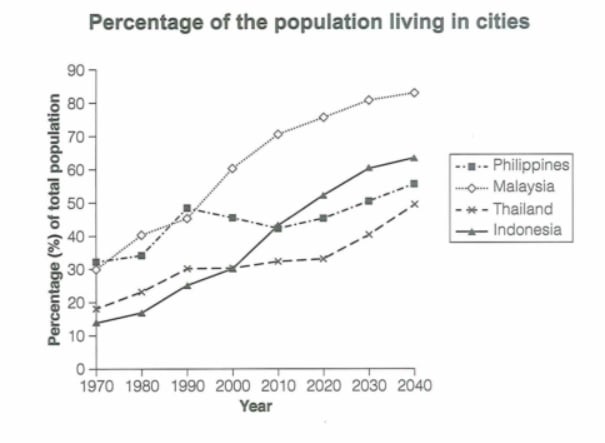
The graph below gives information about the percentage of the population in four Asian countries living in cities from 1970 to 2020, with predictions for 2030 and 2040. Summarize the information by selecting and reporting the main features and make comparisons where relevant.
Student answer (Band 6.0)
The line graph depicts the percentages of population of four Asian countries from 1970 to 2020. It also illustrates the predicted percentages for upcoming two decades.
Overall, it is evident that the Malaysia's value was steadily increased and which would make it most populated area in the future, while Philippines' total populace was not consistent . Indonesia's and Thailand's growth rate also jumped up gradually year on year and would be predicted as growing countries in the coming 20 years.
The Malaysia started from approximately from15% in 1970, took a slight decline from 1980 t0 1990 but again continuously moved up till 2010. It is strongly expected that it will grow close to 90% till 2040. Philippines's population was about 30% and it fluctuated around the period till 2010.It started to grow and then assumed it will also climbed up close to 50% in the approaching two decades.
Indonesia and Thailand jumped in with approximately 15% and 18% growth rate, which climbed up consistently over the years. Their population will be increased in future and will touch the 55% and 45% respectively till 2040.
AI examiner evaluation
| Criterion | Band |
|---|---|
| Task Achievement / Task Response | 6.0 |
| Coherence and Cohesion | 6.0 |
| Lexical Resource | 5.5 |
| Grammatical Range and Accuracy | 5.5 |
| Overall | 6.0 |
Task Achievement / Task Response: Band 6.0
You identify the broad upward trends and include an overview, noting Malaysia’s rise and the Philippines’ fluctuations. You also compare the countries at the start and describe projected growth, so the response addresses the main parts of the task. However, some key details are inaccurate: Malaysia began at about 30%, not 15%, and it did not decline between 1980 and 1990; it rose throughout. The forecast for the Philippines is about 56% by 2040, rather than close to 50%, while Indonesia is projected to reach about 64%, not 55%. The overview also calls Malaysia the “most populated area,” although the graph measures urban population share. Select the most important comparisons and report them precisely.
Coherence and Cohesion: Band 6.0
The response has a clear overall structure: an introduction, an overview, and two paragraphs grouping the Philippines and Malaysia separately from Indonesia and Thailand. This makes the main trends reasonably easy to follow. Some connections, however, are awkward or unclear. For example, “and which would make it” does not link smoothly to the preceding clause, and “Indonesia and Thailand jumped in” is an imprecise transition into the final comparison. The overview also combines several trends in one long sentence, making the relationships between them less clear. Use straightforward linking language and organise comparisons around shared features, such as the strongest growth or the highest projected figures.
Lexical Resource: Band 5.5
You use a reasonable range of trend vocabulary, including “fluctuated,” “consistently,” “decline,” and “predicted,” which helps communicate changes over time. However, several choices are inaccurate or unnatural for describing this graph. “Most populated area” confuses a percentage with a population total, while “growth rate” and “jumped in” do not precisely describe the figures. “Upcoming two decades” and “approaching two decades” are also less natural than standard chart language. There are word-form and spelling slips, including “Philippines's” and the numeral-zero substitution in “t0.” Aim for precise terms such as “urban population share,” “rose,” and “is projected to reach.”
Grammatical Range and Accuracy: Band 5.5
You attempt both simple and more complex sentences, including clauses with “while” and “which,” and the overall meaning is generally understandable. Some grammatical errors nevertheless reduce accuracy. For example, “Malaysia's value was steadily increased” uses an incorrect passive form; “was not consistent” would be more naturally expressed with a suitable verb and subject; and “it will also climbed up” combines incompatible verb forms. The phrase “started from approximately from15%” also contains a repeated preposition, and punctuation spacing is inconsistent, as in “2010.It.” Practise accurate past-tense descriptions and future projections, and check subject–verb patterns and sentence boundaries during proofreading.
See this exact question answered at other band scores. The same prompt compared across bands.
Browse more IELTS Writing model answers or get your own writing scored by the same AI examiner.