Band 5.5 IELTS Writing Task 1 Model Answer
Overall Band Score: 5.5 · Cambridge IELTS 18 · 2026-11-12
IELTS Writing Task 1 question
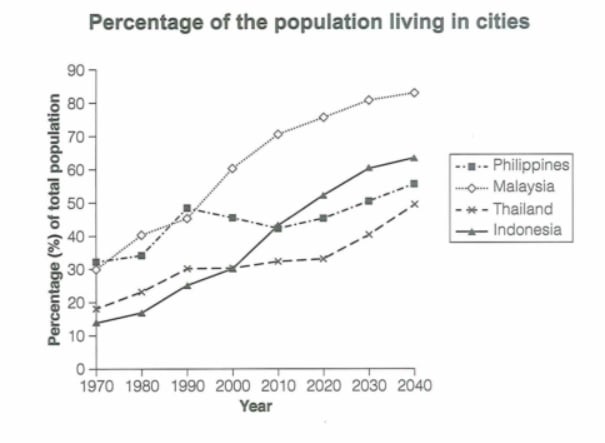
The graph below gives information about the percentage of the population in four Asian countries living in cities from 1970 to 2020, with predictions for 2030 and 2040. Summarize the information by selecting and reporting the main features and make comparisons where relevant.
Student answer (Band 5.5)
The graph below presents information about the proportion in four Asian countries living in cities between 1970 to 2020, with the predictions for 2030 and 2040. The country presents are; Philiphines, Malaysia, Thailand and Indonesia.
Overall, Indonesia and Malaysia increased throughout the years, whereas Thailand remain steady between 1990 to 2010. On the other hand, Malaysia increased most between the four Asian countries.
From 1970 t0 1990, all the four Asian nations increased, whereas Malaysia and Philphines increased the most. Both stood at 30% in 190, and by1990, they rose to over 40%. Indonesia and Thailand, both were less than 20% in 1970, and rose to about 25% in 190. Also Indonesia over taken Thailand in 1990.
From 2000 to 2010, Thailand remain steady at about 39%, whereas Philiphines dropped from about 45% in 1990 to about 41%, then to about 40% in 2010. However, Malaysia increased throughout and by 2040 it will be above 80%, whereas indonesia will be over 50% by 2040.
AI examiner evaluation
| Criterion | Band |
|---|---|
| Task Achievement / Task Response | 5.5 |
| Coherence and Cohesion | 6.0 |
| Lexical Resource | 5.5 |
| Grammatical Range and Accuracy | 5.5 |
| Overall | 5.5 |
Task Achievement / Task Response: Band 5.5
You identify the broad pattern that Malaysia and Indonesia rise and note the Philippines’ decline after 1990, which gives the report relevant coverage. However, the overview is incomplete: it does not clearly compare the countries’ overall positions or highlight that Malaysia is projected to finish highest while Thailand remains lowest. Some figures and periods are inaccurate. Malaysia and the Philippines were about 30% and 32% respectively in 1970, not both 30% in “190”; Thailand was around 30–34% from 1990 to 2020, not 39% in 2010. The final comparison also misstates Indonesia: it is projected to exceed 60% by 2030 and reach about 64% in 2040, rather than merely over 50%. Select key figures carefully and cover the later trends more fully.
Coherence and Cohesion: Band 6.0
The response has a recognisable structure: an introduction, an overview and two paragraphs describing selected periods. This makes the main purpose easy to follow, and linking phrases such as “Overall,” “On the other hand” and “However” help signal relationships. However, the progression is uneven: the final paragraph moves from 2000–2010 to predictions for 2040 without explaining the intervening trends, and the overview’s contrast between Indonesia and Malaysia is not developed clearly. Some connections are also awkward or unclear, as in “Both stood at 30% in 190,” where the year and the countries being compared are uncertain. Organise the body by clear time periods or by country trends, and use references that make each comparison explicit.
Lexical Resource: Band 5.5
You use relevant chart vocabulary, including “proportion,” “increased,” “dropped,” “predictions” and “stood at,” so the reader can understand the general subject and direction of change. The range is nevertheless limited, with repeated use of “increased” and “rose,” and some word choices or forms are inaccurate. “The country presents are” is not a natural way to introduce the countries, while “remain steady” and “over taken” show problems with word form and spelling. There are also misspellings of country names, including “Philiphines” and “Philphines,” which reduce accuracy. Build a more precise range for describing trends and comparisons, and check spelling and collocations carefully.
Grammatical Range and Accuracy: Band 5.5
You attempt both simple and more complex sentences, for example, “Overall, Indonesia and Malaysia increased throughout the years, whereas Thailand remain steady…” and “From 1970 to 1990, all the four Asian nations increased, whereas…”. The use of contrast clauses shows some range, but errors in verb forms and sentence construction recur. “Thailand remain steady” should use a past-tense verb, and “by 2040 it will be above 80%” needs a verb after “will” (“will be”). The opening phrase “between 1970 to 2020” also uses an incorrect preposition pattern. Punctuation and sentence boundaries need attention, particularly around the semicolon in the country list. Review tense consistency and basic clause patterns while retaining your attempts at complex sentences.
See this exact question answered at other band scores. The same prompt compared across bands.
Browse more IELTS Writing model answers or get your own writing scored by the same AI examiner.