Band 6.0 IELTS Writing Task 1 Model Answer
Overall Band Score: 6.0 · Cambridge IELTS 18 · 2026-11-13
IELTS Writing Task 1 question
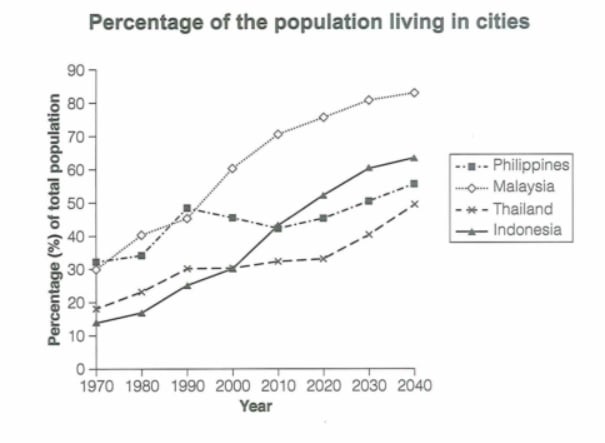
The graph below gives information about the percentage of the population in four Asian countries living in cities from 1970 to 2020, with predictions for 2030 and 2040. Summarize the information by selecting and reporting the main features and make comparisons where relevant.
Student answer (Band 6.0)
The line graph compares the proportion of population in four Asian countries living in the urban areas in the time period of 50 years from 1970, along with the future predictions till 2040.
Overall, all the four nations have shown increasing trend in past as well as in the future. There in a significant increase in Malaysian citizens opting to live in cities. Population from Thailand and Indonesia are increasingly leaving the rural areas and shifting to urban areas. Only the people living in cities in Philippines are not increased much over this time period but are expected to increase in near future.
Starting with the people of Philippines, in 1970 about 32% of total population were living in the cities, whose number incresed till 1990 to approximately 50% then after decreased in 2010 to nearly 40% and then increasing with the slow pace expected to 55% till 2040. On the other hand, Indonesia where least people were residing in urban areas in 1970 about 15% only had increased to approximately 22% and with high growth rate expected proportion in 2040 is 60%.
Meanwhile, Malaysian population's percentage rose from 30% to about 40% in 1990 and nearly 75% in 2020 have highest projection of about 80% till 2040. Lastly, Thailand public living in the cities were about 20%, later on in 2020 it increased to 35% and expected percent of population to opt urban area will be about 40%, least among all.
AI examiner evaluation
| Criterion | Band |
|---|---|
| Task Achievement / Task Response | 6.0 |
| Coherence and Cohesion | 6.5 |
| Lexical Resource | 6.0 |
| Grammatical Range and Accuracy | 5.5 |
| Overall | 6.0 |
Task Achievement / Task Response: Band 6.0
You provide a relevant overview, identifying the broad rise in urbanisation and Malaysia’s particularly strong growth, and you compare several countries with supporting figures. However, some key details are incomplete or imprecise. For example, the Philippines peaks at about 48% in 1990, then falls to around 42.5% in 2010; describing the peak as “approximately 50%” and the later figure as “nearly 40%” is broadly understandable but less precise. More importantly, the account of Indonesia gives an increase to about 22% without specifying the year, and its 2040 figure is closer to 64%, not 60%. Thailand’s 2040 projection is about 50%, rather than 40%, so calling it the lowest projection misrepresents the endpoint comparison. Include the main endpoint rankings and clarify these trends.
Coherence and Cohesion: Band 6.5
The response has a clear overall structure: an introduction, an overview, and two detail paragraphs grouped by countries. Sequencing phrases such as “Starting with,” “On the other hand,” and “Meanwhile” help readers follow the comparisons, and the progression from historical figures to forecasts is generally understandable. This meets the lower-band expectation of coherent organisation and shows some flexibility in linking ideas. However, the country-by-country presentation sometimes makes comparisons less explicit, and “Lastly” introduces Thailand without clearly connecting its figures to the other countries’ endpoints. Some references are also unclear, such as “whose number,” which appears to refer to the proportion rather than a number of people. Grouping countries by contrasting trends and using clearer references would make the progression more consistently smooth.
Lexical Resource: Band 6.0
You use an adequate range of topic vocabulary, including “proportion,” “urban areas,” “future predictions,” “growth rate,” and “projection.” These choices make the subject clear, and you attempt more descriptive phrasing such as “increasing trend” and “high growth rate.” Some word choices and collocations are inaccurate or unnatural, however: “Population from Thailand and Indonesia are increasingly leaving” suggests actual migration, while the graph only reports urban population shares; “Malaysian population’s percentage” is awkward, and “Thailand public” is not an appropriate expression. There are also spelling errors, including “incresed.” Use precise terms such as “the urban share” or “the proportion living in cities,” and check spelling and collocations to make the description more natural.
Grammatical Range and Accuracy: Band 5.5
You attempt both simple and more complex sentence forms, including a contrast introduced by “On the other hand” and a relative clause in “whose number increased.” The main trends are usually understandable, but some grammatical errors recur. For example, “There in a significant increase” has an incorrect verb form, and “all the four nations have shown increasing trend” needs an article and a more suitable construction. Agreement is also inconsistent in “Population … are increasingly leaving” and “the people … were living … whose number increased.” Several long sentences combine multiple time points without clear grammatical control, particularly the Philippines description. Practise accurate articles, subject–verb agreement, and sentence boundaries; splitting long descriptions into shorter sentences would help preserve your intended comparisons.
See this exact question answered at other band scores. The same prompt compared across bands.
Browse more IELTS Writing model answers or get your own writing scored by the same AI examiner.