Band 6.0 IELTS Writing Task 1 Model Answer
Overall Band Score: 6.0 · Cambridge IELTS 18 · 2026-11-13
IELTS Writing Task 1 question
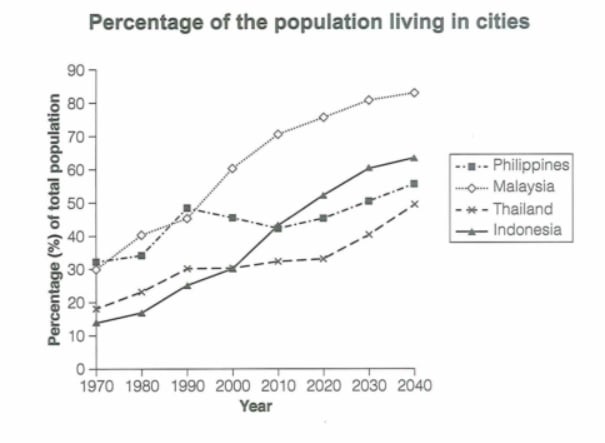
The graph below gives information about the percentage of the population in four Asian countries living in cities from 1970 to 2020, with predictions for 2030 and 2040. Summarize the information by selecting and reporting the main features and make comparisons where relevant.
Student answer (Band 6.0)
The data illusrates thr percentage of population of 4 different Asian countries from 1970 to 2020, living in cities, along with predictions for the years 2030 to 2040.
Overall, Malaysia, Thailand and indonesia saw a gradual increase in populatoin over the years, while the Philippines have fluctuations in the population but saw an increase at the end of the predicted year. Malaysia saw the highest population in cities by 2040.
Malaysian population in cities started just over 30% in 1970 and saw a gradual incline over the years and reached more then 80% by the year 2040. Indonesia population started at just above 10% in 1970 and saw a gradual increase by the years and stopped at almost 60% by 2040.
Thailand started at just 20% in 1970 and saw a increase till 1990 and the population remained satgnent till 2020 and saw a gradual increase till 2040 at around 45%. Lastly the Philippines had many fluctuations over the years stating at just above 30% in 1970 remaind stagnent till 1980 increased 1990 then gradually decreased till 2010 and gradually increased to almost 65% by 2040.
AI examiner evaluation
| Criterion | Band |
|---|---|
| Task Achievement / Task Response | 6.5 |
| Coherence and Cohesion | 6.5 |
| Lexical Resource | 5.5 |
| Grammatical Range and Accuracy | 5.5 |
| Overall | 6.0 |
Task Achievement / Task Response: Band 6.5
You cover all four countries and include a clear overview: Malaysia is identified as the highest by 2040, while the Philippines is described as fluctuating. Several key trends are accurately reported, including Malaysia’s strong rise and Thailand’s relative stability before its later increase. However, some figures and comparisons need closer checking. Indonesia is projected to reach about 64%, not “almost 60%,” and the Philippines is projected to reach about 56%, not “almost 65%.” The claim that the Philippines remained stable from 1970 to 1980 is also imprecise, as it rises slightly. The response addresses the task, but some details are less fully and accurately developed; a more precise account of the final rankings and projected values would strengthen it.
Coherence and Cohesion: Band 6.5
The response has a recognisable structure: an introduction, an overview, and country-by-country details. This gives the reader a coherent route through the information, and transitions such as “Overall,” “Lastly,” and “while” help signal relationships. However, the organisation is somewhat mechanical, with each country presented in a similar sequence rather than grouped to highlight useful comparisons. Some references are unclear, particularly “stopped at almost 60% by 2040,” where “stopped” does not clearly describe a projected endpoint. The overview also combines several trends in a long sentence. To improve progression, group countries with similar or contrasting patterns and use clearer links between historical data and forecasts.
Lexical Resource: Band 5.5
You use relevant vocabulary for describing trends, including “gradual increase,” “fluctuations,” “decreased,” and “remained stagnant,” so the main patterns are generally understandable. However, the range is limited and some choices are imprecise or repetitive. “Population” is repeatedly used where “urban share” or “proportion living in cities” would be more accurate; the graph tracks percentages, not population totals. “Stopped at” is also an awkward way to describe a forecast endpoint, and “saw a gradual incline” is less natural than “rose gradually.” Spelling errors such as “illusrates,” “populatoin,” “satgnent,” and “re maind” (written as “remaind”) are noticeable. Aim for accurate trend vocabulary and proofread carefully, especially for commonly used words.
Grammatical Range and Accuracy: Band 5.5
You attempt both simple and more extended sentence forms, and the overall meaning is usually recoverable. For example, the overview uses a contrast with “while,” and the country descriptions include time clauses and coordinated trends. However, errors in sentence construction and grammatical control recur. In “Malaysia, Thailand and indonesia saw a gradual increase in populatoin,” the subject is not the population share itself, and the country name also needs consistent capitalisation; more importantly, “the Philippines have fluctuations” has a subject–verb agreement problem. Phrases such as “Indonesia population” and “saw a increase” also show missing articles or possessives. Some sentences run together without clear punctuation, especially the final sentence. Review articles, agreement, and sentence boundaries, and vary structures while keeping them controlled.
See this exact question answered at other band scores. The same prompt compared across bands.
Browse more IELTS Writing model answers or get your own writing scored by the same AI examiner.