Band 5.5 IELTS Writing Task 1 Model Answer
Overall Band Score: 5.5 · Cambridge IELTS 18 · 2026-11-13
IELTS Writing Task 1 question
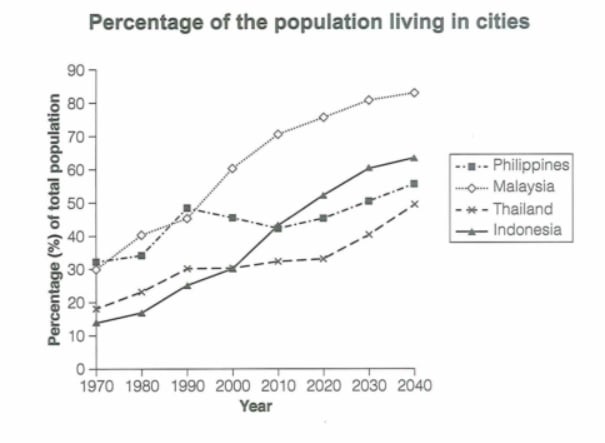
The graph below gives information about the percentage of the population in four Asian countries living in cities from 1970 to 2020, with predictions for 2030 and 2040. Summarize the information by selecting and reporting the main features and make comparisons where relevant.
Student answer (Band 5.5)
The line graph illustrates information on urban population of four asian countries - phillipines, malaysia, thailand and indonesia from 1970 to 2040. The figures are presented as percentages.
Overall, population living in cities are predominently recorded in a upward trend in all the shown countries during this period. Although phillipines and thailand numbers a seen decline for sometime but overall the numbers seems increased by 2040.
in 1970, indonesia had 12% of population living in cities, which is the lowest during this time and phillipines numbers stood at 31% approx which is slightly higher than malaysia and thiland stood at about 18%. By 2024 this trend changed substantially. Malaysia projected highest urban population more than 80% and indonesia predicted this number in between 50% to 60%.
While phillipnes started highest in urban living population in 1970, their numbers started declining around 1990 and continued till 2010. After 2010 these figures rose to 50% by 2040. Numbers in all the countries are fluctuating does not follow clear progression.
AI examiner evaluation
| Criterion | Band |
|---|---|
| Task Achievement / Task Response | 5.5 |
| Coherence and Cohesion | 5.5 |
| Lexical Resource | 5.5 |
| Grammatical Range and Accuracy | 5.0 |
| Overall | 5.5 |
Task Achievement / Task Response: Band 5.5
You identify the overall upward direction and note that the Philippines and Thailand experience periods of decline or slower movement, which gives the response a relevant overview. You also make useful comparisons, such as Malaysia becoming the highest and Indonesia rising substantially. However, several details are inaccurate or unclear: the starting figures are approximately 14% for Indonesia and 32% for the Philippines, not 12% and 31%, and the final-year comparison is mistakenly dated “2024” rather than 2040. The claim that the Philippines’ figures declined continuously from 1990 to 2010 overlooks the rise from 42.5% in 2010 to 45.5% in 2020. The overview also says all countries trend upward, then concludes that there is no clear progression. Select and report the main trends more consistently and accurately.
Coherence and Cohesion: Band 5.5
The response has a basic paragraph structure: an introduction, an overview, and two paragraphs with figures and comparisons. This helps the reader identify the topic and some key information. However, progression between ideas is not always clear. The final sentence, “Numbers in all the countries are fluctuating does not follow clear progression,” conflicts with the earlier overview that describes a general upward trend. The second body paragraph also shifts from the Philippines to a broad statement about all countries without explaining the connection. Linking phrases such as “By 2040” and “In contrast” could clarify comparisons, while grouping countries by their trends would create a more logical sequence. Check that each paragraph develops one clear point and that references such as “this trend” have an unmistakable meaning.
Lexical Resource: Band 5.5
You use relevant task vocabulary, including “urban population,” “projected,” “decline,” and “trend,” and the meaning is generally understandable. However, the range is limited and some word choices or collocations are inaccurate or repetitive. For example, “population living in cities are” is an awkward construction, while “numbers” is used repeatedly where “proportion” or “percentage” would be more precise. “Predominently recorded in a upward trend” is also unnatural, and “numbers are fluctuating” does not accurately describe the overall pattern. Spelling errors such as “phillipines,” “thiland,” and “phillipnes” are noticeable. Use a small range of precise terms consistently, and check country names and common collocations before finishing.
Grammatical Range and Accuracy: Band 5.0
You attempt both simple and more complex sentences, including a contrast with “Although” and a time clause beginning “After 2010.” However, errors are frequent and sometimes make relationships between ideas difficult to follow. Examples include “population living in cities are,” where the subject and verb do not agree, and “phillipines and thailand numbers a seen decline,” which lacks a correct verb structure. The sentence “Numbers in all the countries are fluctuating does not follow clear progression” joins clauses incorrectly. There are also problems with articles and prepositions, as in “a upward trend” and “in between 50% to 60%.” Practise forming complete clauses, checking subject–verb agreement, and using accurate comparisons; then proofread punctuation and sentence boundaries.
See this exact question answered at other band scores. The same prompt compared across bands.
Browse more IELTS Writing model answers or get your own writing scored by the same AI examiner.