Band 5.0 IELTS Writing Task 1 Model Answer
Overall Band Score: 5.0 · Cambridge IELTS 18 · 2026-11-14
IELTS Writing Task 1 question
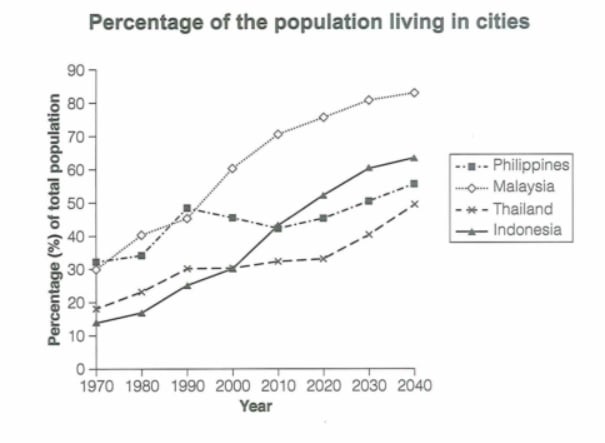
The graph below gives information about the percentage of the population in four Asian countries living in cities from 1970 to 2020, with predictions for 2030 and 2040. Summarize the information by selecting and reporting the main features and make comparisons where relevant.
Student answer (Band 5.0)
THE AVAILABLE LINE GRAPH ILLUSTRATES THE INFORMATION ABOUT CITIZENS OF FOUR DIFFERENT COUNTRIES PHILIPPINES,MALAYSIA,THAILAND,INDONESIA FROM 1970 TO 2020.
PEOPLE FROM THESE FOUR COUNTRIES CHOOSE TO LIVE IN CITIES IN 1970 BUT PHILIPPINES AND MALAYSIAN RESIDENTS MORE FREQUENTLY STAYED AT CITIES ABOUT 30%. IN CONTRAST THAILAND NATIONALS WERE ABOUT ONLY 20% AND INDONESIAN PEOPLE WERE LESS COMMON TO LIVE IN CITIES.
HOWEVER INDIVIDUALS FROM MALAYSIA MORE PERIORITIZE TO LIVE IN CITIES THEIR PERCENTAGES INCREASE WITH THE PESSAGE OF TIME AND MIGHT BE ROSE UPTO 85% WHICH WAS FOLLOWED BY INDONESIA WHICH RECORDS WITH MORE POPULATION IN CITIES. THIRD FAMOUS COUNTRY WHERE PEOPLE MORE COMMONLY LIVED IN CITIES IS THAILAND AT START ONLY 10% PEOPLE LIVED IN CITIES BUT LATER THOSE NUMBERS ROSE UP TIME TO TIME.WHEARS PHILLIPPINES NUMBER FLUCTUATES IN BETWEEN 1970 TO 2020 .
IT IS CLEARLY INDICATED BY GRAPH RESDENTS OF MALASYIA ,THILAND AND INDONESIA MOSTLY LIVED IN CITIES INCONTRAST PHILIPPINES NUMBER FLUCTUATES OVER THE PERIOD OF TIME AND CONSIDERED LEAST COMMON NATION WHO LOVE TO LIVE MODEREN LIFE IN CITIES .
AI examiner evaluation
| Criterion | Band |
|---|---|
| Task Achievement / Task Response | 5.0 |
| Coherence and Cohesion | 5.0 |
| Lexical Resource | 5.0 |
| Grammatical Range and Accuracy | 5.0 |
| Overall | 5.0 |
Task Achievement / Task Response: Band 5.0
You identify the general subject and mention several relevant patterns, including Malaysia’s rise and fluctuation in the Philippines. However, the response only partially reports the graph: it gives no clear overview of the countries’ relative positions at the end, and several details are inaccurate. For example, Thailand starts at about 18%, not 10%, and the Philippines does not remain the least urbanised country throughout; it begins above Thailand and Indonesia. The opening also says people in all four countries chose city living in 1970, which is too broad and does not clearly describe the proportions. Select the main trends accurately, compare the starting and ending figures, and distinguish observed data from forecasts.
Coherence and Cohesion: Band 5.0
The response has paragraph breaks and attempts to organise information from the starting point to later trends, using connectors such as “In contrast,” “However,” and “whereas.” These give some structure, but the progression is difficult to follow because the comparisons shift abruptly and the final paragraph repeats earlier claims rather than drawing the trends together. References such as “those numbers” are not always clear, and some linking expressions do not show the intended relationship. A clearer sequence would be an introduction, a concise overview of the main contrasts, then paragraphs grouping the countries by trend. Use connectors selectively and make each comparison explicit.
Lexical Resource: Band 5.0
You use some task-related vocabulary, including “percentages,” “increase,” “fluctuates,” and “over the period of time,” so the reader can recognise the topic. However, the range is limited and many word choices or collocations are inaccurate, sometimes making the meaning unclear. Phrases such as “more perioritize to live,” “rose up time to time,” and “least common nation who love to live modern life” are not natural ways to describe urbanisation. Spelling errors, including “Philippines,” “Malaysia,” and “Thailand” in several forms, also reduce clarity. Prefer precise, neutral language for describing proportions and trends rather than claims about what people prefer.
Grammatical Range and Accuracy: Band 5.0
You attempt both simple statements and longer sentences with contrast, for example the sentence beginning “However individuals from Malaysia…” and the comparison introduced by “whereas.” This shows some effort to vary sentence forms, but complex attempts are often faulty and errors occur frequently. Examples include “their percentages increase” followed by “might be rose,” the incomplete construction “at start only 10% people lived,” and inconsistent tense when describing the graph. Articles, sentence boundaries, and punctuation are also unreliable, making some relationships hard to interpret. Build accurate short sentences first, then combine them with correctly formed clauses; use past tense for historical data and clear future or prediction forms for later years.
See this exact question answered at other band scores. The same prompt compared across bands.
Browse more IELTS Writing model answers or get your own writing scored by the same AI examiner.