Band 5.5 IELTS Writing Task 1 Model Answer
Overall Band Score: 5.5 · Cambridge IELTS 18 · 2026-11-14
IELTS Writing Task 1 question
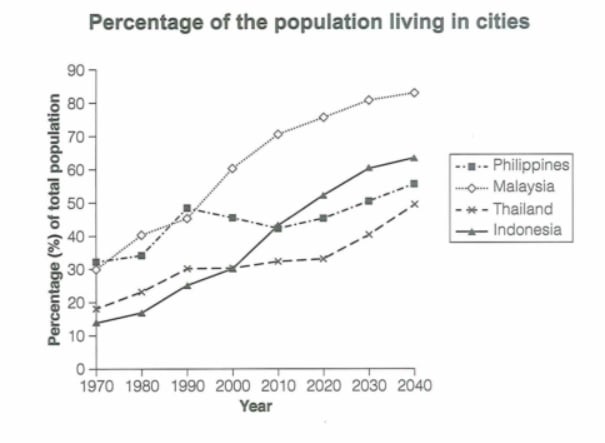
The graph below gives information about the percentage of the population in four Asian countries living in cities from 1970 to 2020, with predictions for 2030 and 2040. Summarize the information by selecting and reporting the main features and make comparisons where relevant.
Student answer (Band 5.5)
The given graph illustrates the portion of Asian countries Philiphines, Malaysia, Thailand and Indonesia population residing in urban areas between 1970 to 2020 along with the calculation for 2030 and 2040.
Overall, there is a significant rise in urban population among all these countries while Malaysia leads the group throughout . Philiphines is a country that show fluctuation.
In begin, Malaysia started from 30% in 1970 then it showed a dramatic rise in urban population to 75% in 2020. Moreover, with the prediction of more increase to 85%. Furthermore, Philippines showed a fluctuation, in first 10 years it almost remain the same at 30% and then it showed a significant increase in decade to 505 and then it declined 40% and future predictions about it will surge to 50% in 2040.
Indonesia was at lowest in 1970 to 13% approximately and then it rose 50% and will be the 2nd leading country in future with almost 60%.However, Thailand started from 19% in 1970 and show a slight increase throughout the years and in 2040 it will at almost 45%.
AI examiner evaluation
| Criterion | Band |
|---|---|
| Task Achievement / Task Response | 6.0 |
| Coherence and Cohesion | 6.0 |
| Lexical Resource | 5.5 |
| Grammatical Range and Accuracy | 5.0 |
| Overall | 5.5 |
Task Achievement / Task Response: Band 6.0
You provide a relevant overview, identifying the general rise in urbanisation and Malaysia’s leading position, and you cover all four countries. Several comparisons are supported by figures, such as Malaysia’s rise from about 30% to 75% by 2020 and Indonesia’s low starting point. However, some details are inaccurate or unclear: the Philippines reaches about 48% in 1990, not “505,” and its 2040 projection is around 56%, rather than 50%. Malaysia is projected to reach about 84%, while Indonesia is expected to reach about 64%. The overview also misses the important contrast that Indonesia overtakes the Philippines around 2010 and is projected to remain ahead. Select the main turning points and report them precisely.
Coherence and Cohesion: Band 6.0
The response has a clear overall structure: an introduction, an overview, and two body paragraphs grouping the countries. This makes the information reasonably easy to follow, and linking expressions such as “Moreover” and “However” help signal relationships. Some connections are less clear or mechanical, though. For example, “Moreover, with the prediction of more increase to 85%” is a fragment, and the Philippines discussion moves from its early stability to later changes without clearly anchoring each figure to a year. The final paragraph also places Indonesia and Thailand together without making their comparison explicit. Use complete sentences and organise details by clear time periods or by contrasting trends, with accurate references to the countries.
Lexical Resource: Band 5.5
You use a relevant range of vocabulary for describing trends, including “significant rise,” “dramatic rise,” “fluctuation,” “declined,” and “surge.” These choices show an effort to vary your language rather than repeat basic terms. However, some word choices and collocations are inaccurate or awkward, such as “calculation” for projections, “portion of … population,” and “showed a significant increase in decade.” “505” also appears to be a typing or number-formatting error that obscures the intended figure. Spelling errors in “Philiphines” and “remain” reduce accuracy. Aim for precise chart language and check country names and numerical expressions carefully; this will make your descriptions clearer and more natural.
Grammatical Range and Accuracy: Band 5.0
You attempt both simple and more extended sentence forms, and the overall meaning is generally recoverable. However, errors in sentence construction and verb forms are noticeable. For example, “Philiphines is a country that show fluctuation” has a subject–verb agreement error, while “in first 10 years it almost remain the same” needs an article and a past-tense verb. The phrase “Moreover, with the prediction of more increase to 85%” is not a complete sentence, and “in 2040 it will at almost 45%” is missing a verb. Punctuation and spacing are also inconsistent, as in “60%.However”. Practise building complete sentences around each comparison, maintaining past tense for historical data and using “is projected to” for forecasts.
See this exact question answered at other band scores. The same prompt compared across bands.
Browse more IELTS Writing model answers or get your own writing scored by the same AI examiner.