Band 5.5 IELTS Writing Task 1 Model Answer
Overall Band Score: 5.5 · Cambridge IELTS 18 · 2026-11-15
IELTS Writing Task 1 question
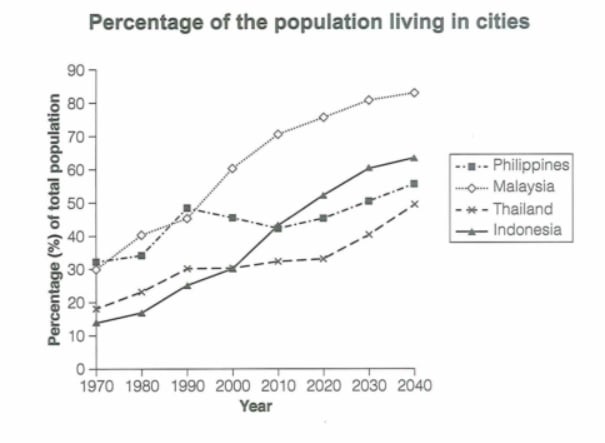
The graph below gives information about the percentage of the population in four Asian countries living in cities from 1970 to 2020, with predictions for 2030 and 2040. Summarize the information by selecting and reporting the main features and make comparisons where relevant.
Student answer (Band 5.5)
With the increase in population the number of people in cities are also increasing. The following graph gives us information about the rise of population in cities of four major Asian countries. This shows the detailed information about rise in population and also predicts the future condition.
Among the four countries the rise of population in cities is highest in Malaysia where the city population has been rising continuously from the year 1970 to the present. At present the percentage of population in cities is almost 75% in Malaysia. While the prediction says that it will reach the level of more than 85% in the year 2040.
Indonesia is following the same trend. At present they have almost 58% city population with the prediction of 63% by the end of 2040. Philippines have a shift in trend. From year 1970 to 1990 the population in city increased but after that it began to decrease till 2010. At present they have almost 50% population living in cities. While it will rise to about 55% in 2040. Thailand has a litle control on urban population. The population in the cities of Thailand is also increasing but at the least rate. Even by the year 2040 they would have population of almost 45% living in cities as compared to the 35% population which is living at present in the cities if Thailand
AI examiner evaluation
| Criterion | Band |
|---|---|
| Task Achievement / Task Response | 5.5 |
| Coherence and Cohesion | 5.5 |
| Lexical Resource | 5.0 |
| Grammatical Range and Accuracy | 5.5 |
| Overall | 5.5 |
Task Achievement / Task Response: Band 5.5
You identify the main upward trends and note useful contrasts: Malaysia remains the highest, Indonesia rises strongly, and the Philippines falls after 1990 before recovering. However, the overview is not sufficiently clear or complete, and some figures and comparisons are inaccurate. Malaysia is about 76% in 2020 and is projected to reach roughly 84% in 2040, rather than “more than 85%”; Indonesia is about 52% in 2020, not 58%. Thailand is also projected to reach about 50%, not 45%. The opening refers generally to population growth rather than clearly summarising urbanisation across all four countries. Select the most important overall patterns and check reported values against the graph.
Coherence and Cohesion: Band 5.5
The response has a basic sequence, moving from a general introduction to country-by-country descriptions, and the country names help readers follow the comparisons. However, the overall progression is limited: there is no distinct overview that brings the main patterns together, and the paragraphs are not clearly separated. Several sentences begin with “While,” creating fragments or loosely connected statements, such as “While the prediction says…” and “While it will rise…”. The repeated “At present” also makes the linking mechanical. Organise the response into an introduction, a concise overview, and grouped detail paragraphs, using clear links to show contrasts and changes over time.
Lexical Resource: Band 5.0
Your vocabulary is sufficient to communicate the broad trends, with relevant terms such as “prediction,” “increased,” and “decrease.” However, the range is limited and several phrases are repetitive or imprecise for describing a graph. “Rise of population in cities” is repeated and is less natural than language about the proportion living in urban areas; “shift in trend” is vague, and “a little control on urban population” does not accurately describe Thailand’s gradual increase. There are also spelling and word-form slips, including “litle.” Use a wider set of precise trend expressions, such as “urbanisation,” “rose steadily,” “declined,” and “is projected to reach,” while avoiding claims that suggest population growth is being controlled.
Grammatical Range and Accuracy: Band 5.5
You attempt both simple and more complex sentences, and the main message is generally understandable. However, errors in agreement, sentence construction, and punctuation recur. For example, “the number of people in cities are” should use a singular verb, while “Philippines have” needs an article and singular agreement (“the Philippines has”). The clauses beginning “While the prediction says…” and “While it will rise…” are incomplete when used as separate sentences. The final sentence also lacks clear punctuation and has an awkward comparison structure. Practise forming complete sentences with subordinate clauses, and check subject–verb agreement, articles, and sentence boundaries. More accurate control of these patterns would make your comparisons easier to follow.
See this exact question answered at other band scores. The same prompt compared across bands.
Browse more IELTS Writing model answers or get your own writing scored by the same AI examiner.