Band 6.5 IELTS Writing Task 1 Model Answer
Overall Band Score: 6.5 · Cambridge IELTS 18 · 2026-11-18
IELTS Writing Task 1 question
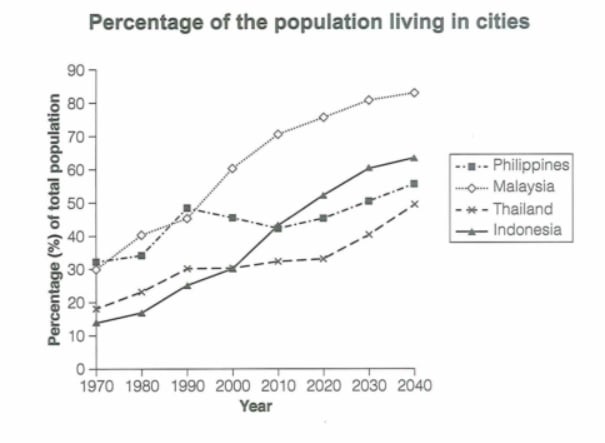
The graph below gives information about the percentage of the population in four Asian countries living in cities from 1970 to 2020, with predictions for 2030 and 2040. Summarize the information by selecting and reporting the main features and make comparisons where relevant.
Student answer (Band 6.5)
The chart illustrates the percentages of people living in cities in four Asian countries during the period from 1970 to 2020, with predictions past that period and up to 2040. Overall, the figure shows an increaing trend in the percentage of people living in cities out of studied countries' respective total population throughout the period.
According to available data of 2020, Malaysia comes first at 75%, and is expected to reach 80% by 2040. At the beginning of the period, Malaysia cities' population was at about 30%, slightly lower than Philippines. On the other hand, Phillipines which had the highst cities' population in 1970 at about 32%, is behind Malaysia and Indonesia at 45%, and is expected to reach 50% by 2040.
Moreover, Percentage of cities inhabitants in Indonesia was at about 13% in 1970. This percentage significantly increased to about 50% in 2020, and is expected to go up to 60% by 2040.
Finally, Thailand with minimal changes starts at 18% in 1970. In 2020, Thailand reached 30%, and is expected to rise up to 47% by 2040.
AI examiner evaluation
| Criterion | Band |
|---|---|
| Task Achievement / Task Response | 6.5 |
| Coherence and Cohesion | 6.5 |
| Lexical Resource | 6.5 |
| Grammatical Range and Accuracy | 6.0 |
| Overall | 6.5 |
Task Achievement / Task Response: Band 6.5
You identify the overall upward movement and make relevant comparisons, including Malaysia’s leading position by 2020 and Indonesia’s strong growth. Most reported figures are broadly consistent with the chart, though some are imprecise: Thailand is about 34% in 2020 rather than 30%, and around 50% in 2040 rather than 47%; Malaysia is approximately 84% in 2040. The overview is also too general to capture the main contrasts: Malaysia is projected to remain highest, while the Philippines fluctuates before rising, unlike the steadier growth in Thailand and Indonesia. The comparison that the Philippines was “behind Malaysia and Indonesia at 45%” is unclear, since Indonesia was already above it in 2020. More precise comparisons and a fuller overview would strengthen coverage of the key features.
Coherence and Cohesion: Band 6.5
The response has a clear overall structure: an introduction and overview are followed by paragraphs describing Malaysia and the Philippines, Indonesia, and Thailand. Sequencing by country makes the information easy to follow, and transitions such as “Moreover” and “Finally” help signal progression. However, the organisation is somewhat list-like, with each country treated separately rather than using more direct comparisons to show the main patterns. Some linking is also mechanical, and the reference in “is behind Malaysia and Indonesia at 45%” is difficult to interpret. Grouping countries by their trends or comparing their 2020 and projected figures would create stronger progression and clearer cohesion while retaining the readable paragraphing.
Lexical Resource: Band 6.5
You use a suitable range of task-related vocabulary, including “predictions,” “significantly increased,” “minimal changes,” and “expected to reach.” These choices communicate the broad trends, and the meaning remains clear. However, some expressions are inaccurate or awkwardly collocated, such as “Malaysia cities’ population,” “cities inhabitants,” and “out of studied countries’ respective total population.” There are also spelling and capitalisation slips, including “increaing,” “Phillipines,” and “highst,” which reduce precision. Aim for natural phrases such as “the proportion of the population living in cities” and “urban population,” and check spelling carefully. More precise trend language would also help distinguish steady growth from fluctuation.
Grammatical Range and Accuracy: Band 6.0
You attempt a mix of sentence forms, including a complex overview sentence and clauses with “which” and “and,” and the main message is generally understandable. Some grammatical errors remain, however. In “Philippines which had the highst cities’ population … is behind,” the relative clause needs clearer punctuation and the verb construction is awkward; “the percentage … was” would also be more suitable than “cities’ population was” when describing a proportion. Capitalisation is inconsistent in “Percentage,” and the sentence beginning “At the beginning of the period” has an unclear possessive construction. These issues do not usually prevent understanding, but they limit accuracy. Practise clear subject–verb patterns and use consistent past forms for historical data and future forms for projections.
See this exact question answered at other band scores. The same prompt compared across bands.
Browse more IELTS Writing model answers or get your own writing scored by the same AI examiner.