Band 4.5 IELTS Writing Task 1 Model Answer
Overall Band Score: 4.5 · Cambridge IELTS 18 · 2026-11-19
IELTS Writing Task 1 question
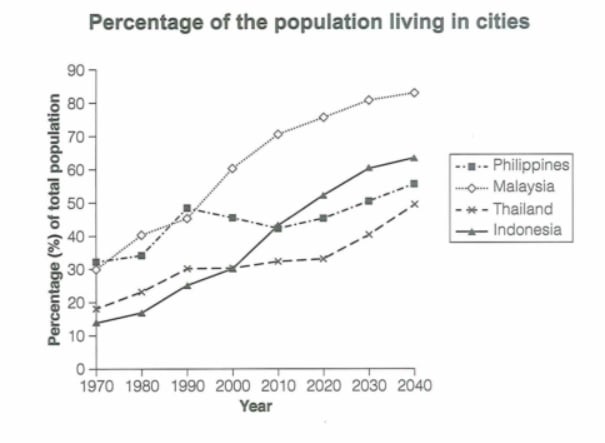
The graph below gives information about the percentage of the population in four Asian countries living in cities from 1970 to 2020, with predictions for 2030 and 2040. Summarize the information by selecting and reporting the main features and make comparisons where relevant.
Student answer (Band 4.5)
The given line chart elucidates the percentages of populaton who living in four Asian countries. This graf shows the percentage of population in four Asion countries living in diffrent countries from 1970 to 2020 with predection for 2030 and 2040.
Firstly, according to chart, l talk about the population of Indoesia. In this graf, indonesia 's population start from 14 percent in 1970 and incresed step by step shell begain 55 to 60 percent in 2040.
c
secondly, l talk about Thailand, it's population in 1970 were 19 percent and than they reach in 2040 round about 40 percent.
t
Thirdly, in Malaysia's population in 1970 start from 3à percent an d end at the 82percent in 2040.
Fourtly, In philippines population range accroding to chart start from 32 percent and reach at the 55 perecent during this during this time poplution becoming invreas and decrease. At least we can say that, population will day by day increas
AI examiner evaluation
| Criterion | Band |
|---|---|
| Task Achievement / Task Response | 4.5 |
| Coherence and Cohesion | 5.0 |
| Lexical Resource | 4.5 |
| Grammatical Range and Accuracy | 4.5 |
| Overall | 4.5 |
Task Achievement / Task Response: Band 4.5
You identify all four countries and give some starting and ending figures, including Indonesia at 14% and the Philippines at about 32% and 55%. However, the response mainly lists countries rather than summarising the graph’s key features. The overview is vague (“population will day by day increas”) and does not clearly compare the countries or identify Malaysia as the highest by 2040, while Thailand remains lower than the others. Some details are inaccurate: Indonesia is reported as reaching 55–60% in 2040, rather than about 64%, and Thailand is said to reach about 40%, rather than about 50%. The Philippines’ rise and fall is mentioned but not explained with clear stages. Select the main trends and make accurate comparisons across the period.
Coherence and Cohesion: Band 5.0
The response has a basic sequence, using “Firstly,” “secondly,” “Thirdly,” and “Fourtly” to move through the countries, so the reader can see the intended organisation. However, this country-by-country listing does not create a clear overall progression from an overview to supporting details, and the repeated “I talk about” framing is mechanical. The isolated letters “c” and “t” interrupt the flow, while the final sentence does not clearly connect to the preceding figures. Grouping the information into an introduction and overview, followed by paragraphs comparing related trends, would make the organisation more coherent. Use linking expressions to show contrasts and changes, rather than relying mainly on ordinal markers.
Lexical Resource: Band 4.5
You use some relevant chart vocabulary, such as “percent,” “reach,” “start,” and “increase,” and the country names and figures generally make the topic recognisable. However, the range is basic and repetitive, with “population” and “talk about” used repeatedly instead of precise language for describing data. Several spelling errors—such as “populaton,” “graf,” “diffrent,” and “predection”—and inaccurate forms such as “invreas” make the writing harder to follow. Some expressions are also unnatural, including “population who living” and “reach in 2040.” Build a small set of accurate trend verbs and comparison phrases, and check spelling and word forms carefully before submitting.
Grammatical Range and Accuracy: Band 4.5
Most sentences follow a simple pattern, and the response attempts some longer constructions, for example, “At least we can say that…” and the sentence describing the Philippines. However, control of sentence structure and verb forms is weak, and errors frequently obscure the intended meaning. Examples include “who living,” “population start,” “were 19 percent,” and “they reach in 2040”; these need appropriate relative clauses, tense, and agreement. The sentence about Indonesia (“start from 14 percent … increased step by step…”) is incomplete or difficult to interpret, and punctuation and apostrophe use are inconsistent. Practise accurate simple past forms for historical data and use “is projected to” for future estimates, then combine these in clear, complete sentences.
See this exact question answered at other band scores. The same prompt compared across bands.
Browse more IELTS Writing model answers or get your own writing scored by the same AI examiner.