Band 6.0 IELTS Writing Task 1 Model Answer
Overall Band Score: 6.0 · Cambridge IELTS 18 · 2026-11-20
IELTS Writing Task 1 question
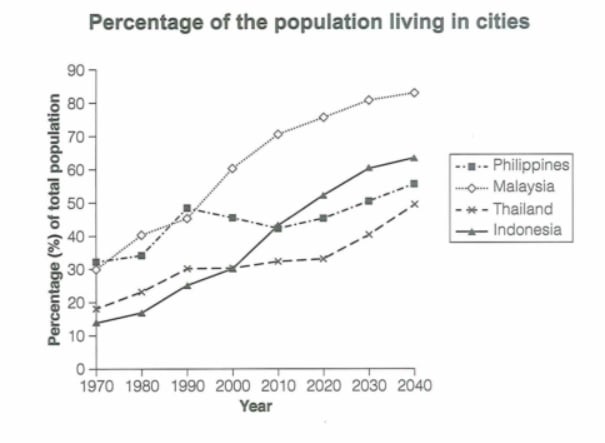
The graph below gives information about the percentage of the population in four Asian countries living in cities from 1970 to 2020, with predictions for 2030 and 2040. Summarize the information by selecting and reporting the main features and make comparisons where relevant.
Student answer (Band 6.0)
The graph illustrates the proportion of the city population living in four Asian countries between 1970 and 2020 , with projection of next two decades.
Overall, all four countries experienced major population growth over the years and predicted that the growth will be continued for next 20 years. Malaysia and Indonesia showed the highest population growth among all four countries.
In 1970, only 30% of Malaysian lived in city area but untill 2020 this value increased to nearly 75% and in 2040 it had been predicted to reach above 80%. Similarly, city's people in Indonesia increased by nearly 40% from 1970 to 2020 and in 2040 it had been predicted to reach 60%.
The value for Thailand increased steadily until 1990 and remained almost stable until 2020 and predicted to reach 45% in 2040. The growth in Philillines was unstable as they increased first until 1990 and then again decreased in 2010 and predicted to reach 50%
AI examiner evaluation
| Criterion | Band |
|---|---|
| Task Achievement / Task Response | 6.0 |
| Coherence and Cohesion | 6.5 |
| Lexical Resource | 6.0 |
| Grammatical Range and Accuracy | 5.5 |
| Overall | 6.0 |
Task Achievement / Task Response: Band 6.0
You provide a relevant overview, identifying the general rise across the four countries and the particularly strong growth in Malaysia and Indonesia. Several figures and trends are also reported accurately, including Malaysia’s rise to above 80% and Thailand’s relative stability after 1990. However, some key comparisons are incomplete or imprecise: Indonesia reaches about 52% in 2020 and is projected to around 64% in 2040, rather than 60%, while the Philippines is projected to about 56%, not 50%. The claim that all countries experienced “major” growth also overlooks the comparatively modest increase in Thailand. Develop the overview with clearer end-point comparisons and report the Philippines’ rise, dip, and recovery more fully.
Coherence and Cohesion: Band 6.5
The response has a clear overall arrangement: an introduction, a summary of the main trends, and two paragraphs grouping country details. Linking expressions such as “Overall” and “Similarly” help readers follow the comparisons, and the country-by-country progression is generally easy to understand. This meets the lower-band expectation of coherent organisation and shows some effective progression. To make the flow more consistently controlled, ensure each comparison is complete and use clearer references: “this value” and “the growth” can be vague when several countries and measures are being discussed. The final paragraph also ends abruptly, and the Philippines’ trend would be clearer if its recovery after 2010 were explicitly connected to the forecast.
Lexical Resource: Band 6.0
You use an adequate range of task-related vocabulary, including “proportion,” “projection,” “increased,” “steadily,” and “remained almost stable.” These choices communicate the main trends, and the reader can understand the response despite some awkward or inaccurate expressions. However, several collocations and word choices are not natural for describing this graph: “city population living in four Asian countries” confuses the population measure, and “city’s people” is imprecise. There are also spelling errors in “untill” and “Philillines.” Aim for precise terms such as “the proportion of the population living in cities” and “urban residents,” and check spelling and collocations during revision.
Grammatical Range and Accuracy: Band 5.5
You attempt both simple and more complex sentence forms, including clauses linked with “but,” “and,” and “as,” and the main meaning is generally clear. Some grammatical errors remain, however. In the overview, “predicted that the growth will be continued” lacks a clear subject and uses an awkward passive construction; “growth is expected to continue” would be more controlled. Other examples include “30% of Malaysian” (missing a plural noun or possessive form), “until 2020 this value increased” (tense and punctuation control), and “in 2040 it had been predicted” (an unsuitable past perfect for a forecast). Review articles, plural forms, and tense choices, and punctuate introductory time phrases consistently.
See this exact question answered at other band scores. The same prompt compared across bands.
Browse more IELTS Writing model answers or get your own writing scored by the same AI examiner.