Band 4.0 IELTS Writing Task 1 Model Answer
Overall Band Score: 4.0 · Cambridge IELTS 18 · 2026-11-20
IELTS Writing Task 1 question
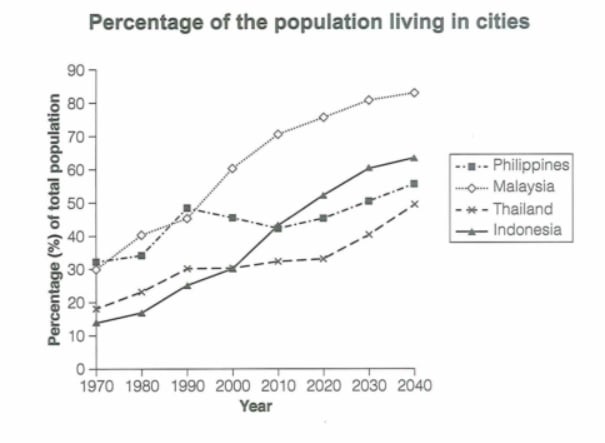
The graph below gives information about the percentage of the population in four Asian countries living in cities from 1970 to 2020, with predictions for 2030 and 2040. Summarize the information by selecting and reporting the main features and make comparisons where relevant.
Student answer (Band 4.0)
The given graph shows that information about population from 1970 to 2020 and then will prediction for 2030 and 2040 . Overall,it is clear that make comparisons where relevant. The main idea in this graph that increasingly with different conuntries population percentages of Philippines,Malaysia, Thailand and Indonesia.
Looking at the details percentage's Indonesia started 12% in 1970. After that,it went up steadly and reached 60% in 2040 as prediction. Similarly Thailand, Malaysia also rose up from round about 20% to 60% in 1970 to 2040.
On the other hand, Phalippines began at the toppest in 1970 to 2040 stayed almost the same around 90% in 2040.
In the graph my opinion that percentage of population in living these cities of different countries very different in these years.
And also change this category in many countries for these years.
AI examiner evaluation
| Criterion | Band |
|---|---|
| Task Achievement / Task Response | 3.0 |
| Coherence and Cohesion | 4.5 |
| Lexical Resource | 4.5 |
| Grammatical Range and Accuracy | 4.5 |
| Overall | 4.0 |
Task Achievement / Task Response: Band 3.0
The response makes a limited attempt to summarise the graph, but it does not identify its main patterns accurately or clearly. It correctly notes that Indonesia rises, yet says it reaches 60% in 2040, whereas the chart shows about 64%. The comparison that Thailand and Malaysia both rise from around 20% to 60% is misleading: Malaysia reaches about 84%, while Thailand is just under 50%. The Philippines is also described as staying near 90%, although it ends at roughly 56% and fluctuates over the period. The overview is vague and includes irrelevant wording such as “make comparisons where relevant.” The response is also 12 words below the required minimum. Select the clearest overall trends and support them with accurate comparisons.
Coherence and Cohesion: Band 4.5
There is a basic attempt to organise the response into an opening, an overview, and detail paragraphs, and phrases such as “Similarly” and “On the other hand” show an effort to connect ideas. However, the progression is difficult to follow because the overview does not state a clear pattern, and the comparisons in the detail paragraph are not grouped or explained logically. The final two sentences repeat the general idea that countries differ and change without adding information. Some linking phrases are also used in ways that do not clarify the relationship between points. A clearer sequence would be to give an accurate overview first, then compare the countries with the highest and fastest-growing urban shares.
Lexical Resource: Band 4.5
The response uses a small set of relevant terms, including “percentage,” “population,” “started,” and “went up,” so the general subject can be recognised. However, vocabulary is repetitive and several choices are inaccurate or unclear, such as “the toppest,” “rose up,” and “change this category.” There are also spelling errors, including “conuntries,” “steadly,” and “Phalippines,” which reduce precision. Phrases such as “population in living these cities” do not express the intended meaning naturally. Use standard graph language and vary it carefully—for example, describe figures as rising, falling, fluctuating, or reaching a level, and refer to the proportion of people living in urban areas.
Grammatical Range and Accuracy: Band 4.5
The response attempts some sentence variety, including a contrast introduced by “On the other hand,” but most sentences rely on simple structures and several are incomplete or difficult to interpret. For example, “Overall, it is clear that make comparisons where relevant” has no clear grammatical subject or complete idea, while “The main idea in this graph that increasingly…” is missing a verb structure. Tense and article use are also inconsistent, as in “Indonesia started 12%” and “then will prediction.” Punctuation spacing is uneven, with spaces before full stops and missing spaces after commas. Practise complete subject–verb sentences and use consistent past tense for historical data and future forms for predictions.
See this exact question answered at other band scores. The same prompt compared across bands.
Browse more IELTS Writing model answers or get your own writing scored by the same AI examiner.