Band 7.0 IELTS Writing Task 1 Model Answer
Overall Band Score: 7.0 · Cambridge IELTS 18 · 2026-11-20
IELTS Writing Task 1 question
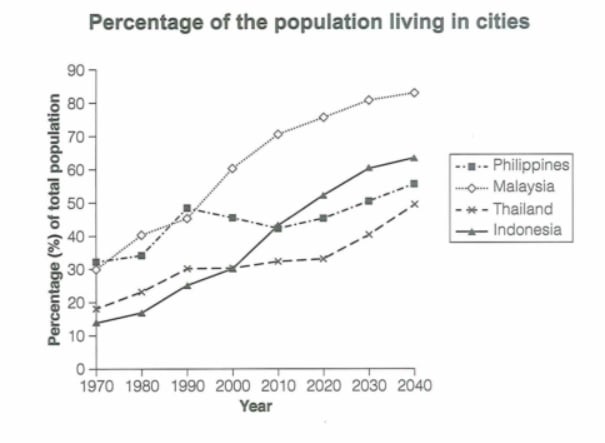
The graph below gives information about the percentage of the population in four Asian countries living in cities from 1970 to 2020, with predictions for 2030 and 2040. Summarize the information by selecting and reporting the main features and make comparisons where relevant.
Student answer (Band 7.0)
The given chart illustrates the trends followed by the population of Philippines, Malaysia, Thailand and Indonesia who lived in cities, from 1970 to 2020, it also predicts how they would be in 2030 and 2040.
Overall, all of them registered a growth in percentage. Indonesia and Malaysia are the ones which growed the most, Thailand and Philippines had a substantial growth, however, compared to the other two, it was less significant.
First of all, Malaysia, started in 1970 with 30%, then it rose to approximately 70% in 2020. Similarly, in Indonesia, in 1970, just above 10% of the population was living in cities, while in 2020, it rose to almost 50%. The predictions for these two cities represent a stable growth ([redacted phone]), they will both reach their peak of above 80% and more than 60% in 2040, respectively.
Regarding Philippines and Thailand, they had a less consistent increase. The former started at more than 30%, it had its peak in 1990, which was around 50%; subsequently it dropped to around 40% in 2010, finally it rose to above 50%. The latter had a stable growth from 1970 (above 10%) to 1990 (around 30%), then it remained almost stable between 1990 and 2020. A growth has been predicted: from 30% in 2020 to more than 40% in 2040.
AI examiner evaluation
| Criterion | Band |
|---|---|
| Task Achievement / Task Response | 7.5 |
| Coherence and Cohesion | 7.0 |
| Lexical Resource | 6.5 |
| Grammatical Range and Accuracy | 6.0 |
| Overall | 7.0 |
Task Achievement / Task Response: Band 7.5
The response gives a clear overview that all four countries become more urbanised and identifies Malaysia and Indonesia as the strongest growers. It also selects useful comparisons and describes the Philippines’ rise, dip and recovery, as well as Thailand’s relatively gradual trend. Most figures are broadly consistent with the chart. However, the overview slightly overgeneralises: Malaysia and Indonesia show the largest overall increases, but the Philippines also rises substantially, and Thailand’s projected growth accelerates after 2020 rather than remaining uniformly modest. Some details are imprecise, such as Malaysia reaching about 76% in 2020, not approximately 70%, and Thailand being around 34% in 2020. More precise comparisons across all four countries would strengthen an already well-focused summary.
Coherence and Cohesion: Band 7.0
The response is organised into a clear introduction, overview and two body paragraphs, with a sensible grouping of Malaysia and Indonesia before the Philippines and Thailand. Linking expressions such as “Similarly,” “Regarding,” “subsequently” and “finally” help the reader follow comparisons and changes over time. The progression is generally logical, though some transitions are slightly mechanical, and the opening sentence joins two independent clauses with only a comma. References such as “these two cities” are also unclear because the discussion concerns countries, not cities. To improve cohesion, use more precise referencing and connect the overview’s comparisons directly to the detailed paragraphs without relying on formulaic sequencing.
Lexical Resource: Band 6.5
There is an adequate range of vocabulary for describing trends, including “registered a growth,” “less consistent increase,” “peak,” “dropped” and “remained almost stable.” These choices communicate the main patterns, and the writer attempts some variation rather than repeating one verb throughout. However, several collocations or word forms are inaccurate or unnatural: “growed” should be “grew,” “the population … who lived” is awkward, and “a stable growth” is less natural than “steady growth.” “These two cities” also mislabels the countries. Such slips do not prevent understanding, but they limit precision and naturalness. Aim for accurate trend collocations and use “urban population” or “proportion living in cities” where appropriate.
Grammatical Range and Accuracy: Band 6.0
The response uses a mix of simple and more complex structures, including time clauses and contrasts with “while,” “then” and “subsequently.” Most relationships between ideas remain understandable, but some grammatical errors recur. The opening sentence is a comma splice: the clause beginning “it also predicts” should be separated or joined with a conjunction. “Indonesia and Malaysia are the ones which growed the most” has an incorrect verb form, and “The predictions … represent a stable growth … they will both reach” creates a faulty connection between clauses. There are also awkward article and preposition patterns, as in “Regarding Philippines.” Check sentence boundaries, past-tense forms for historical data, and articles before country names; these corrections would make the varied structures more controlled.
See this exact question answered at other band scores. The same prompt compared across bands.
Browse more IELTS Writing model answers or get your own writing scored by the same AI examiner.