Band 4.0 IELTS Writing Task 1 Model Answer
Overall Band Score: 4.0 · Cambridge IELTS 18 · 2026-11-21
IELTS Writing Task 1 question
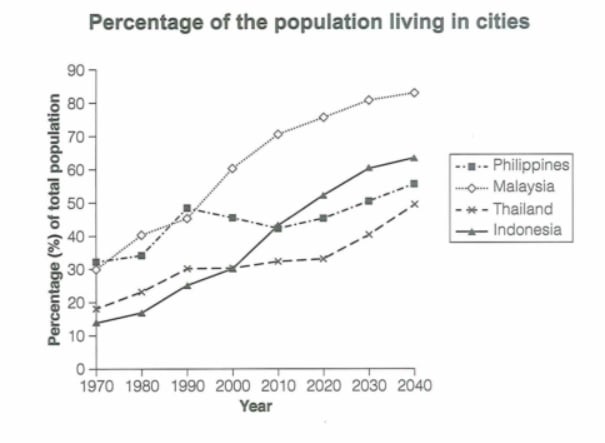
The graph below gives information about the percentage of the population in four Asian countries living in cities from 1970 to 2020, with predictions for 2030 and 2040. Summarize the information by selecting and reporting the main features and make comparisons where relevant.
Student answer (Band 4.0)
the line graph illustrates the information about percentage of the population living in cities from four place in country.
overall; it is clear that information about a total population in four cities palce the number was fiven a 1970 to 2040 perodice time.
In frist pragroph in philippines was incrase a number a serial by so that's way compered to other 30% number was increse responed to malaysia is 29% compered to other it was decrase a number after that's they was increse a point
AI examiner evaluation
| Criterion | Band |
|---|---|
| Task Achievement / Task Response | 3.0 |
| Coherence and Cohesion | 4.0 |
| Lexical Resource | 4.5 |
| Grammatical Range and Accuracy | 4.0 |
| Overall | 4.0 |
Task Achievement / Task Response: Band 3.0
You identify the graph’s general subject and refer to the period from 1970 to 2040, so the response is at least connected to the task. However, the account is extremely limited and does not provide a clear, accurate summary of the four countries’ trends. The statement that the Philippines increased is incomplete, and “compared to other 30%” does not make a meaningful comparison. Malaysia’s rise is mentioned only vaguely, while Thailand and Indonesia are not reported. The overview is also unclear (“in four cities palce”), and the response is 85 words, below the required 150. To improve, write a clear overview of the main contrasts, then select and accurately compare key figures and changes for all four countries.
Coherence and Cohesion: Band 4.0
There is a basic attempt to organise the response with an opening, an overview, and a further paragraph, and “overall” signals that you are trying to summarise the main picture. However, the ideas do not progress clearly: the overview is difficult to interpret, and the final paragraph moves between the Philippines and Malaysia without explaining how the figures relate. Connectors such as “so that’s way,” “compared to other,” and “after that” do not establish precise relationships, while the paragraph ends without a complete conclusion to the comparison. Use one paragraph for a concise overview and another for selected country trends, ordering information by time or by contrasting patterns. Clear sentence boundaries and specific linking phrases would make the progression easier to follow.
Lexical Resource: Band 4.5
You use some task-related vocabulary, including “line graph,” “percentage,” “population,” “cities,” and “increased,” which shows an attempt to describe data. However, the range is narrow and several word choices or spellings make the meaning hard to recover, such as “four place in country,” “palce,” “fiven,” and “perodice time.” Phrases like “the number was increase” and “decrease a number” are not natural ways to describe proportions. Aim to use accurate trend language and collocations, for example, “the proportion of the population living in cities,” “rose steadily,” “fell slightly,” and “was projected to reach.” Check spelling carefully and avoid repeating vague words such as “number” when referring to percentages.
Grammatical Range and Accuracy: Band 4.0
The response attempts a few sentence forms, including an overview beginning “it is clear that,” but grammatical control is weak and sentence meaning is often obscured. For example, “the number was fiven a 1970 to 2040” has an unclear verb form and time expression, while “in philippines was incrase a number” lacks a clear subject–verb structure. Articles, plurals, and sentence boundaries are also inconsistent, as in “four place in country.” Most clauses are joined into long, incomplete sequences rather than formed as clear sentences. Practise simple, accurate patterns first, such as “The percentage in Malaysia rose from 30% in 1970 to 83.5% in 2040.” Then add a small number of controlled comparisons using “while” or “whereas.”
See this exact question answered at other band scores. The same prompt compared across bands.
Browse more IELTS Writing model answers or get your own writing scored by the same AI examiner.