Band 5.0 IELTS Writing Task 1 Model Answer
Overall Band Score: 5.0 · Cambridge IELTS 18 · 2026-11-21
IELTS Writing Task 1 question
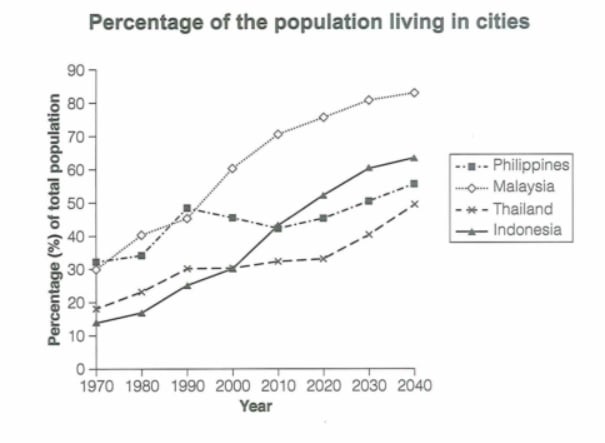
The graph below gives information about the percentage of the population in four Asian countries living in cities from 1970 to 2020, with predictions for 2030 and 2040. Summarize the information by selecting and reporting the main features and make comparisons where relevant.
Student answer (Band 5.0)
The graph illustrates information about the percentage of the population in four Asian countries living in cities from 1970 to 2020, with predictions for 2030 and 2040.
Overall, it is noticeable that the highest percentage of the population living in Malaysia in 2040 and small proportion of people living in Thailand in 2040.
It is evident that the people living in four cities have different percentages of individuals living in the cities of Asia. In Philippines, there was 30% in [redacted phone], almost 49% in 1990, and there is slightly fall in the percentage till 2030 and 2040 it will reaches to almost 55%. Malaysia is city which has living population 30% in 1970 and there is increase of 80% in 2040.
A closer look reveals that the percentage of individuals living in Thailand in start is less but then there is slightest rise in the percentage. In Indonesia, the percentage is 12% in 1970, and will reaches to almost 60% in 2040.
AI examiner evaluation
| Criterion | Band |
|---|---|
| Task Achievement / Task Response | 4.5 |
| Coherence and Cohesion | 5.5 |
| Lexical Resource | 5.0 |
| Grammatical Range and Accuracy | 5.0 |
| Overall | 5.0 |
Task Achievement / Task Response: Band 4.5
You identify the topic and include an overview that correctly notes Malaysia as the highest and Thailand as the lowest by 2040. However, the overview is vague, and the report covers the trends only partially: it omits Indonesia’s strong rise and Malaysia’s substantial lead by 2020, while the Philippines’ movement is described inaccurately as a “slightly fall” continuing to 2030. Some figures are also imprecise: the Philippines was about 32% in 1970 and 34% in 1980, rather than 30% across both years, and Indonesia was about 64% in 2040, not 60%. The response is 138 words, below the 150-word minimum; the 24 words copied from the prompt do not count. Add a fuller overview and accurate comparisons.
Coherence and Cohesion: Band 5.5
The response has a recognisable structure: an introduction, an overview, and two paragraphs describing the countries. Phrases such as “Overall” and “A closer look reveals” help signal the stages of the report. However, progression between the details is limited, and the country comparisons are not organised into a clear pattern. For example, the Philippines and Malaysia are discussed together, while Thailand and Indonesia receive brief, separate comments without comparing their trajectories. Some linking language is repetitive or awkward, particularly repeated uses of “there is.” Group the countries by meaningful trends, such as the steep growth in Malaysia and Indonesia versus the more gradual changes elsewhere, and use clearer links between comparisons.
Lexical Resource: Band 5.0
You use relevant topic vocabulary, including “percentage,” “population,” “increase,” and “predictions,” so the main subject is generally clear. However, the range is limited and several word combinations are unnatural or imprecise, such as “highest percentage of the population living in Malaysia” and “small proportion of people living in Thailand.” The phrase “four cities” also confuses the countries with their urban populations. Repetition of “percentage” and “living” makes the account less flexible. Choose precise terms for describing urbanisation and trends, and vary the language used to compare figures. More accurate collocations would make the report clearer and more natural without requiring unusually advanced vocabulary.
Grammatical Range and Accuracy: Band 5.0
The response includes simple statements and some attempts to combine information, but the range of sentence structures is limited, and errors occur frequently. For example, “there is slightly fall” has an incorrect verb form, while “it will reaches” uses an incorrect form after “will.” The sentence “the highest percentage of the population living in Malaysia in 2040” is also missing a clear verb, making the overview difficult to follow. There are problems with articles and sentence construction in “In Philippines” and “Malaysia is city which has living population.” Use complete clauses with a clear subject and verb, and check verb forms after auxiliaries: “will reach,” not “will reaches.”
See this exact question answered at other band scores. The same prompt compared across bands.
Browse more IELTS Writing model answers or get your own writing scored by the same AI examiner.