Band 5.5 IELTS Writing Task 1 Model Answer
Overall Band Score: 5.5 · Cambridge IELTS 18 · 2026-11-21
IELTS Writing Task 1 question
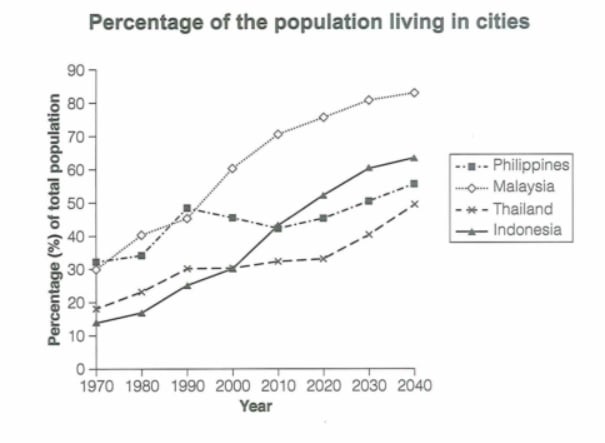
The graph below gives information about the percentage of the population in four Asian countries living in cities from 1970 to 2020, with predictions for 2030 and 2040. Summarize the information by selecting and reporting the main features and make comparisons where relevant.
Student answer (Band 5.5)
The given graph show the information abput the percentages of population in four asian countries living in cities from time period 1970 to 2020 with prediction for 2030 and 2040 .
Overall , the graph show the percentages in flucution of population living in cities Philippines,Malaysia,Thailand,Indonesia . and in time period 1970 to 2040 .
Inatially , the Philippines in 1970 the percentage of population is 30 . and they fluctuate the hole period and in end its about 50 percent citizen live in philippines . secondly , Malaysia the population is started about 30 percent in 1970 and it's countineuos grow up side and in 2020 it's minimum 75 . and in 2040 it's 80 percent moreover its the highest trend in this period .
Thailand the population lived in 1970 it's down to 20 percent and slightly go up ward in 2040 it's about 45 percent . and last in indonesia the started percentage is minimum 12 percent and ciuntinous go up to 60 percent also it is the second large terend in this period .
AI examiner evaluation
| Criterion | Band |
|---|---|
| Task Achievement / Task Response | 5.5 |
| Coherence and Cohesion | 6.0 |
| Lexical Resource | 5.0 |
| Grammatical Range and Accuracy | 4.5 |
| Overall | 5.5 |
Task Achievement / Task Response: Band 5.5
You identify all four countries and include a broad overview that Malaysia rises strongly and finishes highest, while Indonesia also grows substantially. These are relevant main features. However, the overview is vague, and several details are inaccurate or incomplete: the Philippines does not simply fluctuate throughout, but rises to about 48% in 1990, falls, then recovers; its final figure is closer to 56%, not 50%. Malaysia is already around 60% in 2000, a key stage omitted from your account. Thailand reaches about 50% by 2040, rather than 45%, and Indonesia ends near 64%. To strengthen the response, select the major turning points and compare the countries more precisely across the period.
Coherence and Cohesion: Band 6.0
The response has a recognisable sequence: an introduction, an overview, and descriptions of the four countries. Words such as “Overall,” “secondly,” and “last” help signal movement between points. However, the overview repeats the time span without clearly summarising the main contrasts, and the country details are often joined into long, loosely connected sentences. For example, the Malaysia sentence combines its starting point, growth, 2020 figure, 2040 figure, and ranking with repeated “and” and “moreover.” Some transitions are also awkward, such as “Thailand … and last in indonesia.” Grouping the strongest-growing countries together and using clearer sentence boundaries would make the progression easier to follow.
Lexical Resource: Band 5.0
You use some relevant task vocabulary, including “percentages,” “population,” “fluctuate,” and “trend,” so the reader can generally understand the subject. However, the range is limited and several word choices, forms, and spellings reduce precision: “flucution,” “countineuos,” “up side,” and “second large terend” are difficult to interpret or unnatural. Phrases such as “the population is started” and “the percentage … is 30” also do not express the data naturally. Aim for accurate collocations used in describing charts, such as “the proportion of residents living in cities rose” or “urbanisation increased steadily.” Proofreading spelling and choosing precise trend verbs would improve clarity.
Grammatical Range and Accuracy: Band 4.5
You attempt to describe changes over time and use some longer sentences, but grammatical control is inconsistent. Errors in agreement and verb forms appear in “the graph show” and “the population is started,” while sentence construction is unclear in “Thailand the population lived in 1970 it's down to 20 percent.” Articles and prepositions are also often missing or misplaced, as in “in end” and “in 2040 it's about 45 percent.” Several clauses are joined with full stops or “and” in ways that make the relationships between ideas difficult to follow. Practise writing complete subject–verb sentences, using past forms for historical data and “is projected to” for forecasts, and check punctuation.
See this exact question answered at other band scores. The same prompt compared across bands.
Browse more IELTS Writing model answers or get your own writing scored by the same AI examiner.