Band 5.0 IELTS Writing Task 1 Model Answer
Overall Band Score: 5.0 · Cambridge IELTS 18 · 2026-11-21
IELTS Writing Task 1 question
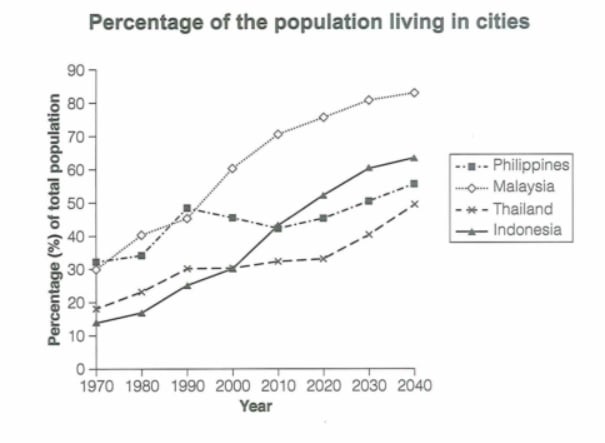
The graph below gives information about the percentage of the population in four Asian countries living in cities from 1970 to 2020, with predictions for 2030 and 2040. Summarize the information by selecting and reporting the main features and make comparisons where relevant.
Student answer (Band 5.0)
The given line graph illustrates the information about the percentage of the population in four asian countries living in cities from 1970 to 2020. Although predictions for 2030 and 2040 years also. Report main features with some comparisions.
Firstly start with Philippines, in 1970 was above 30% and in 1990 reached below 50% and in year 2040 prediction is 50% population. Other one was Malaysia was 30% in 1970 then get increased and reached below 80%. While in 2040 predict to reaching 85%.
Secondly, two more cities was Thailand population was low below 20% and reached 30% in 2020 year. However predict to go approximately 50% in 2040 coming year. Last one was Indonesia this city population was too low in starting year onlu above 10% and in year 2020 was 50% in addition expect to go above 60% in coming year.
Overall, Malaysia was the only city to reached maximum population in coming yaer infact in current time also. Furthermore, Thailand was the low population city. While, Indonesia is the low population in starting but in the last year become second top population city.
AI examiner evaluation
| Criterion | Band |
|---|---|
| Task Achievement / Task Response | 5.5 |
| Coherence and Cohesion | 5.0 |
| Lexical Resource | 5.0 |
| Grammatical Range and Accuracy | 4.5 |
| Overall | 5.0 |
Task Achievement / Task Response: Band 5.5
You identify all four countries and include a broad overview: Malaysia has the highest urban share, while Thailand is comparatively low, and Indonesia rises strongly. Several figures and comparisons are relevant, such as Malaysia starting at about 30% and Indonesia reaching roughly 50% in 2020. However, some key details are inaccurate or unclear: the Philippines is projected to reach about 56% in 2040, not 50%, and it is Indonesia—not the Philippines—that is around 64% then. Thailand is not the lowest by the final year, and calling it the “low population city” confuses the country with its urbanisation rate. Develop the overview with accurate end-point comparisons and describe the main changes more precisely.
Coherence and Cohesion: Band 5.0
The response has a basic structure, with an opening, two body paragraphs and a concluding overview. Sequencing the countries with “Firstly” and “Secondly” gives the reader some guidance, and the final paragraph attempts to compare the overall patterns. However, progression is not consistently clear: the opening says “Report main features” rather than introducing a complete overview, and the body mostly lists countries without linking their trends or making direct comparisons. Connectors such as “While,” “However” and “Furthermore” are sometimes attached to incomplete or awkwardly related ideas. Organise the body around meaningful comparisons—for example, Malaysia’s high level versus Indonesia’s rapid rise—and use clear references to avoid repeating “last one” and “this city.”
Lexical Resource: Band 5.0
You use some task-relevant vocabulary, including “percentage,” “predictions,” “reached” and “increased,” so the general subject is understandable. However, the range is limited and several expressions are imprecise or unnatural, such as “two more cities,” “low population city,” “in starting year” and “in coming year.” These choices sometimes make it difficult to tell whether you mean a country’s population or its urban share. There are also spelling errors, including “comparisions,” “onlu” and “yaer,” and repeated reliance on “was” and “reached.” Use accurate terms such as “urban population,” “proportion” and “share,” and vary trend language with phrases like “rose steadily” or “was projected to increase.”
Grammatical Range and Accuracy: Band 4.5
The response attempts a few longer structures, including “Although predictions for 2030 and 2040 years also” and “While, Indonesia is the low population in starting but in the last year become second top population city.” However, these are incomplete or faulty, and most sentences rely on simple patterns with frequent errors in tense, articles, agreement and sentence construction. For example, “in 1970 was above 30%” lacks a clear subject, while “in 2040 predict to reaching 85%” has an incorrect verb pattern. The opening fragment beginning “Although” also needs a main clause. Practise complete sentences with a clear subject and verb, and use consistent past tense for historical data and “is projected to” for forecasts.
See this exact question answered at other band scores. The same prompt compared across bands.
Browse more IELTS Writing model answers or get your own writing scored by the same AI examiner.