Band 5.5 IELTS Writing Task 1 Model Answer
Overall Band Score: 5.5 · Cambridge IELTS 18 · 2026-11-21
IELTS Writing Task 1 question
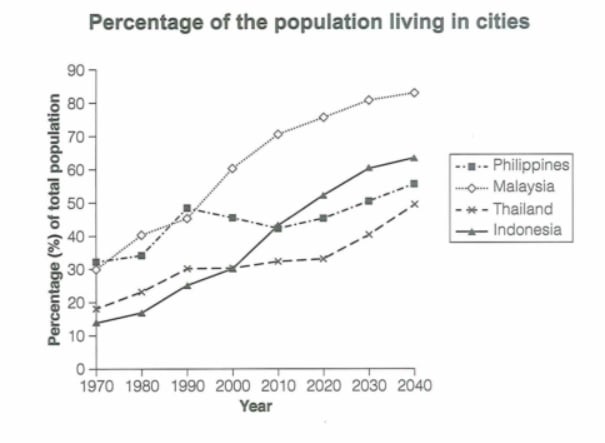
The graph below gives information about the percentage of the population in four Asian countries living in cities from 1970 to 2020, with predictions for 2030 and 2040. Summarize the information by selecting and reporting the main features and make comparisons where relevant.
Student answer (Band 5.5)
The line graph illustrates the percentage of the population living in cities in four asian countries, namely Philippines, Malayisa, Thailand and Indonesia from 1970 to 2020. What will be the prediction in 2030 and 2040.
Overall, it is clear that the chart shows an upward trend the percentage of population will be increased in all four asian countries.
To begin with, in 1970 Malaysia it was started from 30% of total and it follow an upward trend. In 2040, it will be predict the number of population will be almost 80% of the total it was on. Furthermore, in 1970, Indonesia accounted for 12% of the total, before rising sharply it was just to 18% then it will be predict in 2040 60% of total.
In contrast, Philippines it was 32% of total and then it rose steadily in 1990 it was just 49%. Moreover, in 1990 it declined gradually till 2010, then it follow topward trend it can be predict 50% of the total. Similarly, Thailand it was 19% in 1970, then it climbed gradually it can be predict 39% of the total in 2040.
AI examiner evaluation
| Criterion | Band |
|---|---|
| Task Achievement / Task Response | 5.5 |
| Coherence and Cohesion | 6.0 |
| Lexical Resource | 5.5 |
| Grammatical Range and Accuracy | 5.0 |
| Overall | 5.5 |
Task Achievement / Task Response: Band 5.5
You identify the four countries and give a general overview that urbanisation rises overall, then report several relevant figures and trends. However, the overview is broad and does not highlight the most important contrasts: Malaysia finishes highest, while Indonesia rises particularly sharply and overtakes the Philippines around 2010. Some details are inaccurate or unclear: Indonesia begins at about 14%, not 12%, and its 2040 figure is about 64%, rather than 60%; Malaysia is projected to reach roughly 84%, not merely “almost 80%.” The Philippines’ projected level is about 56%, so “50%” is imprecise. Develop the comparisons and report the main endpoints more accurately to make the summary more complete.
Coherence and Cohesion: Band 6.0
The response has a recognisable structure: an introduction, an overview, and body paragraphs that group countries and use transitions such as “Furthermore,” “In contrast,” and “Similarly.” This gives the reader a coherent overall route through the information. However, the progression within the body is sometimes difficult to follow because several time points and predictions are compressed into long, loosely connected sentences. For example, the Indonesia sentence moves from its starting figure to 1980 and then directly to 2040 without clearly marking the intervening rise. The Philippines paragraph also shifts between its 1990 peak, subsequent decline, and forecast without precise links. Organise the details by clear periods or comparisons, and use references that make each trend’s subject explicit.
Lexical Resource: Band 5.5
You use some relevant trend vocabulary, including “upward trend,” “rising sharply,” “declined gradually,” and “climbed gradually,” which helps communicate the graph’s movements. The range is nevertheless limited, and several word choices or collocations are inaccurate or awkward, sometimes making the meaning less clear. Examples include “the number of population,” “it was started from,” and “topward trend.” There are also spelling errors in “asian” and “Malayisa.” Use precise terms for proportions and trends, such as “the share of the population,” “stood at,” and “increased,” and check country names and spelling. Varying verbs and comparison language would also help you describe the four lines more precisely.
Grammatical Range and Accuracy: Band 5.0
You attempt both simple and more extended sentences, and the reader can generally understand the intended comparisons. However, the range is limited, and errors occur frequently in sentence construction and verb forms. For example, “What will be the prediction in 2030 and 2040” is a question fragment rather than a complete introductory sentence, while “Malaysia it was started from 30%” has an unclear subject and verb pattern. Phrases such as “it will be predict” and “it follow an upward trend” show problems with passive forms and tense agreement. Articles and prepositions are also inconsistent, as in “in 1970 Malaysia it was.” Practise complete sentences with a clear subject and consistent past tense for historical data, using “is projected to” for forecasts.
See this exact question answered at other band scores. The same prompt compared across bands.
Browse more IELTS Writing model answers or get your own writing scored by the same AI examiner.