Band 5.5 IELTS Writing Task 1 Model Answer
Overall Band Score: 5.5 · Cambridge IELTS 18 · 2026-11-23
IELTS Writing Task 1 question
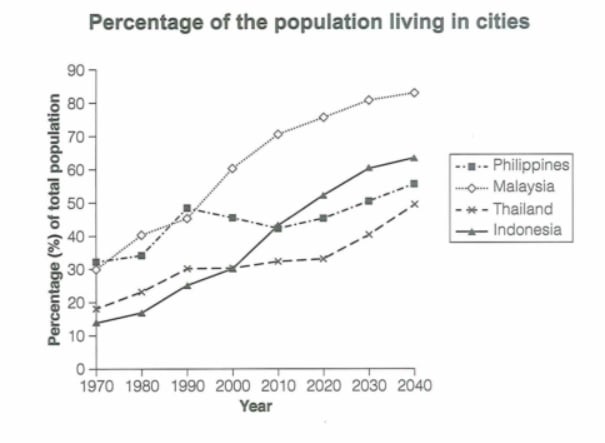
The graph below gives information about the percentage of the population in four Asian countries living in cities from 1970 to 2020, with predictions for 2030 and 2040. Summarize the information by selecting and reporting the main features and make comparisons where relevant.
Student answer (Band 5.5)
The graph below illustrates the population existing in cities in four different Asian countries by percentage from 1970 to 2020 alongside giving an estimated prediction for 2030 and 2040.
Overall, the country that had a very steady increase in population of cities from the very beginning and the highest is Malaysia .On the other hand, the country that has the lowest population in cities over the years is Thailand.
In 1970, Malaysia and Philippines had the almost same number of percentage of population which was around 30% but over the years Malaysia's population grew moderately .Philippines percentage fluctuated over the periods but it is predicted that it will rise steadily from 2020 . Malaysia is expected to be the country with the highest population in cities about 80% by the year 2040 .
Besides Malaysia , Indonesia's population increased consistently as time went by despite having a low percentage which was around 10% in the past. Thailand started with around 20% population in cities and it did not increase much over the decades and is expected to be having the least populated city among rest .
AI examiner evaluation
| Criterion | Band |
|---|---|
| Task Achievement / Task Response | 5.5 |
| Coherence and Cohesion | 6.0 |
| Lexical Resource | 5.5 |
| Grammatical Range and Accuracy | 5.5 |
| Overall | 5.5 |
Task Achievement / Task Response: Band 5.5
You identify the broad upward trend in Malaysia and note that the Philippines fluctuates, which are relevant features. However, the overview misidentifies Thailand as having the lowest urban share throughout: Indonesia starts lower, then overtakes Thailand around 2000 and rises to second place by 2040. The response also says Malaysia increased “moderately” without highlighting its substantial rise, and gives little detail about the countries’ relative positions or key changes. Some figures are broadly accurate, such as the two countries being near 30% in 1970 and Malaysia reaching about 80% by 2040, but the account remains selective and under-developed. To strengthen it, report the main ranking changes and compare the contrasting growth patterns more precisely.
Coherence and Cohesion: Band 6.0
The response has a recognisable structure: an introduction, an overview, and two paragraphs describing trends. This gives the reader a basic route through the information, and phrases such as “On the other hand” and “Besides Malaysia” attempt to connect points. However, the progression is not always clear: the second body paragraph groups Indonesia and Thailand despite their increasingly different trajectories, and the final comparison repeats the claim that Thailand remains lowest. Some links feel mechanical, while punctuation and spacing around full stops and commas interrupt the flow. Organise the body around meaningful comparisons—for example, Malaysia’s high rise, Indonesia’s rapid growth, and the Philippines’ fluctuation—and use clear references to distinguish each country.
Lexical Resource: Band 5.5
You use some relevant task vocabulary, including “fluctuated,” “increased consistently,” “estimated prediction,” and “rise steadily,” so the main trends can generally be understood. However, several expressions are imprecise or unnatural for describing a proportion, such as “population existing in cities,” “number of percentage,” and “least populated city.” Repetition of “population” and “over the years” also limits the range, and “moderately” does not accurately convey Malaysia’s strong increase. Aim for precise terms such as “urban population share,” “proportion,” and “urbanisation,” while choosing verbs that match the data. More accurate collocations would make the description clearer and more appropriately academic.
Grammatical Range and Accuracy: Band 5.5
You attempt a mix of simple and complex sentences, including a contrast with “On the other hand” and a time clause in “despite having a low percentage.” The overall meaning is usually recoverable, but some errors recur in sentence construction, agreement, articles, and punctuation. For example, “Malaysia and Philippines had the almost same number of percentage” has problems with the article, country name, and noun phrase; “it is predicted that it will rise” has an unclear reference; and “is expected to be having” uses an unsuitable verb form. There are also run-on or poorly punctuated sentences, such as the sentence beginning “In 1970.” Practise accurate comparative and prediction structures, and check sentence boundaries and agreement.
See this exact question answered at other band scores. The same prompt compared across bands.
Browse more IELTS Writing model answers or get your own writing scored by the same AI examiner.