Band 5.0 IELTS Writing Task 1 Model Answer
Overall Band Score: 5.0 · Cambridge IELTS 18 · 2026-11-23
IELTS Writing Task 1 question
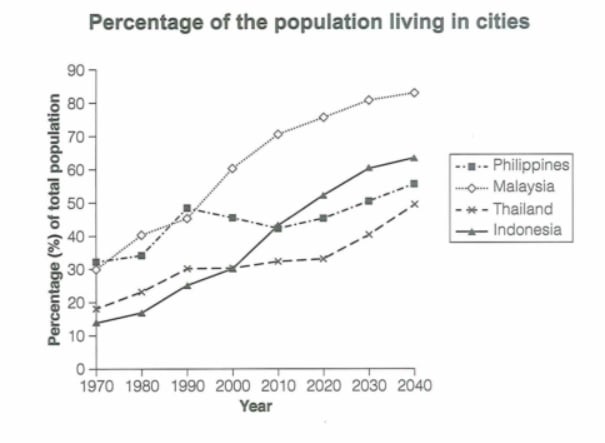
The graph below gives information about the percentage of the population in four Asian countries living in cities from 1970 to 2020, with predictions for 2030 and 2040. Summarize the information by selecting and reporting the main features and make comparisons where relevant.
Student answer (Band 5.0)
The graph lines show the four asian countries living population in cities , Philippines,Malaysia, Thailand and Indonesia 1970 to 2040. Overall i think malaysia was most popular in population and indonesia gone very high population after 2000.
On the first hand, Indonesia wase start in 1970 with 10% of population and in 2000 the population was gone very high stage and in 2040 the Indonesia population gone around 60%. Thailand started population is 18% in 1970 and in 2020 the population was gone the incress and in 2040 its gone around 45%.
On the second hand, Malaysia in 1970 the populatiuon was approxametly30 and in in 1990 the population was started very incress and in 2040 population was around 85% or it will be very big changing the population. Philippines in 1970 the range of population was 31% and its go to incress in 1980 around 45% but after 1990 its gone decline and in 2040 its come around 49%.
AI examiner evaluation
| Criterion | Band |
|---|---|
| Task Achievement / Task Response | 5.0 |
| Coherence and Cohesion | 5.0 |
| Lexical Resource | 4.5 |
| Grammatical Range and Accuracy | 4.5 |
| Overall | 5.0 |
Task Achievement / Task Response: Band 5.0
You identify the four countries and make an attempt to summarise overall patterns, noting Malaysia’s high level and Indonesia’s strong rise after 2000. However, the overview is unclear and does not accurately capture the main comparisons: Malaysia finishes highest, while Indonesia rises sharply and overtakes the Philippines by 2010. Several figures or trends are misreported. For example, Indonesia is about 14% in 1970, not 10%, and about 64% in 2040, rather than 60%; the Philippines rises to about 48% in 1990, not 45% in 1980, and ends near 56%, not 49%. The response therefore selects some relevant features but reports them incompletely and inaccurately. Focus on the clearest overall trends and support them with reliable comparisons.
Coherence and Cohesion: Band 5.0
The response has a basic paragraph structure: an introduction and overview are followed by two body paragraphs, with the countries grouped in a generally understandable way. The sequence from earlier to later years is also attempted. However, progression is not consistently clear, and linking phrases such as “On the first hand” and “On the second hand” do not express the relationships between the data naturally. Repeated use of “population” and “in 2040” makes the account feel list-like, while unclear references such as “its” sometimes make it difficult to tell which country or trend is meant. Organise the body around meaningful comparisons—for example, the steepest rises versus the more moderate trends—and use concise references to avoid repetition.
Lexical Resource: Band 4.5
Your vocabulary is sufficient to identify the topic and describe basic movement, using terms such as “started,” “decline,” and “around.” However, the range is limited and several repeated or inaccurate expressions make the report less precise. Phrases such as “gone very high stage,” “very incress,” and “very big changing” are not natural ways to describe a line graph; “rose sharply,” “increased,” and “substantial change” would be clearer. There are also spelling errors, including “asian,” “wase,” “populatiuon,” and “approxametly.” Try to use a small set of accurate trend verbs and comparison phrases, such as “remained stable,” “overtook,” and “reached a peak,” rather than repeating “gone” and “population.”
Grammatical Range and Accuracy: Band 4.5
You communicate the general subject, but sentence structures are mostly simple and frequently contain errors in verb forms, agreement, articles, and sentence construction. For example, “Indonesia wase start in 1970” and “the population was gone very high stage” do not form accurate clauses, while “Philippines in 1970 the range of population was 31%” lacks a clear grammatical structure. Some longer attempts, such as the sentence beginning “Malaysia in 1970,” become difficult to follow because clauses are joined without clear control. Punctuation and spacing are also inconsistent, including spaces before commas and missing spaces after them. Practise building clear subject–verb sentences in the past tense, then add comparisons with controlled clauses: “Indonesia rose from about 14% in 1970 to 52% in 2020.”
See this exact question answered at other band scores. The same prompt compared across bands.
Browse more IELTS Writing model answers or get your own writing scored by the same AI examiner.