Band 5.0 IELTS Writing Task 1 Model Answer
Overall Band Score: 5.0 · Cambridge IELTS 18 · 2026-11-23
IELTS Writing Task 1 question
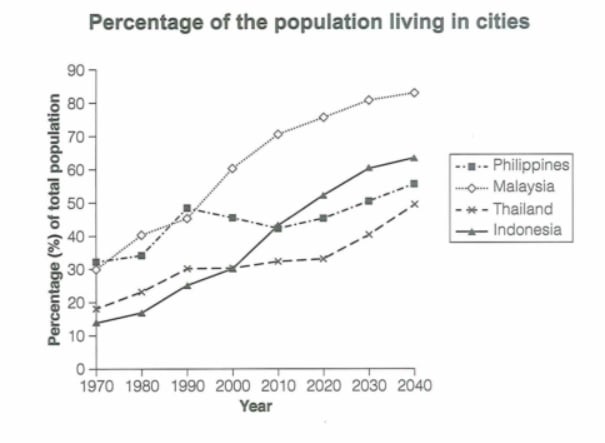
The graph below gives information about the percentage of the population in four Asian countries living in cities from 1970 to 2020, with predictions for 2030 and 2040. Summarize the information by selecting and reporting the main features and make comparisons where relevant.
Student answer (Band 5.0)
The line graph illustrates the percentage of the population in four asian countries living in cities from 1970 to 2020 with predictions for 2030 and 2040.
Overall, it is clear that malaysian population has increased more than other three cities. Secondly, indonecia shows rapid growth but philippines and thailand show normal increase with ups and downs.
Regarding, in 1970 the population of thailand and indonesia at between 20% and 10% while the malaysian population was at 30% and the philippines population just high from 30%. According to the chart, the indonesian population at below 20% and thailand just high than 20% and philipines and malaysia at approximate to the 40% in 1980. Followed by, the philipines, thailand and indonesia population percentage at below 50% till 2020 and the malaysia at high than 70%. Lastly, the population of malaysia will reach at 80% till 2040 and philipines, thailand and indonesia will below to the 60%.
AI examiner evaluation
| Criterion | Band |
|---|---|
| Task Achievement / Task Response | 5.0 |
| Coherence and Cohesion | 5.0 |
| Lexical Resource | 5.0 |
| Grammatical Range and Accuracy | 5.0 |
| Overall | 5.0 |
Task Achievement / Task Response: Band 5.0
You identify the overall upward trend and note that Malaysia rises strongly while Indonesia also grows, which gives the response a relevant overview. However, the overview is imprecise: Malaysia does not increase more than every other country across the whole period, and the Philippines fluctuates rather than simply showing a “normal increase.” Several comparisons are vague or inaccurate. For example, by 2020 Indonesia is above 50%, not below 50%, and by 2040 Indonesia is above 60%, contrary to the claim that it will remain below that level. The response also contains only 132 words, below the required 150, so key trends and comparisons are underdeveloped. Include clearer start-and-end figures and describe the countries’ different trajectories.
Coherence and Cohesion: Band 5.0
The response has a basic structure, with an introduction, an overview and a paragraph of details, and it attempts to guide the reader using phrases such as “Overall,” “Regarding” and “Lastly.” However, progression within the detail paragraph is difficult to follow: it moves from 1970 to 1980, then groups several countries together through 2020 without explaining the intervening changes. Some linking phrases are awkward or do not clearly show the relationship between ideas, such as “Followed by,” and the repeated use of “population” makes the account feel list-like. Organise the details into clearer comparisons—for example, Malaysia and Indonesia in one group, and the Philippines and Thailand in another—and use time markers to show how each trend develops.
Lexical Resource: Band 5.0
You use some relevant task vocabulary, including “percentage,” “predictions,” “rapid growth” and “increase,” so the topic is generally understandable. However, the range is limited and several choices are imprecise or unnatural, such as “normal increase,” “just high from 30%,” and “at high than 70%.” Country names are also repeatedly misspelled (“indonecia,” “philipines”), which reduces accuracy. Use standard trend language and precise comparisons, such as “rose steadily,” “peaked at,” “fell slightly,” or “stood at approximately.” Also distinguish the population share from the population itself: the graph reports the percentage of people living in cities, not the size of each country’s population.
Grammatical Range and Accuracy: Band 5.0
The response uses a few simple sentence patterns and attempts longer sentences with time clauses, but the longer constructions are often faulty, and frequent errors sometimes make the meaning difficult to follow. For example, “the population of thailand and indonesia at between 20% and 10%” is missing a main verb, while “the indonesian population at below 20%” has the same problem. There are also errors in articles, agreement and prepositions, as in “the malaysia at high than 70%” and “will below to the 60%.” Capitalisation and punctuation are inconsistent. Practise complete subject–verb sentences, such as “Indonesia’s figure was below 20% in 1970,” and use accurate future forms for the projections.
See this exact question answered at other band scores. The same prompt compared across bands.
Browse more IELTS Writing model answers or get your own writing scored by the same AI examiner.