Band 6.0 IELTS Writing Task 1 Model Answer
Overall Band Score: 6.0 · Cambridge IELTS 18 · 2026-11-23
IELTS Writing Task 1 question
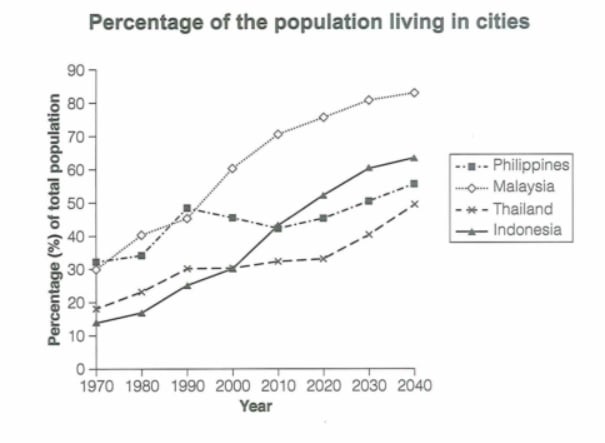
The graph below gives information about the percentage of the population in four Asian countries living in cities from 1970 to 2020, with predictions for 2030 and 2040. Summarize the information by selecting and reporting the main features and make comparisons where relevant.
Student answer (Band 6.0)
The graph shows information amoung four Asian countries about the percentage of population living in cities between 1970 and 2020 and prediction for 2030 and 2040. Amoung all the countries percentage of people living in cities increased till now as compared to 1970.
Malaysia and Phillippines almost start with same percentage in 1970 but in 1980 Malaysia surpassed Phillipines by approx 10% while vice-versa in 1990 but by only 2%. After 1990, in Philliphines percentage of people living in cities in drops a lot till 2010 by almost 10% and then steadily increasing.
In 1970, Indonesia was last amoung all four countries which becomes 2nd by 2020. Percentage in Malaysia and Indonesia never degraded at anypoint of time but there was a degradation in rest of two countries after 1990. Currently Malaysia is on top amount four and will be on top as per perdications which says that almost 80% of people in this country will live in cities.
Overall, in Malaysia and Indonesia ubranization happend at very high pace as compared to Thailand and Phillippines.
AI examiner evaluation
| Criterion | Band |
|---|---|
| Task Achievement / Task Response | 6.0 |
| Coherence and Cohesion | 6.0 |
| Lexical Resource | 5.5 |
| Grammatical Range and Accuracy | 5.5 |
| Overall | 6.0 |
Task Achievement / Task Response: Band 6.0
You identify the overall rise in urban populations and make relevant comparisons, including Malaysia’s leading position and Indonesia’s climb from the lowest share to second place by 2020. The account of the Philippines also captures its rise to 1990, subsequent decline, and later recovery. However, some details are inaccurate or imprecise: the Philippines’ fall from 1990 to 2010 is about six percentage points, not almost ten, and Malaysia and the Philippines are nearly level in 1990 rather than the Philippines being ahead by two points. The overview could also report the contrasting scale of growth more clearly: Malaysia and Indonesia are projected to reach about 84% and 64% by 2040, while Thailand and the Philippines remain lower. Some features are therefore covered more fully than others.
Coherence and Cohesion: Band 6.0
The response has a clear overall arrangement: an introduction, paragraphs comparing country trends, and a concluding overview. This makes the main comparisons reasonably easy to follow, and time markers such as “in 1970,” “in 1980,” and “after 1990” help establish sequence. However, the progression is not always smooth. The opening overview is broad, while the final paragraph repeats the general point about faster urbanisation without adding much detail. Some links are awkward or unclear, particularly “while vice-versa in 1990,” which makes the comparison harder to interpret. Grouping the countries by their trends and using clearer transitions between the historical data and forecasts would make cohesion more controlled and the overview more effective.
Lexical Resource: Band 5.5
You use relevant vocabulary for describing trends and comparisons, including “surpassed,” “degradation,” “steadily increasing,” and “urbanization.” These choices show an attempt to use language beyond basic descriptions. However, several spelling and word-choice errors reduce precision, such as “amoung,” “Philliphines,” “perdications,” and “urb(an)ization happend.” Some expressions are also unnatural or vague: “percentage of population” needs a more natural form, and “in drops a lot” does not describe a trend accurately. Repeated use of “percentage” and “people living in cities” limits flexibility. Aim for accurate trend language and collocations, such as “the urban population share fell” or “the proportion living in cities rose.”
Grammatical Range and Accuracy: Band 5.5
There is some variety in sentence structure, including comparisons and time clauses, as in “After 1990 … and then steadily increasing” and “which becomes 2nd by 2020.” The main message is generally understandable, but some grammatical errors recur. For example, “percentage of population” is missing a determiner, “in Philliphines percentage … in drops” has an incomplete and faulty clause, and “which becomes 2nd” uses an unsuitable tense for a past change. The sentence beginning “Malaysia and Indonesia never degraded” also needs clearer grammatical framing. Use consistent past tense for the historical period and future forms for predictions, and check articles, verb forms, and sentence completeness. More accurate complex sentences would improve control.
See this exact question answered at other band scores. The same prompt compared across bands.
Browse more IELTS Writing model answers or get your own writing scored by the same AI examiner.