Band 5.5 IELTS Writing Task 1 Model Answer
Overall Band Score: 5.5 · Cambridge IELTS 18 · 2026-11-24
IELTS Writing Task 1 question
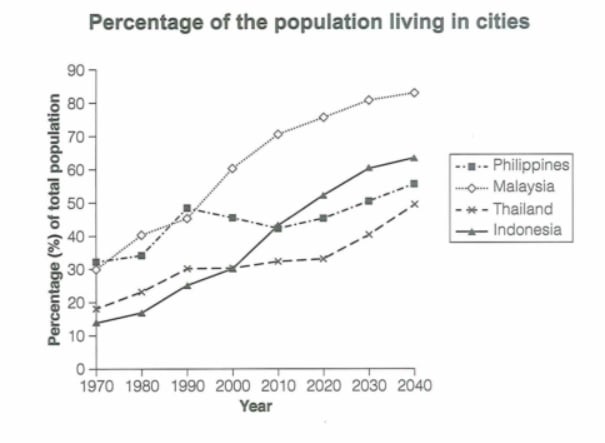
The graph below gives information about the percentage of the population in four Asian countries living in cities from 1970 to 2020, with predictions for 2030 and 2040. Summarize the information by selecting and reporting the main features and make comparisons where relevant.
Student answer (Band 5.5)
The line graph illustrates the percentage of population in four asian countries, the Philippines, Malaysia, Thailand, and Indonesia, between 1970 to 2020, with predictions for 2030 and 2040
overall, the population in the cities increased in all four countries, Malaysia is expected to to have the highest percetage by 2040 while Thailand predict to be the lowest.
In 1970, 30 percent of the population live in cities in Philipines and Malaysia.Malaysia's percentage increase steadily 80 percent in 2020 and prediciting it will reach around 84 percent in 2040.The Phillipines almost 50 percent 1990 and gradually decrease to 44 percent in 2010 and it expected to rise again around 55 percent in 2040
Indonesia also showed a big increase 14 percent in 1970 50 percent in 1970 and 52 percent in 2020 , this expected to in increase 65 percent by 2040.Thailands percentage also increased from 18 percent to 1970, 33 percent in 2020 and predicts to reach around 45 perrcent in 2040
AI examiner evaluation
| Criterion | Band |
|---|---|
| Task Achievement / Task Response | 5.5 |
| Coherence and Cohesion | 5.0 |
| Lexical Resource | 5.5 |
| Grammatical Range and Accuracy | 5.0 |
| Overall | 5.5 |
Task Achievement / Task Response: Band 5.5
You identify the overall upward trend and make useful comparisons, noting that Malaysia is projected to have the highest urban share by 2040 and that the Philippines rises after a decline. However, some key details are inaccurate or unclear: in 1970, the Philippines was about 32%, not 30%, and Indonesia rose from 14% to about 52% by 2020—the phrase “50 percent in 1970” misstates this trend. Thailand is not the lowest in 2040; the Philippines is slightly lower, at about 56% compared with Thailand’s 50%, so Thailand is lowest, as your overview says, but the figures should support that comparison. The overview is relevant, but coverage of the main changes and comparisons is limited and several figures need clearer reporting.
Coherence and Cohesion: Band 5.0
The response has a recognisable structure: an introduction, an overview, and two paragraphs describing the countries. This gives the reader a basic route through the information. However, progression within the detail paragraphs is uneven, and the country comparisons are mostly presented as separate statements rather than being linked. For example, the Indonesia sentence repeats “1970” and moves abruptly from 14% to 50% before giving the 2020 figure. Some linking and punctuation are also missing, as in “Malaysia.Malaysia’s” and the transition between the Philippines and Indonesia. Grouping countries by contrasting trends and using clearer links such as “by contrast” or “meanwhile” would make the organisation easier to follow.
Lexical Resource: Band 5.5
You use enough topic vocabulary to communicate the main subject, including “percentage,” “increased,” “decrease,” and “predictions.” There are also attempts at more descriptive wording, such as “increase steadily” and “big increase.” However, the range is limited and some choices or forms are inaccurate, which makes parts of the account less precise: “population in the cities” is awkward, and “predicting it will reach” does not fit naturally in the sentence. Spelling errors such as “percetage,” “Philipines,” “Phillipines,” and “perrcent” are noticeable. Use accurate country names and more precise trend language, for example “urban population share,” “rose sharply,” and “is projected to reach.”
Grammatical Range and Accuracy: Band 5.0
The response communicates its main points, but grammatical control is inconsistent and sentence structures are mostly simple. Errors occur in verb forms and sentence construction: “the population in cities increased” needs a clearer subject, “the Philippines almost 50 percent 1990” lacks a verb and preposition, and “this expected to in increase” is not grammatically complete. There are also tense and agreement problems in “Thailand predict to be the lowest” and “the population live in cities.” Punctuation and sentence boundaries need attention, particularly the missing full stop before “overall” and the run-together “Malaysia.Malaysia’s.” Practise complete sentences with accurate past-tense descriptions and “is expected/projected to” for forecasts, while varying sentence patterns.
See this exact question answered at other band scores. The same prompt compared across bands.
Browse more IELTS Writing model answers or get your own writing scored by the same AI examiner.