Band 5.0 IELTS Writing Task 1 Model Answer
Overall Band Score: 5.0 · Cambridge IELTS 18 · 2026-11-24
IELTS Writing Task 1 question
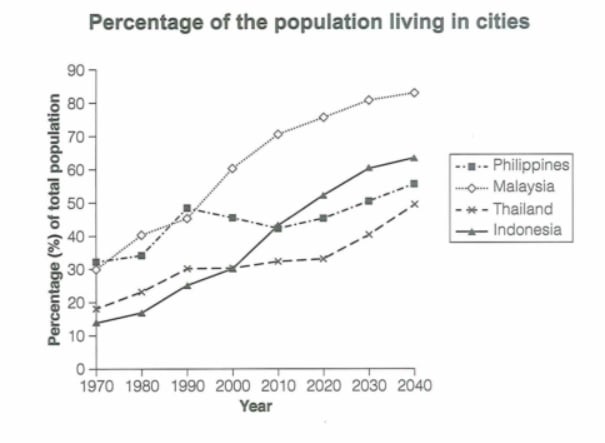
The graph below gives information about the percentage of the population in four Asian countries living in cities from 1970 to 2020, with predictions for 2030 and 2040. Summarize the information by selecting and reporting the main features and make comparisons where relevant.
Student answer (Band 5.0)
The line graph illustrate key information about percentage of the population living in cities in four asian countries between 1970 and 2040 .
Overall, the most noticeable features is that all the four countries increased over the years , and it's is clear that malaysia toke over the hightest percentage while thailand recorded the lowest one .
Malayzsia shared a proportion with 30% in 1970 and increased slightly to 40% and then 45% , in1990, it rose dramaticly until it reached the peak with 85% . Compared to the philipines they both shared he same proporition in 1970 and it remained constant until 1980 and then it rose to the half and again decreased to 42%, after that it shared a point with indonesia with 45% in 2010 ,following this year it rose again and it predicted that it will remain increasing until 2040.
In other hand indonesia since 1970 to 2020 rose gradually .
AI examiner evaluation
| Criterion | Band |
|---|---|
| Task Achievement / Task Response | 5.0 |
| Coherence and Cohesion | 4.5 |
| Lexical Resource | 5.0 |
| Grammatical Range and Accuracy | 5.0 |
| Overall | 5.0 |
Task Achievement / Task Response: Band 5.0
You identify the overall upward movement and note that Malaysia becomes the highest, which are relevant main features. However, the overview is incomplete and partly inaccurate: Thailand is not the lowest throughout, since the Philippines is higher at the start, and Malaysia’s peak is about 84% in 2040, not 85% in 2000. Several important trends are omitted, especially Thailand’s gradual rise and Indonesia’s strong growth to become the second-highest by 2040. Some comparisons are attempted, but the account of the Philippines is difficult to follow and includes an incorrect claim that its share remained constant to 1980. Select the clearest trends and support them with accurate, well-chosen figures.
Coherence and Cohesion: Band 4.5
The response has an opening, an overview and a body paragraph, and it attempts to compare countries using phrases such as “Compared to the Philippines” and “after that.” However, the information does not progress clearly: the second paragraph moves between Malaysia, the Philippines and Indonesia, while Thailand is not described at all. Some linking expressions are inaccurate or awkward, including “In other hand,” and references such as “following this year” are unclear. The long sentence beginning “Compared to the Philippines” combines several trends without clear boundaries, making the comparisons hard to follow. Organise the body by grouping related trends and use shorter, clearly linked sentences with precise references.
Lexical Resource: Band 5.0
You use some task-relevant vocabulary, including “percentage,” “increased,” “decreased” and “peak,” and you attempt to describe change over time. However, the range is limited and several spelling and word-choice errors make the account less clear, such as “toke,” “hightest,” “dramaticly,” “proporition” and “philipines.” Some expressions are also unnatural for graph description: “shared a proportion,” “shared a point” and “rose to the half.” Use standard collocations such as “stood at,” “reached,” “fell to” and “the same proportion.” More precise vocabulary for gradual and sharp changes would help you distinguish the countries’ trends and make comparisons clearer.
Grammatical Range and Accuracy: Band 5.0
You attempt to combine ideas in longer sentences, but control is inconsistent, and errors sometimes make relationships between figures difficult to understand. For example, “The line graph illustrate” has subject–verb disagreement, while “the most noticeable features is” also has an agreement error. The phrase “it's is clear” contains an unnecessary verb, and “it predicted that it will remain increasing” has faulty structure and tense. Sentence boundaries and punctuation are also unreliable, particularly in the long comparison sentence, where several clauses run together. Practise accurate simple past forms for historical data and clear future forms for predictions, then build longer sentences with controlled clauses and correct agreement.
See this exact question answered at other band scores. The same prompt compared across bands.
Browse more IELTS Writing model answers or get your own writing scored by the same AI examiner.