Band 5.0 IELTS Writing Task 1 Model Answer
Overall Band Score: 5.0 · Cambridge IELTS 18 · 2026-11-25
IELTS Writing Task 1 question
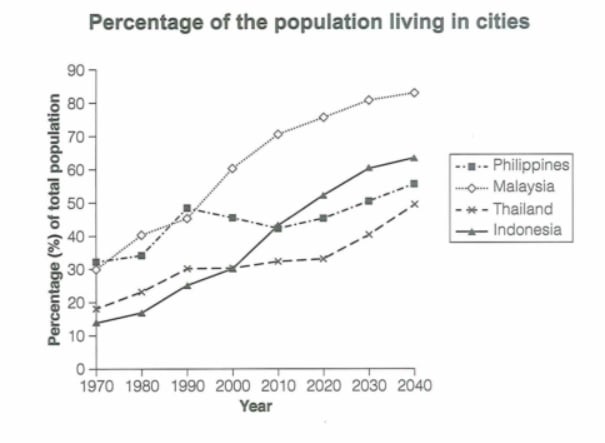
The graph below gives information about the percentage of the population in four Asian countries living in cities from 1970 to 2020, with predictions for 2030 and 2040. Summarize the information by selecting and reporting the main features and make comparisons where relevant.
Student answer (Band 5.0)
the graph shows the up and down percentage of population in four different asian countries living in cities from 1970 to 2020 with predictions for 2030 and 2040.
overall, malasia is top of table with the highest percentage, while philippines and indonesia stays in middle of graph, thailand touches most lowest percentage of graph.
So, Indonesia moves from 11 percent to 25 in 2000 but after population grows and touches 60 percent in 2040. Thailand also grow steadly stay constant from 2010 to 2020 at 30 then move forward and reach at almost 50 percent.
Then, Philippines starts from 31 and moves slightly high in 1990 after that amlost stay up and down at the end it reach at 50. Malasia moves very high and top of table
AI examiner evaluation
| Criterion | Band |
|---|---|
| Task Achievement / Task Response | 5.0 |
| Coherence and Cohesion | 4.5 |
| Lexical Resource | 5.0 |
| Grammatical Range and Accuracy | 5.0 |
| Overall | 5.0 |
Task Achievement / Task Response: Band 5.0
You identify the topic and make a basic overall comparison, noting Malaysia’s leading position and Thailand’s low starting point. You also report several country trends, such as Indonesia’s rise and the Philippines’ fluctuations. However, the overview is incomplete: Malaysia’s strong, sustained growth and Indonesia’s eventual position above the Philippines are not clearly summarised. Some figures and descriptions are inaccurate or vague: Indonesia is about 30% in 2000, not 25%, and Thailand is around 33% in 2020, not 30%. Malaysia’s trend is left unfinished. The response is 113 words, below the required 150, which limits the detail and coverage. Select the main comparisons and support them with accurate figures across the period.
Coherence and Cohesion: Band 4.5
There is a basic paragraph structure, with an opening, an overview and a final paragraph describing country trends. The sequence from Indonesia and Thailand to the Philippines and Malaysia is understandable, and words such as “overall,” “after that” and “Then” attempt to guide the reader. However, the progression is not consistently clear: the final paragraph ends abruptly after saying Malaysia “moves very high,” without completing the comparison. “So” does not clearly connect the overview to the details, and the country-by-country reporting feels like a list rather than a planned comparison. Use separate, balanced detail paragraphs and link countries with shared trends—for example, contrasting Malaysia’s high figures with Thailand’s lower ones.
Lexical Resource: Band 5.0
You use some relevant vocabulary for describing a line graph, including “percentage,” “predictions,” “starts,” “reach” and “stay constant.” This gives the reader a basic understanding of the trends. However, the range is limited and several expressions are imprecise or unnatural, such as “top of table,” “touches most lowest percentage,” “moves very high” and “moves slightly high.” Repetition of “move” and “reach” also makes the account less precise. Spelling errors, including “malasia,” “steadly” and “amlost,” further reduce accuracy. Build a small set of accurate trend verbs and comparison phrases, and use them in natural collocations to describe rises, falls, plateaus and relative positions.
Grammatical Range and Accuracy: Band 5.0
The response communicates its basic meaning through mostly simple clauses, and there are attempts to connect events in time, as in “after that” and “from 2010 to 2020.” However, the range of sentence structures is limited, and errors occur frequently. For example, “Philippines and Indonesia stays” has a subject–verb agreement error, while “Thailand also grow” and “it reach” use incorrect verb forms. The sentence beginning “So, Indonesia moves…” also shifts awkwardly between present and past forms, and “Thailand … stay constant … then move” lacks consistent agreement. Use the present simple consistently for graph descriptions, check singular and plural subjects, and practise combining accurate clauses with “while” and “whereas.”
See this exact question answered at other band scores. The same prompt compared across bands.
Browse more IELTS Writing model answers or get your own writing scored by the same AI examiner.