Band 4.5 IELTS Writing Task 1 Model Answer
Overall Band Score: 4.5 · Cambridge IELTS 18 · 2026-11-25
IELTS Writing Task 1 question
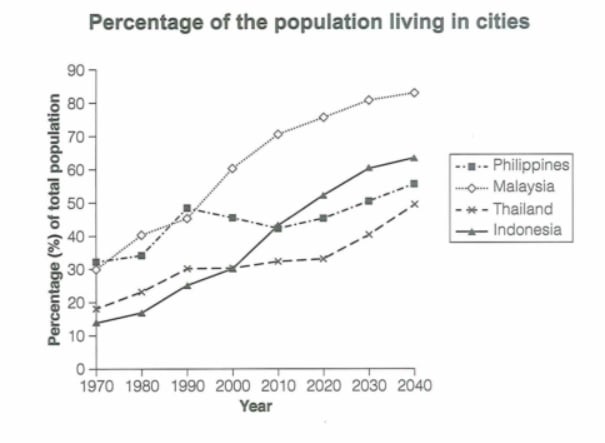
The graph below gives information about the percentage of the population in four Asian countries living in cities from 1970 to 2020, with predictions for 2030 and 2040. Summarize the information by selecting and reporting the main features and make comparisons where relevant.
Student answer (Band 4.5)
The line graph defines the details of the ratio of the members in four asian countries in cities from 1970 to 2020,which predictions for 2030 and 2040.
In Overview,we have a percentage of the population from 0 to 90 and years starting from 1970 to 2040.The maximum number is 0 and highest number is 90 .
The graph explain that the line of indonesia and thialand is starting from the percentage between 10 to 20 and they meet with each other in 2000 after that they rise up and these two have high touch between 40 to 60 in 2040.
After that the Malaysia and Phillippines start from 30 percentage they interconnect at 1990 year and these go to upper direction from 1990 to 2040 and they touch the percentage of upper 80 of malaysia and phillippines tocch the percenatge between 50 to 60 .So,all lines touch the year of 2040 .
AI examiner evaluation
| Criterion | Band |
|---|---|
| Task Achievement / Task Response | 4.0 |
| Coherence and Cohesion | 5.0 |
| Lexical Resource | 4.5 |
| Grammatical Range and Accuracy | 5.0 |
| Overall | 4.5 |
Task Achievement / Task Response: Band 4.0
The response identifies the four countries and the period, and it attempts to describe broad movements, such as Indonesia and Thailand rising and Malaysia reaching a higher level. However, the main features are not accurately or clearly selected. The overview that “the maximum number is 0” and the “highest number is 90” confuses the graph’s scale with its data. Several comparisons are also misleading: Malaysia and the Philippines do not both start at 30%, and they do not simply continue upward after 1990; the Philippines falls from about 48% to 42.5% before rising again. The account omits the key contrast that Malaysia is highest by 2040 while Thailand remains lowest. To improve, give a concise, accurate overview and support it with a few reliable comparisons.
Coherence and Cohesion: Band 5.0
There is some basic organisation: the response begins with an introduction, then uses an overview label and follows with descriptions of two pairs of countries. This gives the reader a rough sense of the intended structure. However, progression is difficult to follow because the overview reports scale markings rather than the main trends, and the later comparisons are not consistently organised around clear changes or rankings. Linking phrases such as “After that” and “So” are used, but they do not always show a precise relationship between ideas. The final sentence, “all lines touch the year of 2040,” adds little and is unclear. Use separate, purposeful paragraphs for the overview and key details, and connect comparisons with clear time references.
Lexical Resource: Band 4.5
The vocabulary is basic and repetitive, with frequent imprecise choices that make some descriptions hard to interpret. For example, “ratio of the members” is not an appropriate way to describe the share of a population living in cities, while “high touch” and “interconnect” do not clearly express the trends shown. “Upper direction” is also vague where a simple verb such as “rise” would be more accurate. There are spelling errors in “asian,” “thialand,” “Phillippines,” “tocch,” and “percenatge,” which further reduce clarity. The response does use some relevant terms, including “percentage,” “starting,” and “rise,” but needs more accurate chart language. Practise phrases such as “the proportion of the population,” “increased steadily,” and “reached approximately”.
Grammatical Range and Accuracy: Band 5.0
The response contains some simple and compound sentence attempts, but control is uneven, and errors sometimes make relationships between ideas unclear. The opening sentence has a faulty construction: “from 1970 to 2020,which predictions for 2030 and 2040.” The sentence beginning “In Overview” is also awkwardly formed, and the long final comparison joins several ideas without clear sentence boundaries. There are recurring issues with articles, capitalization, and punctuation, including missing spaces after commas and inconsistent capital letters in “Overview” and country names. Some basic clauses, such as “they rise up,” are understandable, but the range of accurate structures is limited. Build shorter sentences with a clear subject and verb, and check punctuation and sentence boundaries during revision.
See this exact question answered at other band scores. The same prompt compared across bands.
Browse more IELTS Writing model answers or get your own writing scored by the same AI examiner.