Band 6.0 IELTS Writing Task 1 Model Answer
Overall Band Score: 6.0 · Cambridge IELTS 18 · 2026-11-25
IELTS Writing Task 1 question
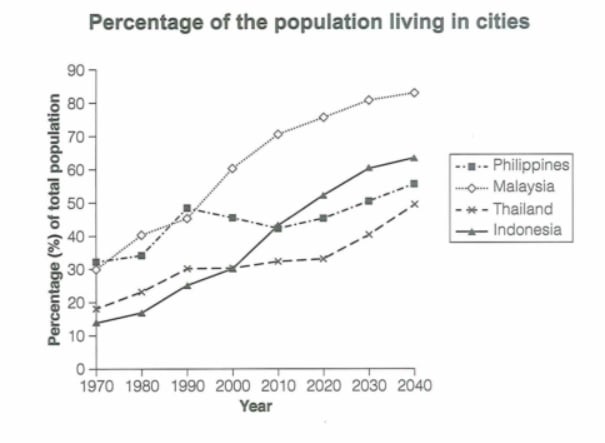
The graph below gives information about the percentage of the population in four Asian countries living in cities from 1970 to 2020, with predictions for 2030 and 2040. Summarize the information by selecting and reporting the main features and make comparisons where relevant.
Student answer (Band 6.0)
The line graph illustrates the the proportion of the population living in cities of four different Asia countries (Phillipines,Malaysia,Thailand,Indonesia) btween 1970 and 2020 with the prediction of 2030 and 2040.
Overall, the proportion of people living in cities icreases in all four countries over the years. The population of people living in cities of Malaysia has higher then other three countries whereas Thailand forecast of the people is less then other three countries.
From 1970 to 2020, the proportion of people living in city of Malaysia reached from 30 to 75 and will increase upto 85 % in 2040.Philipines the population was higher then Malaysia in 1970 and then slightly increased upto 50 in 1990 and then dipped to 40% in 210 and will go upto 55%in 2040
On the other hand, Indonesia intiated from 15% in 1970 and then went up 50% in 2020 leaving behind both thailand and Phillipines and will stood at 60% in 2040. Thailand the population of cities growed from nearly 20 in 1970 and then steadily climbed 30% in 1990 and marginaly increased over 31% in 2020 and then rise upto 45% in 2040.
AI examiner evaluation
| Criterion | Band |
|---|---|
| Task Achievement / Task Response | 6.0 |
| Coherence and Cohesion | 6.5 |
| Lexical Resource | 5.5 |
| Grammatical Range and Accuracy | 5.0 |
| Overall | 6.0 |
Task Achievement / Task Response: Band 6.0
You provide an overview and cover all four countries, identifying Malaysia as the highest overall and describing Indonesia’s strong rise. Several figures and trends are broadly accurate: Malaysia rises from about 30% to the mid-70s by 2020, while Indonesia reaches roughly 52%. However, the overview that Thailand is the lowest throughout is not accurate: the Philippines is higher than Malaysia in 1970, and Thailand is not the lowest in every year. The Philippines’ 1990 peak is also described as “50” rather than about 48%, and its 2010 value is mistyped as “210.” Thailand’s forecast is understated at 45% rather than about 50%. More precise comparisons and a clearer account of the Philippines’ fluctuations would make the report more complete.
Coherence and Cohesion: Band 6.5
The response has a clear overall structure: an introduction, a summary of the main trends, and two paragraphs grouping the countries. Linking phrases such as “Overall” and “On the other hand” help signal the organisation, and the reader can generally follow the movement from historical data to forecasts. This coherent arrangement is a strength. However, some connections are mechanical or unclear, particularly the long sentence about the Philippines, which combines its initial position, rise, fall and forecast without clear sentence boundaries. The comparison in the overview also needs more precise qualification. To strengthen progression, use separate sentences for major changes and connect them with clear time markers, while ensuring each comparison refers unambiguously to the relevant years.
Lexical Resource: Band 5.5
You use a reasonable range of trend vocabulary, including “slightly increased,” “dipped,” “steadily climbed” and “marginally increased,” which helps describe changes rather than simply list figures. Some choices, however, are inaccurate or unnatural for this task: “the population … reached from 30 to 75” should describe the proportion rising, and “Thailand forecast of the people” does not clearly express the projected urban share. Spelling errors such as “Phillipines,” “icreases,” “intiated” and “marginaly” are noticeable, while repeated use of “population” and “people living in cities” limits precision. Choose standard chart language and check spelling; this will make the descriptions clearer and more natural.
Grammatical Range and Accuracy: Band 5.0
You attempt both simple and more extended sentences, and the overall meaning is usually recoverable. However, grammatical control is uneven. The opening has a duplicated article in “the the proportion,” while “has higher then” and “will stood” show problems with comparative and verb forms. Several clauses are joined without adequate punctuation, especially the sentence beginning “Philipines the population…,” and the final paragraph contains incomplete or awkwardly connected constructions. There are also errors in articles and prepositions, as in “living in city” and “increase upto.” Work on forming complete clauses, maintaining consistent past and future forms, and punctuating long sentences. More accurate control of these patterns would make your range easier to follow.
See this exact question answered at other band scores. The same prompt compared across bands.
Browse more IELTS Writing model answers or get your own writing scored by the same AI examiner.