Band 5.5 IELTS Writing Task 1 Model Answer
Overall Band Score: 5.5 · Cambridge IELTS 18 · 2026-11-25
IELTS Writing Task 1 question
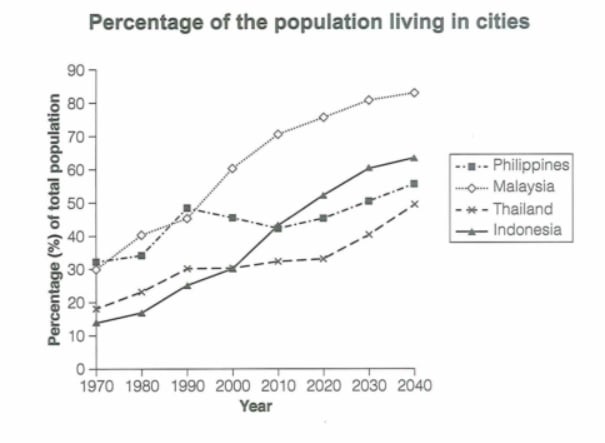
The graph below gives information about the percentage of the population in four Asian countries living in cities from 1970 to 2020, with predictions for 2030 and 2040. Summarize the information by selecting and reporting the main features and make comparisons where relevant.
Student answer (Band 5.5)
The graph illustrates the proportion of population living in urban areas of four Asian nations from 1970 to 2020, also the projections between 2030 and 2040. Overall, it can be seen that despite having fluctuations, the population ratio increased in the past and it is forcasted that it will keep increasing in the upcoming given period of time.
with regards to Malaysia, the percentage of population was at 30% in 1970. The population jupmed at 45% from 1970 to 1990. After that increased singnificantly and accounted for 75% by 2020. it is predicted that it will increase till 85% by the year of 2040. As for Indonesia, the population rate rose up from 14% to 25% till 2000 and reached at 50% in 2020 and will increase slightly by 10% in 2024.
in case of Philippines faced fluction.In Philippines, the percentage incresed dfrom 31% to peak at 49% in 1990, decreased at 40% in 2010 but rebounded at 45% by 2020 and in future the proportion will increase steadily at 50%. In terms of Thailand the ration started at 19% ,wept up to 29% in 1990 and increased by one percent till 2020 and will reach at 45 by the year of 2040.
AI examiner evaluation
| Criterion | Band |
|---|---|
| Task Achievement / Task Response | 5.5 |
| Coherence and Cohesion | 6.0 |
| Lexical Resource | 5.5 |
| Grammatical Range and Accuracy | 5.0 |
| Overall | 5.5 |
Task Achievement / Task Response: Band 5.5
You identify the overall upward direction and include all four countries, with relevant comparisons such as Malaysia’s rise and the Philippines’ fluctuation. However, the overview is broad and does not clearly highlight the key contrast: Malaysia becomes the most urbanised country, while Thailand remains comparatively low, and Indonesia rises strongly. Some details are inaccurate or unclear: Indonesia is said to rise from 14% to 25% “till 2000,” although it is about 30.5% in 2000, and the forecast is for 2024 rather than 2040. The Philippines’ peak is given as 49% rather than approximately 48%, and Thailand’s 2040 figure is understated. More accurate, selectively chosen figures and a clearer overview would make the report more complete and precise.
Coherence and Cohesion: Band 6.0
The response has a recognisable sequence: an introduction and overview are followed by country-by-country details. This makes the main subject easy to follow, and phrases such as “As for Indonesia” and “In terms of Thailand” help signal shifts. However, the country sections are crowded into one paragraph, and the transitions sometimes feel mechanical rather than showing relationships between trends. The overview is separated from the details, but it does not establish a clear comparison that the later paragraphs develop. Sentence boundaries and inconsistent capitalisation also interrupt the flow, for example “it is predicted” and “in case of Philippines faced fluction.” Grouping countries with similar or contrasting patterns and using clearer sentence divisions would strengthen progression.
Lexical Resource: Band 5.5
You use a reasonable range of task-related language, including “proportion,” “projections,” “peak,” “decreased,” “rebounded,” and “steadily.” These choices show an attempt to describe changes rather than simply list figures. However, spelling errors and imprecise or unnatural collocations are noticeable, including “forcasted,” “jupmed,” “singnificantly,” “population ratio,” and “rose up.” Some phrases are also unclear, such as “increased by one percent till 2020,” which does not accurately express Thailand’s gradual rise. Aim for accurate spelling and conventional chart language, such as “the proportion of the population,” “rose,” and “is projected to reach.” This would make the report more precise and easier to read.
Grammatical Range and Accuracy: Band 5.0
You attempt both simple and more complex forms, including a concession in “despite having fluctuations” and time clauses such as “After that.” However, control is uneven, and several sentence structures are incomplete or awkward. For example, “in case of Philippines faced fluction” lacks a clear grammatical subject and verb structure, while “After that increased significantly” has no stated subject. There are also problems with articles, tense and sentence boundaries, as in “the year of 2040” and the lower-case “it” after a full stop. These errors sometimes make relationships between ideas difficult to interpret. Build complete sentences with an explicit subject and verb, and check articles, punctuation and consistent past-versus-future forms.
See this exact question answered at other band scores. The same prompt compared across bands.
Browse more IELTS Writing model answers or get your own writing scored by the same AI examiner.