Band 6.0 IELTS Writing Task 1 Model Answer
Overall Band Score: 6.0 · Cambridge IELTS 18 · 2026-11-25
IELTS Writing Task 1 question
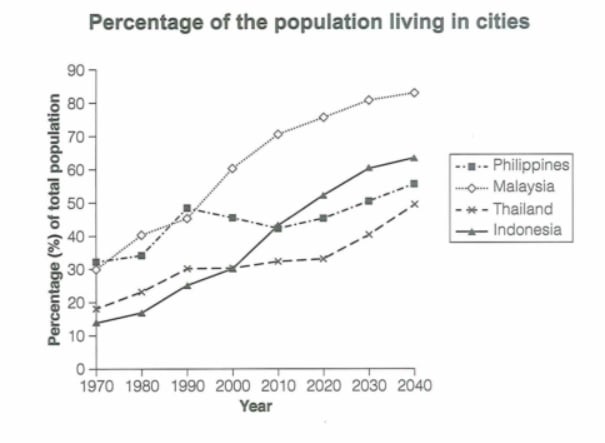
The graph below gives information about the percentage of the population in four Asian countries living in cities from 1970 to 2020, with predictions for 2030 and 2040. Summarize the information by selecting and reporting the main features and make comparisons where relevant.
Student answer (Band 6.0)
The line graph illustrates the ratios of total population living in four Asian cities from1970 to 2020 and an anticipation number for 2030 and 2040.
Overall, it can be seen that the number of people in Philippines, Malaysia, Thailand and Indonesia were increased during the given period, with prediction that these numbers will jump in upcoming years.
In Philippines, the number of populations started with around 31% in 1970, and it kept fluctuated during the period given until reached approximately 55% in 2040. the population in Malaysia were 30% in 1970, and it skyrocketed with 80% in the end of 2040. However, in Thailand, the percentage were around 19%, then increased and stay remained from 1990 till 2010 before it jumped to 45% in the end of the period. Finally, Indonesia scored the lowest number of populations in 1970 with around 15% and by the end of 2040 the population will reach 41% of total population.
AI examiner evaluation
| Criterion | Band |
|---|---|
| Task Achievement / Task Response | 5.5 |
| Coherence and Cohesion | 6.0 |
| Lexical Resource | 6.0 |
| Grammatical Range and Accuracy | 5.5 |
| Overall | 6.0 |
Task Achievement / Task Response: Band 5.5
You identify the four countries and give a broad overview that urbanisation generally rises, with Malaysia reaching the highest level. However, the overview is imprecise: the Philippines does not rise steadily, and Thailand’s increase is gradual for much of the period rather than a general “jump.” There is also a significant factual error in the final sentence: Indonesia is projected to reach about 64% in 2040, not 41%; 41% is closer to Thailand’s 2030 figure. The Philippines’ fluctuations are mentioned but not clearly described, and the account gives few useful comparisons between countries. To strengthen the response, report the main contrasting patterns and check that each endpoint matches the graph.
Coherence and Cohesion: Band 6.0
The response has a recognisable structure: an introduction, an overall statement, and a country-by-country account. Sequencing with “Overall,” “In Philippines,” “However,” and “Finally” helps readers follow the information. However, the progression is somewhat mechanical, and the country descriptions are not grouped to highlight comparisons—for example, Malaysia’s strong rise could be contrasted with the Philippines’ fluctuation. Some connections are also unclear: “then increased and stay remained” makes Thailand’s timeline difficult to follow. Use clearer time stages and link related trends, while keeping the overview distinct from the detailed comparisons.
Lexical Resource: Band 6.0
You use an adequate range of task-related vocabulary, including “fluctuated,” “increased,” “prediction,” and “percentage,” and the general meaning is usually clear. There are, however, several inaccurate or unnatural choices. “Ratios of total population” is not the natural way to describe the data, and “an anticipation number” is unclear. “Skyrocketed” is overly dramatic for a measured trend, while “number of populations” is not an appropriate collocation. Aim for precise, neutral language suited to describing a graph, such as “proportion of the population,” “was projected to,” and “rose sharply.” This would make the account more accurate and natural without requiring more elaborate vocabulary.
Grammatical Range and Accuracy: Band 5.5
You attempt both simple and more extended sentences, including clauses linked with “and,” “until,” and “before,” so there is some variety. Some grammatical errors remain, though the main message is generally understandable. Examples include “the number … were increased,” where the verb form and agreement are incorrect, and “the percentage were,” which should use a singular verb. In “it kept fluctuated,” the verb pattern is faulty; use “continued to fluctuate.” The sentence beginning “then increased and stay remained” also has inconsistent verb forms. Capitalisation after a full stop is inconsistent, as in “the population in Malaysia.” Practise accurate past-tense reporting and subject–verb agreement in otherwise varied sentences.
See this exact question answered at other band scores. The same prompt compared across bands.
Browse more IELTS Writing model answers or get your own writing scored by the same AI examiner.