Band 6.0 IELTS Writing Task 1 Model Answer
Overall Band Score: 6.0 · Cambridge IELTS 18 · 2026-11-25
IELTS Writing Task 1 question
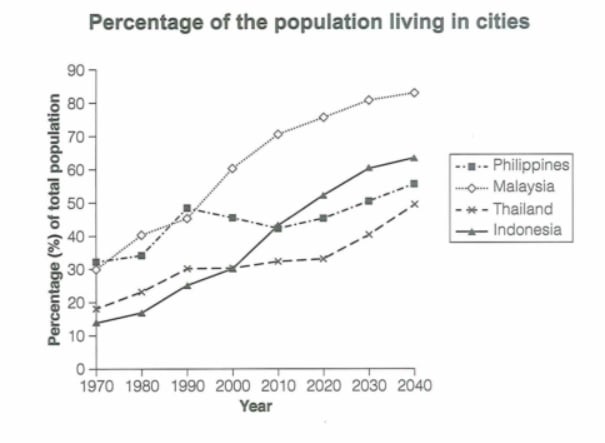
The graph below gives information about the percentage of the population in four Asian countries living in cities from 1970 to 2020, with predictions for 2030 and 2040. Summarize the information by selecting and reporting the main features and make comparisons where relevant.
Student answer (Band 6.0)
The graph demonstrates changes in population's percentages living in cities of four Asian countries during the period from 1970 to 2020, in addition to expected numbers in 2030 and 2040. Overall, Malaysian population grown significantly during the period followed by Indonesian population.Both Thailand and Philippines shared modest growth over the same period.
Indonesia had least percentage in 1970 with just over 12% living in cities . This percentage kept growing surpassing Thailand's percentage in 2000 then peaked in 2020 reaching approximaltely 50% becoming second populated cities. Thailand started in third place in 1960 with over 19% then increased steadily to reach just 30%in 2020. It is expected to keep modest increase and may reaxh 45% in 2040. Philipines had the most considerable fluctuations among other countries. It had over 31% in 1970 then jumped to almost 50%in 1990 followed by a decline in figures for the next 20 years. It started growing again after 2010 and reached 48% in 2020. In contrast, Malaysia experienced a noticeable groth from 45% in 1990 to over 75% in 2020. It is predicted to keep growing to reach over 80% by 2040.
AI examiner evaluation
| Criterion | Band |
|---|---|
| Task Achievement / Task Response | 6.5 |
| Coherence and Cohesion | 6.0 |
| Lexical Resource | 6.0 |
| Grammatical Range and Accuracy | 5.5 |
| Overall | 6.0 |
Task Achievement / Task Response: Band 6.5
You identify the main overall pattern: Malaysia rises strongly, Indonesia also grows substantially, and Thailand and the Philippines show more moderate change. The response includes relevant comparisons and several supporting figures, such as Malaysia reaching over 75% in 2020 and the Philippines rising to nearly 50% in 1990. This covers the task well, with some features more fully reported than others. However, a few details are inaccurate: Thailand began in 1970, not 1960, and was about 18%, rather than over 19%; it reached roughly 33.5% in 2020, not 30%. The Philippines was about 45.5% in 2020, not 48%. To make the summary more complete, report the forecast endpoints for all four countries and clarify the key ranking changes.
Coherence and Cohesion: Band 6.0
The response has a clear overall arrangement: an introduction and overview are followed by descriptions of the individual countries. This makes the main trends easy to follow, and linking expressions such as “Overall,” “In contrast,” and “It is expected” help signal relationships between ideas. However, the country-by-country sequence sometimes makes comparisons less direct, and some references are unclear—for example, “becoming second populated cities” does not clearly identify what is second. There are also awkward joins and spacing around sentence boundaries, such as “population.Both” and “cities .” Grouping countries with similar trends, then comparing their figures at key dates, would create smoother progression and more effective cohesion.
Lexical Resource: Band 6.0
You use a suitable range of trend vocabulary, including “surpassing,” “peaked,” “fluctuations,” “decline,” and “predicted,” which helps describe changes rather than simply list figures. The meaning is generally clear, and the language is appropriate to a graph summary. Some word choices and collocations are inaccurate or unnatural, however: “population’s percentages living in cities,” “second populated cities,” and “modest increase” do not express the intended ideas precisely. Spelling errors such as “approximaltely,” “reaxh,” “Philipines,” and “groth” also reduce accuracy. Aim for standard phrases such as “the proportion of the population living in cities” and check spelling carefully; this would make your otherwise relevant vocabulary more precise and controlled.
Grammatical Range and Accuracy: Band 5.5
You attempt both simple and more complex sentence forms, including clauses with “followed by” and “while,” and most of the trends remain understandable. However, some grammatical errors recur. The opening phrase “changes in population’s percentages” has an awkward possessive construction, while “Malaysian population grown significantly” is missing the auxiliary “has.” In “Indonesia had least percentage,” the superlative needs an article, and “Thailand started in third place in 1960” uses the wrong year and an unclear grammatical construction. Punctuation and spacing are also inconsistent, particularly around full stops. Review articles, auxiliary verbs, and sentence boundaries, then proofread each sentence for a complete and clearly formed clause.
See this exact question answered at other band scores. The same prompt compared across bands.
Browse more IELTS Writing model answers or get your own writing scored by the same AI examiner.