Band 5.0 IELTS Writing Task 1 Model Answer
Overall Band Score: 5.0 · Cambridge IELTS 18 · 2026-11-26
IELTS Writing Task 1 question
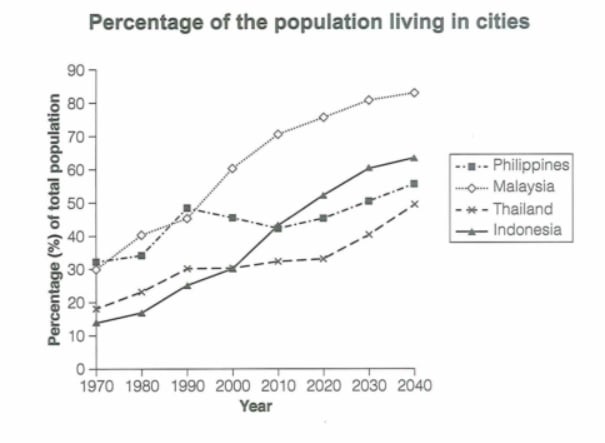
The graph below gives information about the percentage of the population in four Asian countries living in cities from 1970 to 2020, with predictions for 2030 and 2040. Summarize the information by selecting and reporting the main features and make comparisons where relevant.
Student answer (Band 5.0)
The graph gives us data about the percentage of the population living in four countries from 1970 to 2020, with assumptions for 2030 to 2040.
Overall, Malaysia would be the most populated among all and, indonesia would be the second most populated country however, thailand would remain the least populated country as compared with other asian countries according to this line chart.
According to the population prediction for 2030 and 2040, malaysia would be the most populated country in Asia with almost 85% of the population starting from 30% in 1970. The graph shows upward trend. Percentage of the population in phillipines declined from 1990 to 2010 before rising as predicted in 2040.
Starting from 20% of the population in thailand the trend remained almost constant from 1990 to 2020 with increasing trend from 2020 to 2040. Percentage of the population in indonesia starting from almost 12%, the lowest increased
AI examiner evaluation
| Criterion | Band |
|---|---|
| Task Achievement / Task Response | 4.5 |
| Coherence and Cohesion | 5.0 |
| Lexical Resource | 5.0 |
| Grammatical Range and Accuracy | 5.0 |
| Overall | 5.0 |
Task Achievement / Task Response: Band 4.5
You identify several relevant patterns, including Malaysia’s strong rise, the Philippines’ decline between 1990 and 2010 followed by recovery, and Thailand’s relatively steady period before a later increase. However, the overview is inaccurate in calling these figures population levels: the chart shows the share living in cities, and Indonesia—not Malaysia—is projected to have the second-highest urban share in 2040. Some figures and trends are also incomplete or incorrect: Malaysia starts at about 30%, not “starting from 30%” as a population total, while Thailand begins near 18%, not 20%; the final sentence about Indonesia is unfinished. The response therefore reports only part of the key information and leaves important comparisons unclear. Focus on urbanisation percentages and summarise all four countries’ overall trajectories.
Coherence and Cohesion: Band 5.0
The response has a basic paragraph structure: an introduction, an overview, and paragraphs describing selected countries. This gives the reader some sense of organisation, and phrases such as “before rising” help show changes over time. However, progression is limited because the country descriptions are not completed or balanced: the final sentence about Indonesia stops after “increased,” leaving its trend and comparison unfinished. Connections between ideas are also awkward, particularly the overview’s sequence of claims joined by “however.” Grouping countries by their trends and completing each comparison would make the information easier to follow. Use clear links such as “by contrast” or “while,” but ensure each paragraph develops a complete point.
Lexical Resource: Band 5.0
You use some relevant chart vocabulary, including “upward trend,” “declined,” “remained almost constant,” and “increasing trend,” which helps communicate basic movement. However, the range is limited and several choices are imprecise for this task. “Most populated” refers to the number of people, whereas the graph compares the percentage living in cities; “assumptions” is also not the right term for future estimates, for which “projections” is suitable. Repetition of “trend” and “percentage of the population” makes the account less precise, and spelling errors in “indonesia,” “thailand,” “asian,” and “phillipines” are noticeable. Use terms such as “urban population share” and “rose steadily” to describe the data more accurately.
Grammatical Range and Accuracy: Band 5.0
You attempt both simple and more extended sentences, for example, “The graph shows upward trend” and the sentence describing the Philippines’ decline and later rise. However, control is inconsistent, and several sentence structures are incomplete or awkward. “Starting from 20% of the population in thailand the trend remained…” lacks clear punctuation and a natural grammatical connection, while “Percentage of the population in indonesia starting from almost 12%, the lowest increased” is unfinished and does not form a complete sentence. The overview also joins clauses with commas in “and, indonesia…” and “however,” creating faulty punctuation. Practise complete subject–verb sentences, use commas and conjunctions carefully, and check that every sentence has a clear ending and grammatical structure.
See this exact question answered at other band scores. The same prompt compared across bands.
Browse more IELTS Writing model answers or get your own writing scored by the same AI examiner.