Band 5.0 IELTS Writing Task 1 Model Answer
Overall Band Score: 5.0 · Cambridge IELTS 18 · 2026-11-26
IELTS Writing Task 1 question
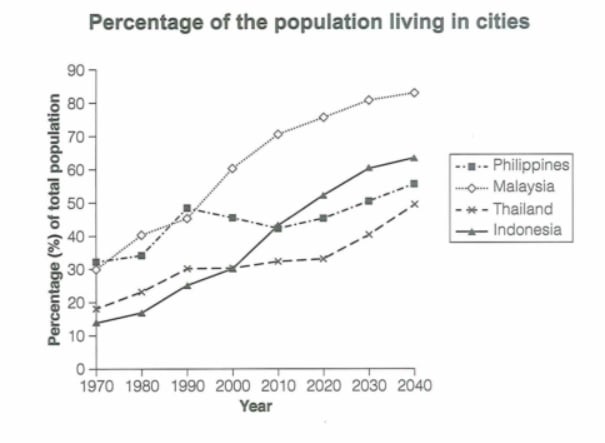
The graph below gives information about the percentage of the population in four Asian countries living in cities from 1970 to 2020, with predictions for 2030 and 2040. Summarize the information by selecting and reporting the main features and make comparisons where relevant.
Student answer (Band 5.0)
the line graph illustrate the pourcentage of population who lives in cities across 4 different countries phillipins , Malaysia, Thailand and indonisia situated in asia from 1970 to 2020 and anticipation untile 2040 .
Overall , the population of malaysa we can see that has grown significantly ranked as the most pupled city compared to others in 2020 ,the prediction said that it will continue to grow steadily until , whereas thiland which grounn slightly.
from 1979 to 2020 the population of thiland and indonisia grown significantly also , thiland increased steadily , simultanly phillipin regestrated an irregular increase .
from 2020 untile 2040 the prediction said that all country will continue to grow , a'ticipated that the most country wich will have the most population between the 4 is Malaysia with 90% in contrast thiland will have the last pourcentage of population.
in conclusion the prédication says that zll countries will countunie growing thiere population in an incertain future .
AI examiner evaluation
| Criterion | Band |
|---|---|
| Task Achievement / Task Response | 5.0 |
| Coherence and Cohesion | 5.0 |
| Lexical Resource | 5.0 |
| Grammatical Range and Accuracy | 5.0 |
| Overall | 5.0 |
Task Achievement / Task Response: Band 5.0
You identify the four countries, the period covered, and the broad upward trend, and you attempt an overview by noting Malaysia’s strong growth and the continued rise forecast for all countries. However, the account only partially reports the main features and includes important inaccuracies. Malaysia is forecast to reach about 83.5%, not 90%, and Thailand is not projected to have the lowest figure in 2040: the Philippines is higher than Thailand, while Thailand is lowest. The statement that Malaysia was the most urbanised in 2020 is accurate, but the response omits Indonesia’s marked rise and the Philippines’ rise and fall before recovery. Select key comparisons and support them with accurate figures to make the summary more complete.
Coherence and Cohesion: Band 5.0
There is some organisation: the opening introduces the graph, a separate paragraph gives an overview, and later sentences refer to historical trends and forecasts. This gives the reader a basic sense of the response’s intended structure. However, progression is not consistently clear, and several ideas are repeated, especially the prediction that all countries will continue growing. Connections such as “from 2020 until 2040” help signal time, but the sequence of comparisons is difficult to follow, and the conclusion largely repeats the overview. Group the information into a clear overview followed by past trends and future projections, and use linking phrases to show contrasts between countries rather than listing them loosely.
Lexical Resource: Band 5.0
The response uses some relevant topic vocabulary, including “population,” “prediction,” “increased steadily,” and “irregular increase,” so the general subject is usually recognisable. However, the range is limited and many spelling and word-choice errors make parts difficult to understand, such as “pourcentage,” “most pupled city,” and “incertain future.” Some expressions are also imprecise: “population” is used where “proportion of the population living in cities” or “urbanisation rate” is intended. Aim for accurate, consistent terms for percentages and trends, and check spelling carefully. More precise language would help distinguish a rise in the urban share from growth in the number of people.
Grammatical Range and Accuracy: Band 5.0
You attempt both simple statements and longer sentences, including a comparison introduced by “whereas” and a forecast clause beginning “that it will continue to grow.” However, the longer constructions are often faulty, and frequent errors in verb forms, agreement, articles, and sentence boundaries make the meaning harder to follow. For example, “the population of thiland and indonisia grown significantly” lacks an auxiliary, while “all country will continue to grow” has an agreement error. The opening also lacks a clear, correctly formed main clause. Practise building accurate short sentences first, then combine them with “while,” “whereas,” and “by contrast,” checking subject–verb agreement and past versus future forms.
See this exact question answered at other band scores. The same prompt compared across bands.
Browse more IELTS Writing model answers or get your own writing scored by the same AI examiner.