Band 5.5 IELTS Writing Task 1 Model Answer
Overall Band Score: 5.5 · Cambridge IELTS 18 · 2026-11-26
IELTS Writing Task 1 question
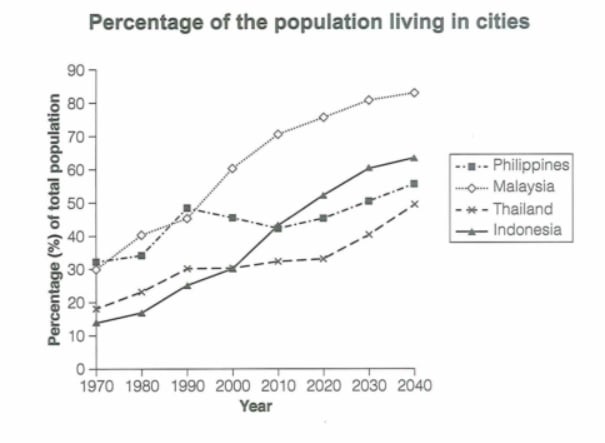
The graph below gives information about the percentage of the population in four Asian countries living in cities from 1970 to 2020, with predictions for 2030 and 2040. Summarize the information by selecting and reporting the main features and make comparisons where relevant.
Student answer (Band 5.5)
The line graph illustrates the proportion of the population living in the cities of four different Asian countries (Phillipines,Malaysia,Thailand and Indonesia) between 1970 and 2020, with projections for 2030 and 2040.
Overall, the population of urban areas increases in all four countries over the period. Malaysia become the top country with the highest population living in cities.Thailand had the lowest population in terms of the other three countries.
From 1970 to 2020, in Malaysia the percentage of people residing in urban area dramatically rose fom 30% to 75% and then peak to 85% in 20240 while Philipines had more people living in cities from other three countries (50%in 1990) and then fell to 40% in 2010 and become stable in 2020 and will grew up to 40% in 2040.
On the other hand, Indonesia the population of people living in cities is lower than others but then increased sharply upto 50% in 2020 ahead of Malaysia and Thailand and will climb 60% in 2040 whereas ,Thailand poulation grew from 20% and increased up to 30% and will rise upto 40% in 2040 lower than ather three countries.
AI examiner evaluation
| Criterion | Band |
|---|---|
| Task Achievement / Task Response | 5.5 |
| Coherence and Cohesion | 6.0 |
| Lexical Resource | 5.5 |
| Grammatical Range and Accuracy | 5.0 |
| Overall | 5.5 |
Task Achievement / Task Response: Band 5.5
You identify the graph’s subject and include an overview noting that urbanisation rises overall and that Malaysia becomes the leading country. You also select relevant figures, such as Malaysia’s rise from about 30% to 75% by 2020 and Indonesia’s increase to roughly 50%. However, several comparisons and trends are inaccurate or unclear: Malaysia’s 2040 figure is about 84%, not 85% in 20240; the Philippines is around 45% in 2020 and rises to about 56% by 2040, rather than remaining stable and reaching 40%; and Indonesia is not below the other countries in 2020. The overview also misses Indonesia’s strong growth and the Philippines’ fluctuating pattern. More accurate comparisons and a clearer account of the projections would strengthen coverage.
Coherence and Cohesion: Band 6.0
The response has a recognisable structure: an introduction, an overview, and two paragraphs describing the figures. The contrastive phrase “On the other hand” helps signal a shift to Indonesia and Thailand, and the information generally follows the timeline. However, the final two paragraphs contain very long sentences that combine several countries and time periods, making comparisons difficult to follow. Some links are also unclear, particularly “ahead of Malaysia and Thailand,” which does not accurately express the 2020 ranking. Use shorter sentences, group the countries by comparable trends, and make references explicit. These changes would make the progression clearer and reduce the occasional mechanical or confusing effect of the linking.
Lexical Resource: Band 5.5
You use a reasonable range of task-related language, including “proportion,” “projections,” “residing,” “dramatically rose,” and “increased sharply.” This allows you to describe changes and comparisons, although some choices are imprecise or awkward: “population of urban areas increases” is less exact than describing the percentage living in cities, and “peak to 85%” does not fit the intended trend. There are also noticeable spelling errors, including “Phillipines,” “fom,” “poulation,” and “ather,” alongside inconsistent country-name spelling. Aim for accurate collocations such as “reached a peak” and “the proportion living in urban areas,” and proofread proper nouns and common words. This would make the meaning more precise and fluent.
Grammatical Range and Accuracy: Band 5.0
You attempt both simple and complex sentences, including clauses linked with “while” and “whereas,” but control is uneven. Errors in verb forms and agreement appear in phrases such as “Malaysia become,” “then peak,” “become stable,” and “will grew up.” Sentence construction is also faulty in “On the other hand, Indonesia the population…” and “will climb 60%,” while missing or inconsistent punctuation makes the long final sentences harder to process. The reader can usually understand the intended trends, but these recurring errors limit accuracy. Build shorter sentences around a clear subject and verb, and check tense consistency when moving from past data to forecasts—for example, use “is projected to rise” for future figures.
See this exact question answered at other band scores. The same prompt compared across bands.
Browse more IELTS Writing model answers or get your own writing scored by the same AI examiner.