Band 6.0 IELTS Writing Task 1 Model Answer
Overall Band Score: 6.0 · Cambridge IELTS 18 · 2026-11-26
IELTS Writing Task 1 question
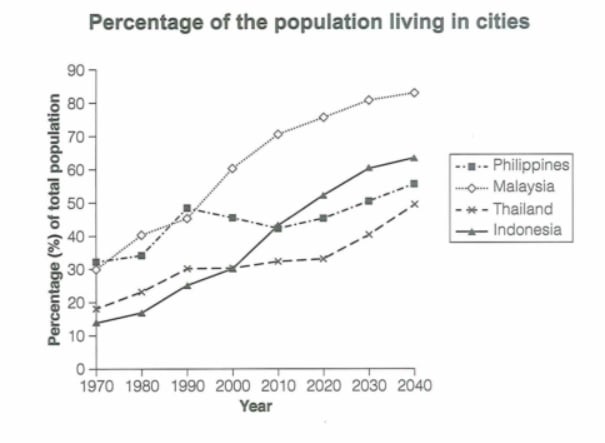
The graph below gives information about the percentage of the population in four Asian countries living in cities from 1970 to 2020, with predictions for 2030 and 2040. Summarize the information by selecting and reporting the main features and make comparisons where relevant.
Student answer (Band 6.0)
The line graph illustrates the comparison of percentage of population living in cities among four different Asian countries over a period of 70 years. The first 50 years period, shows existing trend, whereas the next 20 years demonstrate predictions. Overall, Malaysia shows an increasing trend, with the most population, almost 82 percent, in 2040 having started with approximately 32 percent in 1970. Philippines show a significantly fluctuation trend ending with 50 percent of total population. Thailand demonstrates a gradually increasing trend, ending with almost 42 percent at the end of the timeline. Indonesia shows an increase from almost 14 percent to 58 percent. There are sharp increases for Malaysia and Indonesia. However, Philippines and Thailand show gradual increases. The 20 years of predictions among the four cities also show an increasing trend outlining an increase in population over the years, which can help prepare for the mitigation of possible problems.
AI examiner evaluation
| Criterion | Band |
|---|---|
| Task Achievement / Task Response | 6.0 |
| Coherence and Cohesion | 5.5 |
| Lexical Resource | 6.0 |
| Grammatical Range and Accuracy | 6.0 |
| Overall | 6.0 |
Task Achievement / Task Response: Band 6.0
You identify the overall upward direction in all four countries and note the particularly strong rises in Malaysia and Indonesia. The comparison that Malaysia reaches the highest level by 2040 is relevant, and you include several approximate figures. However, some reported values and descriptions do not match the graph: Malaysia begins at about 30%, not 32%; the Philippines ends near 56%, rather than 50%; Thailand reaches about 50%, not 42%; and Indonesia is projected to about 64%, not 58%. The overview also says Malaysia has “the most population,” which confuses the urbanisation percentage with population size. The response covers the main task, but the trends and key comparisons need more accurate reporting and fuller support.
Coherence and Cohesion: Band 5.5
The response has a recognisable overall structure: an introduction is followed by an overview of the four countries and a concluding comment about the forecasts. Linking words such as “Overall,” “However,” and “whereas” help signal relationships between ideas. However, most information is compressed into one long paragraph, so the reader cannot easily distinguish the overview from supporting details. The final sentence about preparing for “possible problems” is not clearly connected to the graph and interrupts the summary’s progression. Some comparisons are listed rather than developed, and repeated references to increases make the organisation feel somewhat mechanical. Separate the overview from the detailed comparisons and group countries with similar patterns to make the progression clearer.
Lexical Resource: Band 6.0
You use a suitable range of trend vocabulary, including “increasing trend,” “sharp increases,” “gradually increasing,” and “predictions,” so the main message is generally clear. There are also attempts at more formal phrasing, such as “demonstrate” and “outlining.” However, some choices are imprecise or unnatural for describing this graph. “The most population” should refer to the highest proportion living in cities, while “significantly fluctuation trend” is an awkward and incorrectly formed phrase. “The first 50 years period” and “the next 20 years” are also less natural than direct references to the historical and forecast periods. More precise collocations and varied verbs for rises, falls, and projections would improve clarity and control.
Grammatical Range and Accuracy: Band 6.0
You attempt both simple and more complex sentence forms, including a contrast with “whereas” and a sentence beginning “However.” Most of the message remains understandable, and the time references are generally clear. Some grammatical errors nevertheless reduce accuracy. For example, “The first 50 years period, shows” has an unnecessary comma and an awkward noun phrase; “Philippines show” lacks the article and has subject–verb agreement problems; and “There are sharp increases” shifts into the present without a clear reason. The sentence beginning “Overall” also contains several clauses joined together without clear grammatical control. Review articles with country names, agreement, punctuation, and sentence boundaries, while keeping the useful variety of structures you already attempt.
See this exact question answered at other band scores. The same prompt compared across bands.
Browse more IELTS Writing model answers or get your own writing scored by the same AI examiner.