Band 5.5 IELTS Writing Task 1 Model Answer
Overall Band Score: 5.5 · Cambridge IELTS 18 · 2026-11-26
IELTS Writing Task 1 question
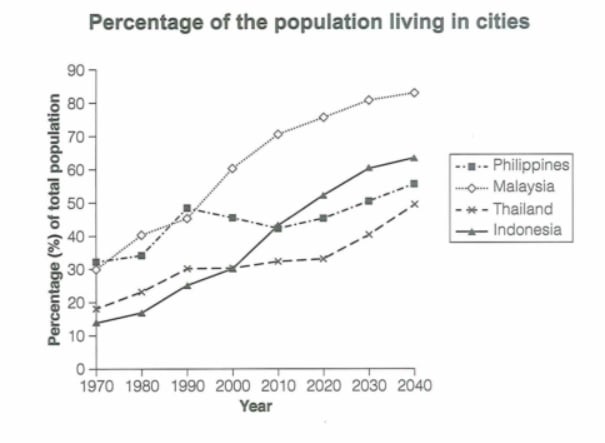
The graph below gives information about the percentage of the population in four Asian countries living in cities from 1970 to 2020, with predictions for 2030 and 2040. Summarize the information by selecting and reporting the main features and make comparisons where relevant.
Student answer (Band 5.5)
The graph below illusterates the population of four countries in percentage from 1970 to 2020. Moreover, we can also make an estimate of the percentage increase in population by 2040.
If we carefully examine the given data, we come accross that in 1970, the lowest proportion of population was in Idonesia. Whereas, Philippines was one of the countries with highest percentage of population of about 32 percentage. By 2020, a clear surge in population occur by 2020. Among those countries, Malaysia is top of the list.
Thailand is another country that shows a relatively gradual increase in the population. In 1970, its population was 19 percent. By 2020, this would rise to almost 29 percent. Malaysia and Indonesia are the two countries that shows a sharp rise in population.
If we make an estimate, this percentage will further increases by 2040 and will be highest in Malaysia. It is estimated that the percentage population will increase upto 81 percent in Malaysia by 2040.
AI examiner evaluation
| Criterion | Band |
|---|---|
| Task Achievement / Task Response | 5.0 |
| Coherence and Cohesion | 5.5 |
| Lexical Resource | 5.5 |
| Grammatical Range and Accuracy | 5.5 |
| Overall | 5.5 |
Task Achievement / Task Response: Band 5.0
The response identifies some relevant features, including Indonesia as the lowest in 1970 and Malaysia as the leading country by 2020, and it recognises that urbanisation generally rises. However, the task is only partly addressed because the overview is vague and several key comparisons are missing or inaccurate. Thailand is reported to rise from 19% to almost 29%, whereas the chart shows about 18% to 33.5%. The claim that Malaysia reaches 81% by 2040 also understates the plotted figure of roughly 83.5%. More importantly, the response does not report Indonesia’s strong rise or distinguish the Philippines’ fluctuation from the steadier increases elsewhere. Give a clear overview of the main rankings and contrasting trends, then support it with accurate figures.
Coherence and Cohesion: Band 5.5
The response has a basic paragraph structure: an introduction, discussion of earlier figures, and a short forecast. Some sequencing is clear through phrases such as “By 2020” and “If we make an estimate.” However, progression is uneven: the first body paragraph moves from 1970 directly to 2020 without explaining the intervening trends, and the next paragraph introduces Thailand and then groups Malaysia and Indonesia without a clear comparison. “By 2020” is also repeated, while “Moreover” does not add a distinct point. Organise the body by meaningful comparisons—for example, the countries with the highest urban shares and those with lower starting points—and use linking phrases to show contrast or change over time more precisely.
Lexical Resource: Band 5.5
The response uses some suitable task vocabulary, including “proportion,” “surge,” “gradual increase,” and “sharp rise,” so the reader can understand the general topic and direction of change. However, the range is limited and several choices are inaccurate or unnatural. “Population” is repeatedly used where “urban population” or “proportion living in cities” is needed; “percentage increase in population” can suggest population growth rather than urbanisation. There are also spelling errors such as “illusterates,” “come accross,” and “Idonesia,” which reduce control. Use precise terms for the measure and vary trend language, while checking spelling and collocations. For instance, describe the share as “the proportion of residents living in cities.”
Grammatical Range and Accuracy: Band 5.5
There is an attempt to use both simple and more complex forms, including the conditional opening “If we carefully examine…” and the forecast sentence beginning “If we make an estimate…”. Meaning is generally recoverable, but errors in verb forms and agreement occur in several sentences. Examples include “a clear surge … occur,” “Malaysia and Indonesia … shows,” and “this percentage will further increases”; these should be “occurred,” “show,” and “will further increase.” The construction “the lowest proportion … was in Indonesia” is also awkwardly formed, and “By 2020” is used with inconsistent time framing. Improve control of subject–verb agreement and tense, and use straightforward comparative sentence patterns accurately before attempting more complex ones.
See this exact question answered at other band scores. The same prompt compared across bands.
Browse more IELTS Writing model answers or get your own writing scored by the same AI examiner.