Band 5.5 IELTS Writing Task 1 Model Answer
Overall Band Score: 5.5 · Cambridge IELTS 18 · 2026-11-27
IELTS Writing Task 1 question
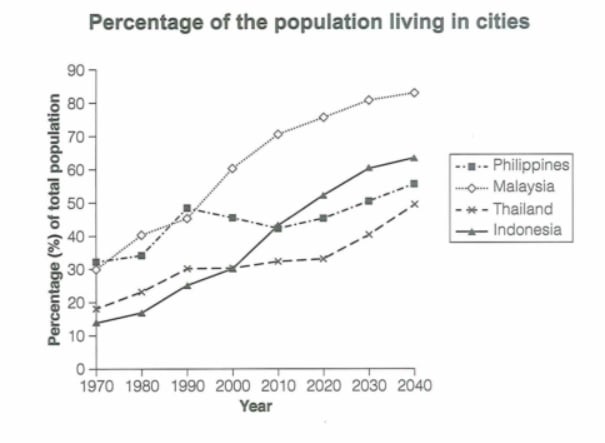
The graph below gives information about the percentage of the population in four Asian countries living in cities from 1970 to 2020, with predictions for 2030 and 2040. Summarize the information by selecting and reporting the main features and make comparisons where relevant.
Student answer (Band 5.5)
The line chart depicts the change in the percentage of the population in four Asian countries living in the cities over the period of 50 years, with prediction for next 20 years.
In general, the figure follow almost same pattern, all countries population increasing with the passage of time. It is noticeable that, all the countries have up rise in every single year.
On the one side, Indonesia and Thailand starting between the percentage of 10% to 20%. They almost have same starting point. But in end they will have different ending points. Indonesia started from 13% and will reach near 60% in 2040. While the Thailand started from 18% and will reach near to the 48%. on the other side, Malaysia and Philippines have the same starting point but in end they will also have a huge gap in percentage. Malaysia will be the country with high percentage in chart.
Comparatively, Philippines have the same starting point but do not have to much up rise in population. While the Indonesia have 10% lower starting point then Philippines but in end it goes up the Philippines.
AI examiner evaluation
| Criterion | Band |
|---|---|
| Task Achievement / Task Response | 5.5 |
| Coherence and Cohesion | 5.5 |
| Lexical Resource | 5.0 |
| Grammatical Range and Accuracy | 5.0 |
| Overall | 5.5 |
Task Achievement / Task Response: Band 5.5
You identify the broad upward movement and make relevant comparisons, including Indonesia’s rise and Malaysia’s position as the highest country by the end. However, the overview is not fully accurate: “all the countries” do not rise in every period, since the Philippines falls from about 48% in 1990 to 42.5% in 2010. Some comparisons are also mistaken or unclear. Malaysia and the Philippines did not have the same starting point (about 30% and 32%), and Indonesia finishes above the Philippines, not merely “goes up” it. The response selects some key features, but limited and under-developed reporting, together with these inaccuracies, keeps the account only partially complete. Include the Philippines’ fluctuation and clearer, accurate endpoint comparisons.
Coherence and Cohesion: Band 5.5
The response has a basic paragraph structure: an introduction, a general statement, and paragraphs comparing pairs of countries. This gives the reader some sense of organisation, and phrases such as “In general” and “Comparatively” signal the intended relationships. However, progression is not consistently clear. “On the one side” and “on the other side” are awkwardly applied, and the final paragraph repeats the Philippines comparison without clearly advancing the account. References such as “they” and “it” can also be difficult to follow when several countries are being discussed. Organise the body around clear trends or time periods, and use linking phrases and country names more precisely rather than relying on repeated contrasts.
Lexical Resource: Band 5.0
You use enough basic vocabulary to communicate the main subject and some changes, including “percentage,” “starting point,” and “ending points.” There are also attempts at trend language, such as “up rise” and “huge gap.” However, the range is limited and several choices are unnatural or imprecise, which sometimes makes the meaning less clear. For example, “up rise” is not a natural collocation, “in end” is awkward, and “do not have to much up rise” does not clearly describe the Philippines’ fluctuating trend. Repetition of “same starting point” and “percentage” also limits flexibility. Build a more accurate set of chart verbs and comparison phrases, such as “increase,” “decline,” “remain stable,” and “overtake,” and check collocations.
Grammatical Range and Accuracy: Band 5.0
You attempt both simple and longer sentences, including contrasts introduced by “While,” but control is inconsistent. Errors in agreement and verb forms appear in “the figure follow” and “all countries population increasing”; these should use a singular verb and a complete clause. Articles and sentence construction are also problematic in “the Thailand started” and “While the Indonesia have 10% lower starting point.” Several sentences begin with “While” but are left as fragments, and punctuation and capitalisation are inconsistent, as in the lowercase “on the other side.” These errors sometimes make relationships between ideas harder to understand. Practise complete comparative sentences, accurate subject–verb agreement, and consistent past and future forms when describing historical data and projections.
See this exact question answered at other band scores. The same prompt compared across bands.
Browse more IELTS Writing model answers or get your own writing scored by the same AI examiner.