Band 5.5 IELTS Writing Task 1 Model Answer
Overall Band Score: 5.5 · Cambridge IELTS 18 · 2026-11-27
IELTS Writing Task 1 question
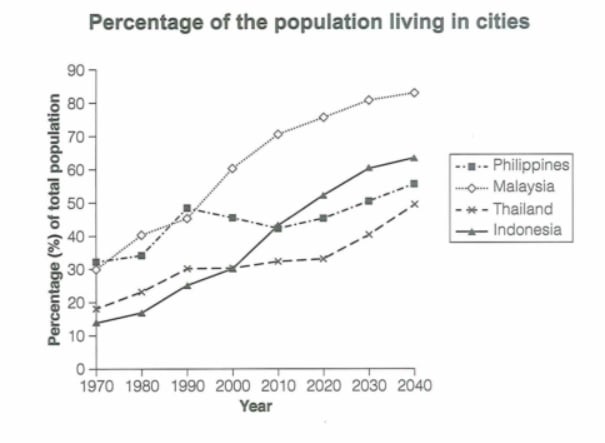
The graph below gives information about the percentage of the population in four Asian countries living in cities from 1970 to 2020, with predictions for 2030 and 2040. Summarize the information by selecting and reporting the main features and make comparisons where relevant.
Student answer (Band 5.5)
The line graph illustrates the given information about the proportion of the population in four different Asian countries namely, Philippines, Malaysia, Thailand and Indonesia who living in cities over a 50 years time period. The units are measured in percentage.
By looking at the overall perspectives, It is clear that Malaysia had the highest proportion of population while Thailand had the lowest at the end of the period .Philippines decreased slightly on the other hand, Indonesia increase continuously over the period.
on the one hand, we can easily see that Philippines have the largest proportion in 1970, with 31% of total then gradually increasing until reaching over 49% in 1990, after that sharply decreasing throughout the period. Indonesia have the lowest proportion in 1970 with the 11% after that this figure increased significantly until 2040.
Looking at the remaining figure, The population of Malaysia who lives in cities accounted for 30% in the beginning of the period after that this figure rose slightly until 1980 this figure will picked at almost 85% in 2040. Thailand had flacututed over the period.
AI examiner evaluation
| Criterion | Band |
|---|---|
| Task Achievement / Task Response | 5.0 |
| Coherence and Cohesion | 5.5 |
| Lexical Resource | 5.5 |
| Grammatical Range and Accuracy | 5.0 |
| Overall | 5.5 |
Task Achievement / Task Response: Band 5.0
You identify the four countries and include an overview, noting Malaysia’s strong position and Indonesia’s rise. However, the overview contains important inaccuracies: Thailand, not Malaysia, had the lowest urban share in 2040, and the Philippines did not decrease overall; it ended higher than it began. Several details are also misreported. The Philippines peaked at about 48% in 1990, then fluctuated before rising, rather than decreasing sharply throughout. Indonesia rose steadily, but its starting figure was about 14%, not 11%. Thailand’s gradual increase is not meaningfully described. To make the report more complete, select the main contrasts accurately and summarise each country’s overall trajectory.
Coherence and Cohesion: Band 5.5
The response has a basic structure: an introduction, an overview and two detail paragraphs, so the reader can identify the intended sections. However, progression within the paragraphs is uneven, and the country comparisons are not consistently organised. The repeated phrase “after that” makes the account sound mechanical, while “on the one hand” is not followed by a corresponding “on the other hand” structure. The final paragraph ends abruptly after saying Thailand “had flacututed,” without explaining its trend. Grouping countries by their patterns or describing each series in chronological order, then using clearer links such as “by contrast” and “meanwhile,” would make the information easier to follow.
Lexical Resource: Band 5.5
You use some relevant task vocabulary, including “proportion,” “accounted for,” “increased significantly” and “period,” which helps communicate the topic. However, the range is limited and several choices are inaccurate or awkward. “Overall perspectives” is not a natural way to introduce the summary, and “picked” does not clearly express that Malaysia is projected to reach a peak or high point. The spelling error “flacututed” also makes the intended description harder to understand. Repeated use of “figure” and “after that” limits variety. Build a more precise set of trend expressions, such as “rose steadily,” “reached a peak,” “declined before recovering” and “remained comparatively low,” and check spelling carefully.
Grammatical Range and Accuracy: Band 5.0
You attempt longer sentences and use some time expressions, but grammatical control is inconsistent, which sometimes makes relationships between ideas unclear. For example, “who living in cities” is missing a verb form, and “Philippines have” and “Indonesia increase” have incorrect subject–verb agreement and tense. The overview also shifts between past and present forms, while “this figure will picked” has an incorrect verb construction. Sentence boundaries and punctuation need attention: the opening sentence is overloaded, and the overview runs together after “period.” Practise forming accurate past-tense comparisons and future projections, and use shorter, correctly punctuated sentences before attempting more complex structures.
See this exact question answered at other band scores. The same prompt compared across bands.
Browse more IELTS Writing model answers or get your own writing scored by the same AI examiner.