Band 5.0 IELTS Writing Task 1 Model Answer
Overall Band Score: 5.0 · Cambridge IELTS 18 · 2026-11-27
IELTS Writing Task 1 question
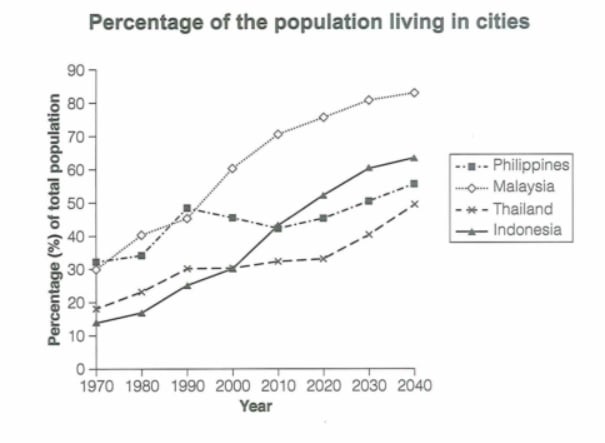
The graph below gives information about the percentage of the population in four Asian countries living in cities from 1970 to 2020, with predictions for 2030 and 2040. Summarize the information by selecting and reporting the main features and make comparisons where relevant.
Student answer (Band 5.0)
The line graph gives a comparison of the population percentage among four Asian countries from 1970 to 2020, with intented to the prediction for 2030 and 2040.
Overall, percentage of two countries become rapidly increases ( Malaysia and Indonesia ) with total population ,and two countries become slightly inclined over the year.
The country that increased in percentage are Malaysia and Indonesia.Malaysian population will overtake all three countries.From 1970 to 2020, its inclining rate hovered to 70%and will be forward upto 2040. Addionally, Indonesian, which started as the second most expanded Inhabitants at 49%,and be intensify rapidly until the predicted year. There was a dip in 2010, after which there has a decade of consistent raise of population meaning that Phillippines may be increases with percentage over 2040.Furthermore, the residental percentage of Thailand slightly expand upto 30% in between 1970 to 2020 and rapidly expand until 2040. Finally, the percentage of the population living in cities will remark singnificant strengthen.
AI examiner evaluation
| Criterion | Band |
|---|---|
| Task Achievement / Task Response | 5.5 |
| Coherence and Cohesion | 5.0 |
| Lexical Resource | 5.0 |
| Grammatical Range and Accuracy | 5.0 |
| Overall | 5.0 |
Task Achievement / Task Response: Band 5.5
You identify the broad upward movement in Malaysia and Indonesia and mention that Thailand and the Philippines rise more gradually, so the response includes relevant features of the graph. However, the overview is unclear and does not accurately distinguish the countries’ patterns. Malaysia rises strongly, while Indonesia also climbs steadily; the Philippines fluctuates, peaking in 1990 before falling and then recovering, rather than simply showing a slight incline. Several figures and comparisons are inaccurate: Indonesia did not start as the second most urbanised country at 49%; it began at about 14% and reached about 52% in 2020. The claim of a dip in 2010 is also misplaced. Select the main trends accurately and support them with a few reliable comparisons.
Coherence and Cohesion: Band 5.0
The response has an introduction, an overview, and a further paragraph, and signposting such as “Overall,” “Additionally,” and “Finally” shows an attempt to organise the information. However, the progression is difficult to follow because several ideas are joined without clear relationships, and some references are ambiguous. For example, “its inclining rate hovered to 70%” does not clearly identify the period or what the figure describes, while the sentence about a dip and the Philippines combines unrelated trends. The final sentence repeats a general claim rather than adding a useful comparison. Organise the body by grouping countries with similar patterns, and use clear time markers and references so each sentence develops one point.
Lexical Resource: Band 5.0
You attempt a range of trend vocabulary, including “overtake,” “dip,” “consistent raise,” and “rapidly,” which is relevant to describing a line graph. However, many choices are inaccurate or unnatural and sometimes make the intended meaning hard to understand. Phrases such as “inclining rate hovered,” “second most expanded Inhabitants,” and “remark significant strengthen” do not express the trends clearly; spelling errors such as “intented,” “Addionally,” and “singnificant” also reduce control. Use precise, familiar graph language rather than forcing uncommon expressions. For example, describe a figure as rising, falling, fluctuating, or reaching a peak, and use “urban population” or “proportion living in cities” consistently.
Grammatical Range and Accuracy: Band 5.0
There are attempts to form longer sentences and use future predictions, but control of sentence structure and verb forms is inconsistent. Examples include “two countries become rapidly increases,” “which started … at 49%, and be intensify rapidly,” and “after which there has a decade,” where the verb forms and sentence construction are faulty. Articles and agreement are also often missing or incorrect, as in “percentage of two countries” and “the country that increased in percentage are.” These errors frequently make relationships between ideas difficult to interpret. Practise building accurate simple sentences first, then combine them with clauses using clear subjects and correctly formed past, present, and future verbs.
See this exact question answered at other band scores. The same prompt compared across bands.
Browse more IELTS Writing model answers or get your own writing scored by the same AI examiner.